Question
Write the reactions involved when D-glucose is treated with the following reagents:
i. $\mathrm{Br}_2$ water
ii. $\mathrm{H}_2 \mathrm{N}-\mathrm{OH}$
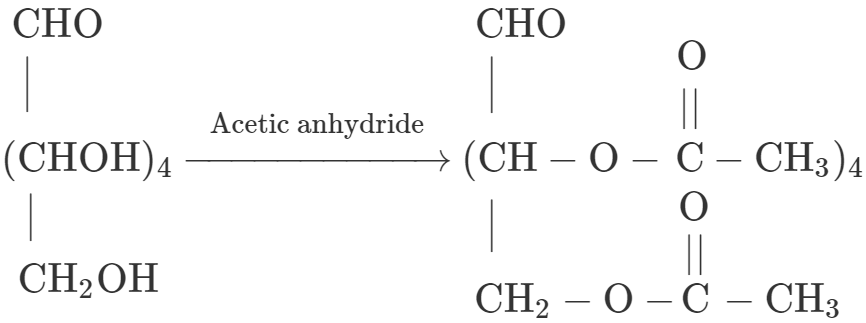
iii. $\left(\mathrm{CH}_3 \mathrm{CO}\right)_2 \mathrm{O}$
Answer

  1. $\ \text{CHO}\ \ \ \ \ \ \ \ \ \ \ \ \ \ \ \ \ \ \ \ \ \ \ \ \ \ \text{COOH}\\\ \ | \ \ \ \ \ \ \ \ \ \ \ \ \ \ \ \ \ \ \ \ \ \ \ \ \ \ \ \ \ \ \ \ \ \ | \$\text{CHOH})_4\xrightarrow{\ \ {\text{Br}_2 \text{water}}\ \ }(\text{CHOH})_4\\ \ \ \ |\ \ \ \ \ \ \ \ \ \ \ \ \ \ \ \ \ \ \ \ \ \ \ \ \ \ \ \ \ \ \ \ \ \ |\\ \ \ \text{CH}_2\text{OH}\ \ \ \ \ \ \ \ \ \ \ \ \ \ \ \ \ \ \ \ \ \text{CH}_2\text{OH}$
  2. $\ \text{CHO}\ \ \ \ \ \ \ \ \ \ \ \ \ \ \ \ \ \ \ \ \ \ \ \ \ \text{CH}=\text{N}-\text{OH}\\\ \ | \ \ \ \ \ \ \ \ \ \ \ \ \ \ \ \ \ \ \ \ \ \ \ \ \ \ \ \ \ \ \ \ \ | \$\text{CHOH})_4\xrightarrow{\ \ {\text{NH}_2 \text{OH}}\ \ }(\text{CHOH})_4\\ \ \ \ |\ \ \ \ \ \ \ \ \ \ \ \ \ \ \ \ \ \ \ \ \ \ \ \ \ \ \ \ \ \ \ \ |\\ \ \ \text{CH}_2\text{OH}\ \ \ \ \ \ \ \ \ \ \ \ \ \ \ \ \ \ \ \ \text{CH}_2\text{OH}$
  3.  

Need a full question paper?

Generate a complete, print-ready paper with questions like this in minutes — across 16+ boards, with answer keys.

Start Generating Free

Similar questions

Explain preparation of haloarene from amine compound. ### Preparation of hyloarene by sandmayer reaction.
How will the rate of the reaction be affected when:
  1. Surface area of the reactant is reduced.
  2. Catalyst is added in a reversible reaction.
  3. Temperature of the reaction is increased?
Explain by giving an equation how the presence of carbonyl group and five -OH groups in the structure of glucose is determined ### Write the equation reactions of glucose with NH, OH, HCN, and acetic anhydride and state what information is obtained about the structure of glucose through it.
Give the structures and IUPAC names of the products expected from the following reactions:
a. Catalytic reduction of butanol.
b. Hydration of propene in the presence of dilute sulphuric acid.
c. Reaction of propanone with methyl magnesium bromide followed by hydrolysis.
How do you convert:
  1. Chlorobenzene to biphenyl.
  2. Propene to I-iodopropane.
  3. 2-bromobutane to but-2-ene.
Calculate the charge of one mole of electrons.
Considering the parameters such as bond dissociation enthalpy, electron gain enthalpy and hydration enthalpy, compare the oxidising power of $F_2$ and $Cl_2.$
How the following conversions can be carried out?
i. 2-Bromopropane to 1-bromopropane
ii. Chloroethane to butane
iii. Benzene to diphenyl
Write the chemical reactions involved in the process of extraction of Gold. Explain the role of dilute $NaCN$ and $Zn$ in this process.