Question
Write the reactions taking place at the anode and cathode in the above cell.

Answer

Inert electrodes:
Anode: $2\text{H}_2\text{O}(\text{l})\xrightarrow{ \ \ \ \ \ \ \ }\text{O}_2(\text{g})+4\text{H}^{+}(\text{aq})+4\text{e}^-$
Cathode: $\text{Ag}^{+}(\text{aq})+\text{e}^-\xrightarrow{\ \ \ \ \ \ \ }\text{Ag(s)}$

Need a full question paper?

Generate a complete, print-ready paper with questions like this in minutes — across 16+ boards, with answer keys.
Start Generating Free

Similar questions

Explain with two examples each of the following: coordination entity, ligand, coordination number, coordination polyhedron, homoleptic and heteroleptic.
How many gram of Al metal will be obtained at the cathode by passing 0.1 Faraday electric current in $AlCl _3$ solution? (Atomic mass of Al $=27$ )
Sucrose decomposes in acid solution into glucose and fructose according to the first order rate law, with t1/2 = 3.00 hours. What fraction of sample of sucrose remains after 8 hours?
Discuss the nature of bonding in metal carbonyls.
The activation energy for the reaction,
2 HI(g) → H2 + I2(g)
is 209.5 kJ mol–1 at 581K. Calculate the fraction of molecules of reactants having energy equal to or greater than activation energy?
Give conversion in three steps: Nitrobenzene into chlorobenzene.
Write a note on esterification of alcohols and phenols.
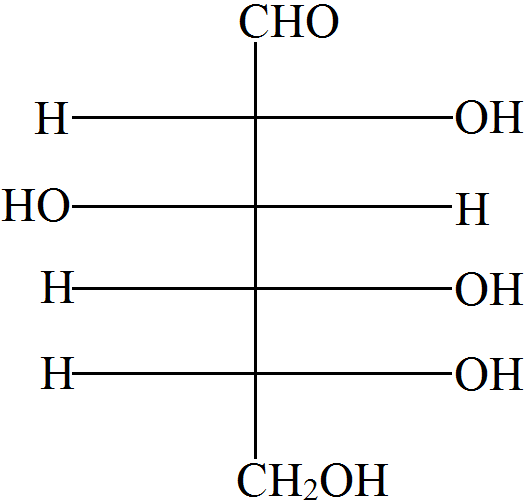
The Fischer projection of D-Glucose is given alongside.
Give the Fischer projection of L-Glucose.

Complete the following reactions :

  1. $\text{C}_6\text{H}_5-\text{COO}^-\text{NH}^+_4\xrightarrow{\text{ }\text{ }\text{ }\text{ }\text{ }\text{ }\text{ }\text{ }\triangle\text{ }\text{ }\text{ }\text{ }\text{ }\text{ }\text{ }\text{ }\text{ }}\text{A}\xrightarrow{\text{ }\text{ }\text{ }\text{ }\text{Br}_2/\text{KOH}\text{ }\text{ }\text{ }\text{ }}\text{B}\xrightarrow{\text{ }\text{ }\text{ }\text{ }\text{CH}_3\text{COC}l_3/\text{pyridine}\text{ }\text{ }\text{ }\text{ }}\text{C}$

  2. $\text{C}_6\text{H}_5\text{N}^+_2\text{BF}^-_4\xrightarrow[\triangle]{\text{ }\text{ }\text{ }\text{ }\text{ }\text{ }\text{ }\text{ }\text{NaNO}_2/\text{Cu}\text{ }\text{ }\text{ }\text{ }\text{ }\text{ }\text{ }\text{ }\text{ }}\text{A}\xrightarrow{\text{ }\text{ }\text{ }\text{ }\text{Sn}/\text{HC}l\text{ }\text{ }\text{ }\text{ }}\text{B}\xrightarrow[\triangle]{\text{ }\text{ }\text{ }\text{ }\text{CHC}l_3+\text{alc. KOH}\text{ }\text{ }\text{ }\text{ }}\text{C}$

Give reasons:
  1. C–Cl bond length in chlorobenzene is shorter than C–Cl bond length in CH3–Cl.
  2. The dipole moment of chlorobenzene is lower than that of cyclohexyl chloride.
  3. SN1 reactions are accompanied by racemization in optically active alkyl halides.