Question
Write the S.I. unit and dimensional formula for the permittivity of free space ?

Answer

The basic formula that relates permittivity of free space with the electrical force between two charges is :
$F=(1/4~\pi\in_{0}).q_{1}.q_{2}/r^{2}$
Where F is the electric force between two charges, $q_{1}$, $q_{2}$ are the charges and r is the distance between the charges.
$\in_{0}$ is the permittivity of free space.
$Unit=C^{2}/Nm^{2}$
The dimensional formula of force is [MLT-2].
The dimensional formula of charge (q) is [AT].
The dimensional formula of distance (r) is [L].
Assembling all the formulas, we get the dimensional formula of $\in_{0}$ is $[m^{-1}L^{-3}T^{4}A^{2}]$

Need a full question paper?

Generate a complete, print-ready paper with questions like this in minutes — across 16+ boards, with answer keys.
Start Generating Free

Similar questions

Two identical capacitors of 12 pF each are connected in series across a battery of 50 V. How much electrostatic energy is stored in the combination? If these were connected in parallel across the same battery, how much energy will be stored in the combination now?
Also find the charge drawn from the battery in each case.
A wire carries an alternating current $\text{i}=\text{i}_0\sin\omega\text{t}.$ Is there an electric field in the vicinity of the wire?
Indium antimonide has a band gap of 0.23eV between the valence and the conduction band. Find the temperature at which kT equals the band gap.
In Young’s double slit experiment, monochromatic light of wavelength 630 nm illuminates the pair of slits and produces an interference pattern in which two consecutive bright fringes are separated by 8.1 mm. Another source of monochromatic light produces the interference pattern in which the two consecutive bright fringes are separated by 7.2 mm. Find the wavelength of light from the second source.
What is the effect on the interference fringes if the monochromatic source is replaced by a source of white light?
It is said that any charge given to a conductor comes to its surface. Should all the protons come to the surface? Should all the electrons come to the surface? Should all the free electrons come to the surface?
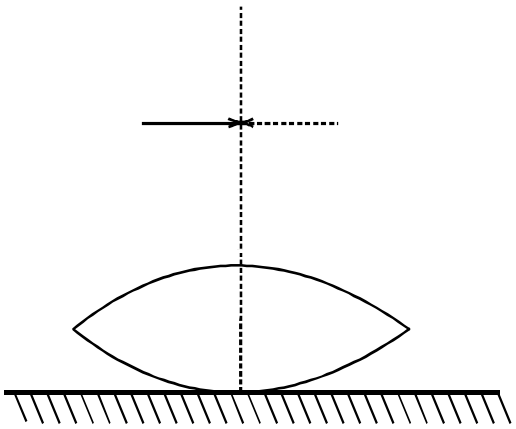
A symmetric biconvex lens of radius of curvature $R$ and made of glass of refractive index $1·5,$ is placed on a layer of liquid placed on top of a plane mirror as shown in the figure. An optical needle with its tip on the principal axis of the lens is moved along the axis until its real, inverted image coincides with the needle itself. The distance of the needle from the lens is measured to be $x$. On removing the liquid layer and repeating the experiment, the distance is found to be $y$. Obtain the expression for the refractive index of the liquid in terms of $x$ and $y.$
A hollow charged conductor has a tiny hole cut into its surface. Show that the electric field in the hole is $(\sigma /2ε_0) \hat{\text{n}}$ , where $\hat{\text{n}}$ is the unit vector in the outward normal direction, and $\sigma$ is the surface charge density near the hole.
Electrons are continuously in motion within a conductor but there is no current in it unless some source of potential is applied across its ends. Give reason.
Find the angle of minimum deviation for an equilateral prism made of a material of refractive index 1.732. What is the angle of incidence for this deviation?
Answer the following questions:
If χ-stands for the magnetic susceptibility of a given material, identity the class of materials for which $(\text{i})-1 \geq\text{X} < 0 (\text{ii}) 0< \text{X} < \varepsilon 0 (\varepsilon$ is a small positive number).
  1. Write the range of relative magnetic permeability of these materials.
  2. Draw the pattern of the magnetic field lines when these materials are placed on an strong magnetic field.