Question
Write the statements of Kirchhoff's laws.

Answer

The statements of Kirchhoff"s laws are as follows:
(1) Junction rule : "At any junction, the sum of the currents entering the junction is equal to the sum of currents leaving the junction."
(2) Loop rule : "The algebraic sum of changes in potential around any closed loop involving resistors and cells in the loop is zero."
Kirchhoff's junction rule works on the law of conservation of charge and loop rule works on the law of conservation of energy.

Need a full question paper?

Generate a complete, print-ready paper with questions like this in minutes — across 16+ boards, with answer keys.
Start Generating Free

Similar questions

Using the formula $\overrightarrow{\text{F}}=\text{q}\overrightarrow{\text{v}}\times\overrightarrow{\text{B}}$ and $\text{B}=\frac{\mu_0\text{i}}{2\pi\text{r}},$ show that the SI units of the magnetic field B and the permeability constant $\mu_0$ may be written as N/A-m and NA2 respectively.
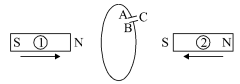
Two bar magnets are moving rapidly towards a metallic loop joined across a capacitor C as shown in the figure. What is the polarity of the capacitor?
Image
Explain the relationship between mass and energy from Einstein's theory of special relativity.
Explain what happens when iron filings are sprinkled on a sheet of glass placed over a short bar magnet.
The objective of a telescope is large and the eyepiece is small, whereas the objective of a microscope is small and the eyepiece is large. If a telescope is turned upside down, can it be used like a microscope? Can a microscope be used like a telescope in the same way?
Two identical metal spheres of exactly equal mass have been taken. One is charged with negative charge say q and the other with the same amount of positive charge. Will there be any difference in the mass of the two spheres? If yes then why?
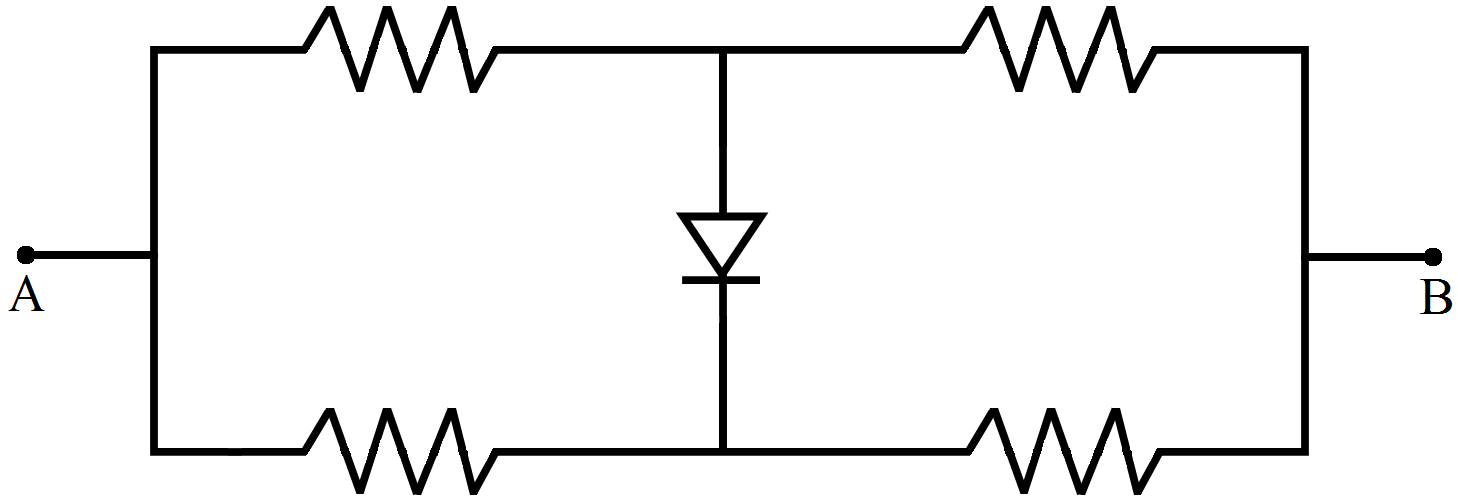
Each of the resistances shown in figure. has a value of $20\Omega.$ Find the equivalent resistance between A and B. Does it depend on whether the point A or B is at higher potential?

The refractive index of a material is. What is the angle of refraction if the unpolarised light is incident on it at the polarising angle of the medium?
Two transparent slabs having equal thickness but different refractive indices $\mu_1$ and $\mu_2$ are pasted side by side to form a composite slab. This slab is placed just after the double slit in a Young's experiment so that the light from one slit goes through one material and the light from the other slit goes through the other material. What should be the minimum thickness of the slab so that there is a minimum at the point P0 which is equidistant from the slits?
Think over the experiment number 2 of Faraday and Henry and tell :
(a) What will you do to obtain more deflection in the galvanometer?
(b) How will you show the presence of current in the absence of a galvanometer?