Question
Write the time period formula of a simple pendulum. Which factor affect the period?

Answer

Oscillation period $T =2 \pi \sqrt{\frac{l}{g}}$
It is clear that the oscillation period of a simple pendulum is proportional to the square roots of its effective length and inversely proportional to the square root of the gravitational acceleration g. It happens due to change in the value of gravitational acceleration g, the oscillation period is also affected. The period of oscillation does not depend on the mass of the sphere. Changing the length of a simple pendulum also affects the periods of oscillations.

Need a full question paper?

Generate a complete, print-ready paper with questions like this in minutes — across 16+ boards, with answer keys.

Start Generating Free

Similar questions

A ball is projected from a point on the floor with a speed of 15m/s at an angle of 60° with the horizontal. Will it hit a vertical wall 5m away from the point of projection and perpendicular to the plane of projection without hitting the floor? Will the answer differ if the wall is 22m away?
In Exercise, let us take the position of mass when the spring is unstreched as x = 0, and the direction from left to right as the positive direction of x-axis. Give x as a function of time t for the oscillating mass if at the moment we start the stopwatch (t = 0), the mass is:At the maximum compressed position.
In what way do these functions for SHM differ from each other, in frequency, in amplitude or the initial phase?
A ball is thrown vertically upward with a speed of 20m/s. Draw a graph showing the velocity of the ball as a function of time as it goes up and then comes back.
Although velocity of air molecules is very fast but fragnance of a perfume spreads at a much slower rate, explain?
Name four fundamental forces in nature.
Is the rate of cooling the same thing as the rate of loss of heat? Explain.
A metre scale is graduated at every millimetre. How many significant digits will be there in a length measurement with this scale?
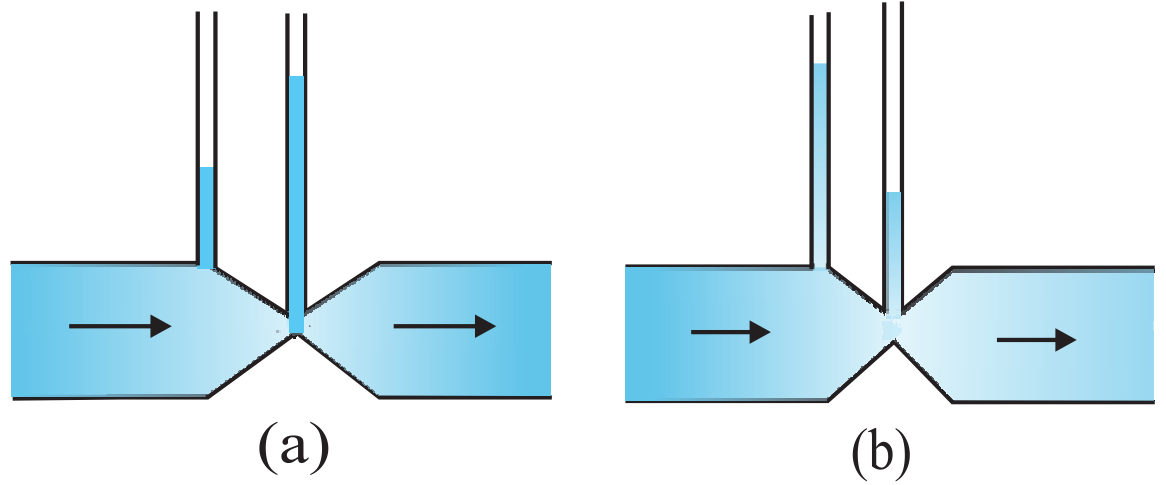
Figures(a) and (b) refer to the steady flow of a (non viscous) liquid. Which of the two figures is incorrect? Why?
Give two properties of Carnot's engine as compared to other engines. $($Carnot's theorem$).$
Can virtual image be formed on the retina in a seeing process?