Question
Write the value of $2\sin^{-1}\frac{1}{2}+\cos^{-1}\Big(-\frac{1}{2}\Big).$

Answer

$2\sin^{-1}\frac{1}{2}+\cos^{-1}\Big(-\frac{1}{2}\Big)$
$=\sin^{-1}2\times\frac{1}{2}\sqrt{1-\Big(\frac{1}{2}\Big)^2}+\cos^{-1}\Big(-\frac{1}{2}\Big)$
$=\sin^{-1}\frac{\sqrt3}{2}+\cos^{-1}\Big(-\frac{1}{2}\Big)$
$=\sin^{-1}\Big(\sin\frac{\pi}{3}\Big)+\cos^{-1}\Big(\cos\frac{2\pi}{3}\Big)$
$=\frac{\pi}{3}+\frac{2\pi}{3}$
$=\pi$

Need a full question paper?

Generate a complete, print-ready paper with questions like this in minutes — across 16+ boards, with answer keys.
Start Generating Free

Similar questions

Fatima and John appear in an interview for two vacancies for the same post. The probability of Fatima's selection is $\frac{1}{7}$ and that of John's selection is $\frac{1}{5}$. What is the probability that,
None of them will be selected?
Using the principal values, write the value of $\cos ^{-1}\left(\frac{1}{2}\right)+2 \sin ^{-1}\left(\frac{1}{2}\right)$.
If $A=\left[\begin{array}{ccc}\frac{2}{3} & 1 & \frac{5}{3} \\ \frac{1}{3} & \frac{2}{3} & \frac{4}{3} \\ \frac{7}{3} & 2 & \frac{2}{3}\end{array}\right]$ and $B=\left[\begin{array}{ccc}\frac{2}{5} & \frac{3}{5} & 1 \\ \frac{1}{5} & \frac{2}{5} & \frac{4}{5} \\ \frac{7}{5} & \frac{6}{5} & \frac{2}{5}\end{array}\right]$, then compute $3 A-5 B$.
Write the probability that a number selected at random from the set of first 100 natural numbers is a cube.
Determine the order and degree of the following differential equations. state also whether they are linear or non linear.
$\Big(\frac{\text{dy}}{\text{dx}}\Big)^2+\frac{1}{\frac{\text{dy}}{\text{dx}}}=2$
Using cofactors of elements of second row, evaluate $\Delta = \left| {\begin{array}{*{20}{c}} 5&3&8 \\ 2&0&1 \\ 1&2&3 \end{array}} \right|$
Verify Mean Value Theorem, if $f(x) = x^2 - 4x - 3$ in the interval $[a, b],$ where $a = 1$ and $b = 4$.
Show that $\text{f}(\text{x})=\text{x}^2-\text{x}\sin\text{x}$ is an increasing function on $\Big(0,\frac{\pi}{2}\Big).$
Write the length (magnitude) of a vector whose projections on the coordinate axes are 12, 3 and 4 units.
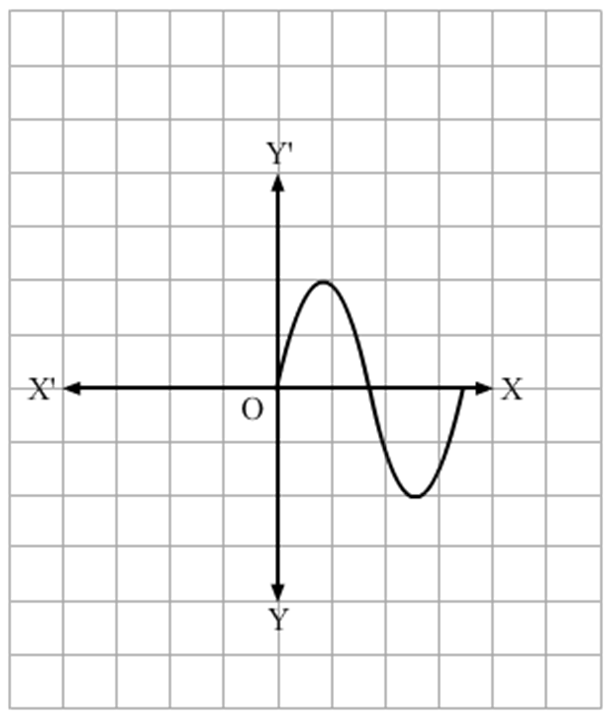
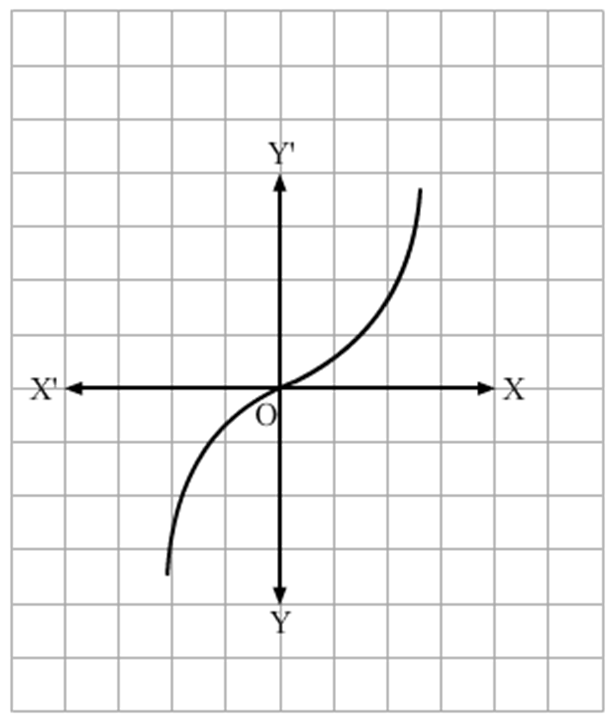
Which of the following graphs represents a one-one function?
  1.  
  1.