Question
Write ‘True’ or ‘False’ and justify your answer.
If $cosA + cos^2A = 1, then sin^2A + sin^4A = 1$

Answer

True.$cosA + cos^2A = 1 [Given]$
$\Rightarrow cosA = 1 - cos^2A$
$\Rightarrow cosA = sin^2A$
$\Rightarrow cos^2A = sin^4A$
$Now, LHS = sin^2A + sin^4A$
$= cosA + cos^2A$
$= 1 = RHS$
Hence, the given statement is true.

Need a full question paper?

Generate a complete, print-ready paper with questions like this in minutes — across 16+ boards, with answer keys.
Start Generating Free

Similar questions

State whether the following statements are true or false. Justify your answer.
The point P(-2, 4) lies on a circle of radius 6 and centre C(3, 5).
Write ‘True’ or ‘False’ and justify your answer.
$(\tan\theta+2)(2\tan\theta+1)=5\tan\theta+\sec^2\theta$
D is a point on side QR of $\triangle\text{PQR}$ such that $\text{PD}\perp\text{QR}$ will it be correct to say that $\triangle\text{PQD}\sim\triangle\text{RPD}?$ Why?
Write ‘True’ or ‘False’ and justify your answer.
The tangent to the circumcircle of an isosceles triangle$\triangle\text{ABC}$ at A, in which AB = AC, is parallel to BC.
Write whether the following statements are true or false. Justify your answers.
If the coefficient of $x^2$ and the constant term have the same sign and if the coefficient of x term is zero, then the quadratic equation has no real roots.
Write whether the following statements are true or false. Justify your answers.
Every quadratic equations has at most two roots.
If in two right triangles, one of the acute angles of one triangle is equal to an acute angle of the other triangle, can you say that the two triangles will be similar? Why?
Are the following statements 'True' or 'False'? Justify your answers.
If the graph of a polynomial intersects the x-axis at exactly two points, it need not be a quadratic polynomial.
Is it true to say that area of a segment of a circle is less than the area of its corresponding sector? Why?
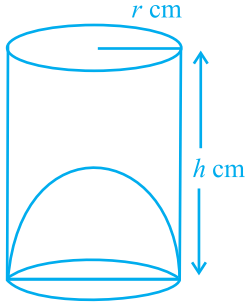
Write ‘True’ or ‘False’ and justify your answer in the following: The capacity of a cylindrical vessel with a hemispherical portion raised upward at the bottom as shown in the Fig. is $\frac{\text{r}^2}{3}3\text{h}-2\text{r}.$