Question
Write True or False and justify your answer in the following: In a right circular cone, height, radius and slant height do not always be sides of a right triangle.
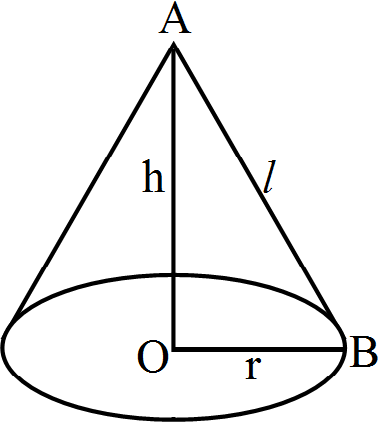
Answer

On rotating a right-angled triangular lamina $AOB$ about $OA,$ it generates a cone. The point $A$ is the vertex of a cone. Its base is a circle with centre $O$ and radius $OB$. The length $OA$ is the height of the cone and the length $AB$ is called its slant height.

Clearly, $\angle\text{AOB}=90^\circ$ Let the radius of the base $= r$ unit, height $= h$ units and slant height $= l$ unit,
then $\text{l}^2=\text{h}^2+\text{r}^2\Rightarrow\text{l}=\sqrt{\text{h}^2+\text{r}^2}$

Need a full question paper?

Generate a complete, print-ready paper with questions like this in minutes — across 16+ boards, with answer keys.

Start Generating Free

Similar questions

State whether the following statement are true or false. Give reason for your answer. Every rational number is an integer.
The volume of the largest right circular cone that can be fitted in a cube whose edge is $2r$ equals to the volume of a hemisphere of radius $r.$
Write True or False and justify your answer: The area of the isosceles triangle is $\frac{5}{4}\sqrt{11}\text{cm}^2,$ if the perimeter is $11\ cm$ and the base is $5\ cm.$
Write True or False and justify your answer:In a triangle, the sides are given as 1$1\ cm, 12\ cm$ and $13\ cm$. The length of the altitude is $10.25\ cm$ corresponding to the side having length $12\ cm.$
Write whether the following statements are True or False? Justify your answer: Attempts to prove Euclid’s fifth postulate using the other postulates and axioms led to the discovery of several other geometries.
Write whether the following statements are True or False? Justify your answer: Euclidean geometry is valid only for curved surfaces.
Write True or False and justify your answer: In the figure, $ABCD$ and $EFGD$ are two parallelograms and $G$ is the mid-point of $CD.$ Then, $\text{ar}(\triangle\text{DPC})=\frac{1}{2}\text{ar}(\text{EFGD}).$ 
Which of the following statements are true $(T)$ and which are false $(F)?$ If three sides of a quadrilateral are equal, it is a parallelogram.
$ABCD$ is a cyclic quadrilateral such that $\angle\text{A}=90^\circ,\angle\text{B}=70^\circ,\angle\text{C}=95^\circ$ and $\angle\text{D}=105^\circ.$
A cone, a hemisphere and a cylinder stand on equal bases and have the same height. The ratio of their volumes is $1 : 2 : 3.$