Question
Write ‘True’ or ‘False’ and justify your answer in the following:
Two identical solid hemispheres of equal base radius r cm are stuck together along their bases. The total surface area of the combination is $6\pi\text{r}^2.$
Answer

False: When two hemispheres of equal bases are stuck base to base it forms a sphere and total surface area of resulting sphere is $4\pi\text{r}^2.$
Hence, the given statement is false.

Need a full question paper?

Generate a complete, print-ready paper with questions like this in minutes — across 16+ boards, with answer keys.

Start Generating Free

Similar questions

Two sides and the perimeter of one triangle are respectively three times the corresponding sides and the perimeter of the other triangle. Are the two triangles similar? Why?
Are the following statements 'True' or 'False'? Justify your answers.
If the graph of a polynomial intersects the x-axis at only one point, it cannot be a quadratic polynomial.
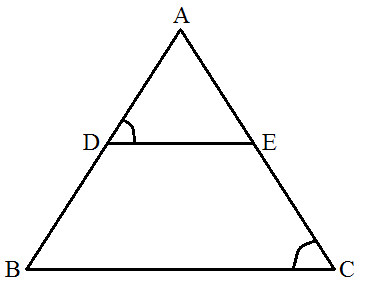
If $\angle\text{D}=\angle\text{C},$ then is it true that $\triangle\text{ADE}\sim\triangle\text{ACB}?$ Why?
Write ‘True’ or ‘False’ and justify your answer.
If a man standing on a platform 3 metres above the surface of a lake observes a cloud and its reflection in the lake, then the angle of elevation of the cloud is equal to the angle of depression of its reflection.
Write ‘True’ or ‘False’ and justify your answer.
If angle between two tangents drawn from a point P to a circle of radius a and centre O is 90°, then $\text{OP}=\text{a}\sqrt{2}.$
HCF of two numbers is always a factor of their LCM.
Write the truth value (T/F) of the following statements:
Two polygons are similar, if their corresponding sides are proportional.
Are the following statements 'True' or 'False'? Justify your answers.
If two of the zeroes of a cubic polynomial are zero, then it does not have linear and constant terms.
Write ‘True’ or ‘False’ and justify your answer in the following:
The curved surface area of a frustum of a cone is $\pi\text{l}(\text{r}_1+\text{r}_2),$ where $\text{l}\sqrt{\text{h}^2(\text{r}_1\ \ \text{r}_2)^2},$ $r_1$ and $r_2$ are the radii of the two ends of the frustum and h is the vertical height.
Write ‘True’ or ‘False’ and justify your answer.
The length of tangent from an external point P on a circle with centre O is always less than OP.