Question
Write ‘True’ or ‘False’ and justify your answer.
$\sqrt{(1-\cos^2\theta)\sec^2\theta}=\tan\theta$

Answer

True.LHS $=\sqrt{(1-\cos^2\theta)\sec^2\theta}=\sqrt{\sin^2\theta.\frac{1}{\cos^2\theta}}$
$=\sqrt{\frac{\sin^2\theta}{\cos^2\theta}}=\tan\theta=$ RHS
Hence, the given expression is true.

Need a full question paper?

Generate a complete, print-ready paper with questions like this in minutes — across 16+ boards, with answer keys.
Start Generating Free

Similar questions

Is it true to say that area of a square inscribed in a circle of diameter $p cm$ is $p ^2 cm^2$ ? Why?
Write the truth value (T/F) of the following statements:
Two polygons are similar, if their corresponding sides are proportional.
State whether the following statements are true or false. Justify your answer.
Points A(-6, 10), B(-4, 6) and C(3, -8) are collinear such that
$\text{AB}=\frac{2}{9}=\text{AC}.$
State whether the following statements are true or false. Justify your answer. Point P(5, -3) is one of the two points of trisection of the line segment joining the points A(7, -2) and B(1, -5).
Write ‘True’ or ‘False’ and justify your answer.
The tangent to the circumcircle of an isosceles triangle$\triangle\text{ABC}$ at A, in which AB = AC, is parallel to BC.
Write ‘True’ or ‘False’ and justify your answer.
The length of tangent from an external point on a circle is always greater than the radius of the circle.
Write ‘True’ or ‘False’ and justify your answer in the following:
An open metallic bucket is in the shape of a frustum of a cone, mounted on a hollow cylindrical base made of the same metallic sheet. The surface area of the metallic sheet used is equal to curved surface area of frustum of a cone + area of circular base + curved surface area of cylinder.
Write ‘True’ or ‘False’ and justify your answer in the following:
A solid ball is exactly fitted inside the cubical box of side a. The volume of the ball is $\frac{4}{3}\pi\text{a}^3.$
Are the following statements 'True' or 'False'? Justify your answers.
If the zeroes of a quadratic polynomial $ax^2 + bx + c$ are both positive, then a, b and c all have the same sign.
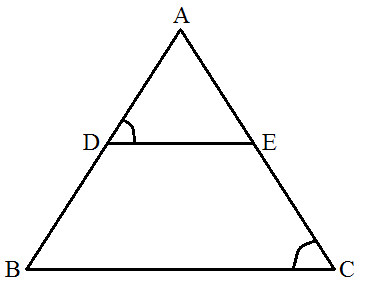
If $\angle\text{D}=\angle\text{C},$ then is it true that $\triangle\text{ADE}\sim\triangle\text{ACB}?$ Why?