Question
Write two differences between electromagnet and permanent magnet.

Answer

Electro MagnetPermanent Magnet
1. These can be magne-tised and demagnetised again and again.1. These can not be magnetised and demagnetised again and again.
2. These are made of substances having high magnetic suspectibility and low retentivity e.g. Iron.2. These are made up of sub-stances having high coercitivity and retentivity, e.g. steel or alloys.

Need a full question paper?

Generate a complete, print-ready paper with questions like this in minutes — across 16+ boards, with answer keys.
Start Generating Free

Similar questions

An inductor L of inductance XL is connected in series with a bulb B and an ac source. How would brightness of the bulb change when (i) number of turns in the inductor is reduced, (ii) an iron rod is inserted in the inductor and (iii) a capacitor of reactance XC = XL is inserted in series in the circuit. Justify your answer in each case.
  1. Draw a graph showing variation of photocurrent with anode potential for a particular intensity of incident radiation. Mark saturation current and stopping potential.
  2. By how much would the stopping potential for a given photosensitive surface go up if the frequency of the incidentradiations were to be increased from $4\times10^{15}\text{ }\text{Hz}\text{ }\text{to}8\text{ }\times10^{15}\text{ }\text{Hz}$?
Draw a labelled ray diagram of a refracting telescope. Define its magnifying power and write the expression for it.
Write two important limitations of a refracting telescope over a reflecting type telescope.
A concave mirror has a focal length of 20cm. Find the position or positions of an object for which the imagesize is double of the object-size.
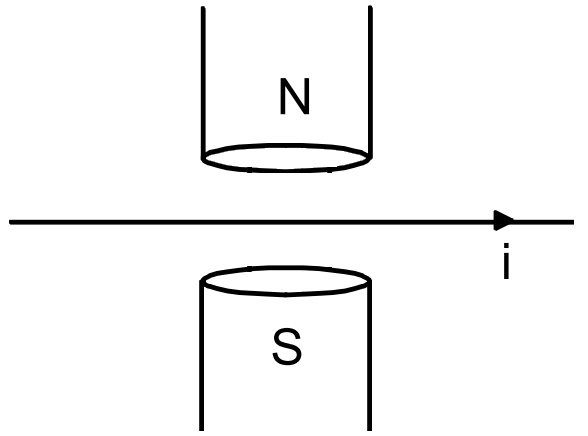
A magnetic field of strength 1.0T is produced by a strong electromagnet in a cylindrical region of radius 4.0cm, as shown in the figure. A wire, carrying a current of 2.0A, is placed perpendicular to and intersecting the axis of the cylindrical region. Find the magnitude of the force acting on the wire.

A square coil of side 10 cm consists of 20 turns and carries a current of 12 A. The coil is suspended vertically and the normal to the plane of the coil makes an angle of 30º with the direction of a uniform horizontal magnetic field of magnitude 0.80 T. What is the magnitude of torque experienced by the coil?
A charge of 3.14 × 10⁻⁶C is distributed uniformly over a circular ring of radius 20.0cm. The ring rotates about its axis with an angular velocity of 60.0 rad/s. Find the ratio of the electric field to the magnetic field at a point on the axis at a distance of 5.00cm from the centre.
(a) What happens if a bar magnet is cut into two pieces: (i) transverse to its length, (ii) along its length?
(b) A magnetised needle in a uniform magnetic field experiences a torque but no net force. An iron nail near a bar magnet, however, experiences a force of attraction in addition to a torque. Why?
(c) Must every magnetic configuration have a north pole and a south pole? What about the field due to a toroid?
(d) Two identical looking iron bars A and B are given, one of which is definitely known to be magnetised. (We do not know which one.) How would one ascertain whether or not both are magnetised? If only one is magnetised, how does one ascertain which one? [Use nothing else but the bars A and B.]
  1. States law of Malus.
  2. Draw a graph showing the variation of intensity (I) of polarised light transmitted by an with angle $(\theta)$between polariser and analyser.
  3. What is the value of refractive index of a medium of polarising angle 60o?
Explain the principle, construction, working and application of moving coil galvanometer.