MCQ
$X$ can be prepared by except
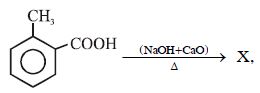
- A
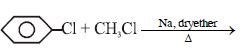
- B
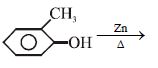
- C
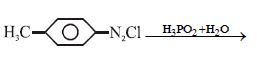
- ✓$C{H_3} - C \equiv CH\,\xrightarrow[{Fe\,tube}]{{\operatorname{Re} d\,hot}}$
Generate a complete, print-ready paper with questions like this in minutes — across 16+ boards, with answer keys.
${N_2}(g)\, + \,{O_2}(g)\,\underset{{{k_2}}}{\overset{{{k_1}}}{\longleftrightarrow}}\,2NO(g)$
$C_0=Ce^{-2.1 \times 10^{-3}t}$ for the forward reaction and $C'_0=C'e^{-4.2 \times 10^{-4}t}$ for the backward reaction, hence $K_c$ for the above equilibrium is :-
$C{H_3} - C{H_2} - Br\xrightarrow{{{\text{alc}}{\text{.KCN}}}}$ $C{H_3}C{H_2}CN$$\xrightarrow{{{\text{HOH}}}}X$
$(I)$ they exhibit high enthalpies of atomisation as the $d-$ subshell is full
$(II)$ $zn$ and $Cd$ do not show variable oxidation states while $Hg$ shows $+ I$ and $+ II$
$(III)$ Compound of $Zn,\,Cd$ and $Hg$, are paramagnetic in nature
$(IV)$ $Zn,\,Cd$ and $Hg$ are called soft metals