Question
X-ray incident on a material:

Answer

  1. Exerts a force on it.
  2. Transfers energy to it.
  3. Transfers momentum to it.
  4. Transfers impulse to it.
Explanation:
An X-ray exerts force on the material on which it is incident. For example, it can penetrate into metals. An X-ray also transfers energy, momentum and impulse to the material on which it incident. Therefore, all options are correct.

Need a full question paper?

Generate a complete, print-ready paper with questions like this in minutes — across 16+ boards, with answer keys.
Start Generating Free

Similar questions

A parallel monochromatic beam of light is incident normally on a narrow slit. A diffraction pattern is formed on a screen placed perpendicular to the direction of incident beam. At the first maximum of the diffraction pattern the phase difference between the rays coming from the edges of the slit is 
When the nucleus of a radioactive element emits an alpha particle, the atomic number is decreased by:
The unit for molar susceptibility is
The electrical conductivity of pure germanium can be increased by:
Two metallic spheres of radii $1 \ cm$ and $2 \ cm$ are given charges $10^{-2} C$  and  $5 \times 10^{-2} C$  respectively. If they are connected by a conducting wire, the final charge on the smaller sphere is
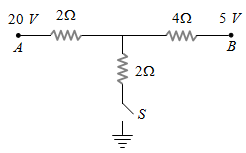
As the switch $S$ is closed in the circuit shown in figure, current passed through it is
An open organ pipe of length L vibrates in its fundamental mode. The pressure variation is maximum.
  1. At the two ends.
  2. At the middle of the pipe.
  3. At distances $\frac{\text{L}}{4}$ inside the ends.
  4. At distances $\frac{\text{L}}{8}$ inside the ends.
The true statement is, on increasing the distance between the plates of a parallel plate condenser(a)  The electric intensity between the plates will decrease(b) The electric intensity between the plates will increase(c) The electric intensity between the plates will remain unchanged(d) The P.D. between the plates will decrease


When the current through the electromagnet of a relay reaches a particular value:
On going from north pole to equator, the value of angle of dip :