MCQ
X-ray incident on a material:
- AExerts a force on it.
- BTransfers energy to it.
- CTransfers momentum to it.
- DTransfers impulse to it.
Explanation:
An X-ray exerts force on the material on which it is incident. For example, it can penetrate into metals. An X-ray also transfers energy, momentum and impulse to the material on which it incident. Therefore, all options are correct.
Generate a complete, print-ready paper with questions like this in minutes — across 16+ boards, with answer keys.
A 60 watt bulb operates on 220V supply. The current flowing through the bulb is
|
(a) 11/3 amp |
(b) 3/11 amp |
(c) 3 amp |
(d) 6 amp |
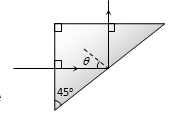
A triangular prism of glass is shown in the figure. A ray incident normally to one face is totally reflected, if θ = 45° . The index of refraction of glass is
|
(a) Less than 1.41 |
(b) Equal to 1.41 |
(c) Greater than 1.41 |
(d) None of the above |
A transmitter supplies 9 kW to the aerial when unmodulated. The power radiated when modulated to 40% is
|
(a) 5 kW |
(b) 9.72 kW |
(c) 10 kW |
(d) 12 kW |
A biconvex lens with equal radii curvature has refractive index 1.6 and focal length 10 cm. Its radius of curvature will be
|
(a) 20 cm |
(b) 16 cm |
(c) 10 cm |
(d) 12 cm |
The diameter of each plate of an air capacitor is 4 cm. To make the capacity of this plate capacitor equal to that of 20 cm diameter sphere, the distance between the plates will be
|
(a) 4 |
(b) 1 |
(c) 1 cm |
(d) 1 |
