MCQ
$X-$ rays cannot be deflected by means of an ordinary grating due to
  • A
    Large wavelength
  • B
    High speed
  • Short wavelength
  • D
    None of these

Answer

Correct option: C.
Short wavelength
c
(c)

Need a full question paper?

Generate a complete, print-ready paper with questions like this in minutes — across 16+ boards, with answer keys.
Start Generating Free

Similar questions

The capacity of the conductor does not depend upon
Intensity of X-rays depends upon the number of
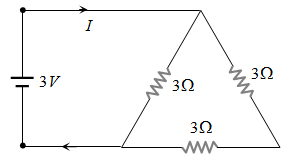
A 3volt battery with negligible internal resistance is connected in a circuit as shown in the figure. The current I, in the circuit will be
Two point charges $4\,\mu C$ and $ - 1\,\mu C$ are kept at a distance of $3\ m$ from each other. What is the electric potential at the point where the electric field is zero?......$V$
A red colour in air has wavelength $760 \,nm$ when light passes through water of refractive index $\left(n=\frac{4}{3}\right)$, wavelength becomes $570 \,nm$. (wavelength of yellow colour in air is $570 \,nm$ ). Then colour of red light in water is
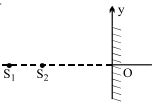
Two point monochromatic and coherent sources of light of wavelength $l$ are placed on the dotted line in front of an large screen. The source emit waves in phase with each other. The distance between $S_1$ and $S_2$ is $'d'$ while their distance from the screen is much larger. Then,

$(1)$ $\rightarrow$ If $d = 7\lambda /2, O$ will be a minima

$(2)$ $\rightarrow$ If $d = 4.3\lambda$ , there will be a total of $8$ minima on $y$ axis.

$(3)$ $\rightarrow$ If $d = 7\lambda , O$ will be a maxima.

$(4)$ $\rightarrow$ If $d = \lambda$ , there will be only one maxima on the screen.

Which is the set of correct statement :
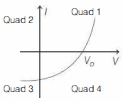
When light shines on a $p-n$ junction diode, the current $I$ versus voltage $V$ is observed as in figure below. In which quadrant$(s)$ does the diode generate power, so that it can be used as a solar cell?
If ${I_1}$ and ${I_2}$ be the size of the images respectively for the two positions of lens in the displacement method, then the size of the object is given by
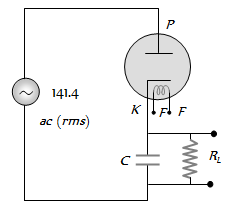
An alternating voltage of 141.4V (rms) is applied to a vacuum diode as shown in the figure. The maximum potential difference across the condenser will be.
A parallel plate capacitor is connected to a battery. The plates are pulled apart with a uniform speed. If $x$ is the separation between the plates, the time rate of change of electrostatic energy of capacitor is proportional to