MCQ
$X-$ rays were discovered by
  • A
    Becquerel
  • Roentgen
  • C
    Marie Curie
  • D
    Von Laue

Answer

Correct option: B.
Roentgen
b
(b) Roentgen, a German physicist accidentally discovered the $x$ - rays on November $8,1895 .$ working with a cathode-rays tube is his laboratory, Roentgen observed a flue scent glow of crystals on a table near his tube.

Need a full question paper?

Generate a complete, print-ready paper with questions like this in minutes — across 16+ boards, with answer keys.

Start Generating Free

Similar questions

The rate of disintegration was observed to be ${10^{17}}$ disintegrations per sec when its half life period is $1445$ years. The original number of particles are
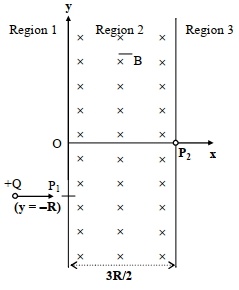
A uniform magnetic field $B$ exists in the region between $x=0$ and $x=\frac{3 R}{2}$ (region $2$ in the figure) pointing normally into the plane of the paper. A particle with charge $+Q$ and momentum $p$ directed along $x$-axis enters region $2$ from region $1$ at point $P_1(y=-R)$. Which of the following option(s) is/are correct?

$[A$ For $B>\frac{2}{3} \frac{p}{QR}$, the particle will re-enter region $1$

$[B]$ For $B=\frac{8}{13} \frac{\mathrm{p}}{QR}$, the particle will enter region $3$ through the point $P_2$ on $\mathrm{x}$-axis

$[C]$ When the particle re-enters region 1 through the longest possible path in region $2$ , the magnitude of the change in its linear momentum between point $P_1$ and the farthest point from $y$-axis is $p / \sqrt{2}$

$[D]$ For a fixed $B$, particles of same charge $Q$ and same velocity $v$, the distance between the point $P_1$ and the point of re-entry into region $1$ is inversely proportional to the mass of the particle
Assertion : If a compass needle be kept at magnetic north pole of the earth the compass needle may stay in any direction.

Reason : Dip needle will stay vertical at the north pole of earth
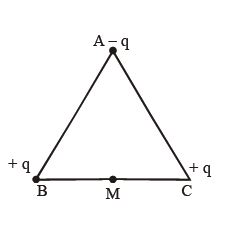
Charges $-q,\, q,\,q$ are placed at the vertices $A$, $B$, $C$ respectively of an equilateral triangle of side $'a'$ as shown in the figure. If charge $-q$ is released keeping remaining two charges fixed, then the kinetic energy of charge $(-q)$ at the instant when it passes through the mid point $M$ of side $BC$ is 
A solid metallic sphere has a charge +3Q. Concentric with this sphere is a conducting spherical shell having charge -Q. The radius of the sphere is a and that of the spherical shell is b(b > a). What is the electric field at a distance R(a < R < b) from the centre 
Flux passing through an equipotential surface is always:
Pick out the application of potentiometer from the following.
Equal charges are located at three corners of an equilateral triangle. The true statement for electric potential V and electric field intensity E at the centre O of the triangle will be:
In the $ n^{th} $ orbit, the energy of an electron ${E_n} = - \frac{{13.6}}{{{n^2}}}eV$ for hydrogen atom. The energy required to take the electron from first orbit to second orbit will be.....$eV$
A current carrying coil is placed with its axis perpendicular to N-S direction. Let horizontal component of earth's magnetic field be $\mathrm{H}_{\mathrm{o}}$ and magnetic field inside the loop is H. If a magnet is suspended inside the loop, it makes angle θ with H. Then θ =