MCQ
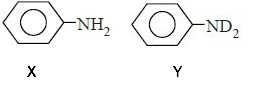
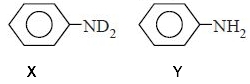
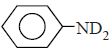
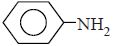
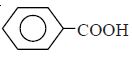
$Y$ $\mathop {\xleftarrow{{(i)\,N{H_3},\Delta }}}\limits_{(ii)\,KOD,B{r_2}\Delta } $ (image) $\mathop {\xrightarrow{{(i)\,N{D_3},\Delta }}}\limits_{(ii)\,KOH,B{r_2}\Delta } X,$

What are $X$ and $Y$ :

  • $X$ is (image)  ; $Y$ is (image)
  • B
    $X$ is (image) ; $Y$ is (image)
  • C
    both (image)
  • D
    both (image) 

Answer

Correct option: A.
$X$ is (image)  ; $Y$ is (image)
a

Need a full question paper?

Generate a complete, print-ready paper with questions like this in minutes — across 16+ boards, with answer keys.

Start Generating Free

Similar questions

When iodine reacts with $NaF,$ $NaBr$ and $NaCl$
Carbylamine test is used in the detection of
Vitamin $A$ is present in
Isomeric amines with molecular formula $C _8 H _{11} N$ give the following tests

Isomer $(P) \Rightarrow$ Can be prepared by Gabriel phthalimide synthesis

Isomer $(Q) \Rightarrow$ Reacts with Hinsberg's reagent to give solid insoluble in $NaOH$

Isomer (R) $\Rightarrow$ Reacts with $HONO$ followed by $\beta$-naphthol in $NaOH$ to give red dye.

Isomers $( P ),( Q )$ and $( R )$ respectively are

The reagent which easily reacts with ethanol and propanol is
Pure ${N_2}$ gas is obtained from
A $0.1\,molal$ aqueous solution of a weak acid HX is $30\%$ ionized. If $K_f$ for water is $1.86\,^o \,C/m,$ the freezing point of the solution will be  .........$^oC$.
When a metal rod ${M}$ is dipped into an aqueous colourless concentrated solution of compound ${N}$, the solution turns light blue. Addition of aqueous $\mathrm{NaCl}$ to the blue solution gives a white precipitate ${O}$. Addition of aqueous $\mathrm{NH}_3$ dissolves ${O}$ and gives an intense blue solution.

$1.$ The metal rod ${M}$ is

$(A)$ $\mathrm{Fe}$ $(B)$ $\mathrm{Cu}$ $(C)$ $\mathrm{Ni}$ $(D)$ $\mathrm{Co}$

$2.$ The compound ${N}$ is

$(A)$ $\mathrm{AgNO}_3$ $(B)$ $\mathrm{Zn}\left(\mathrm{NO}_3\right)_2$

$(C)$ $\mathrm{Al}\left(\mathrm{NO}_3\right)_3$ $(D)$ $\mathrm{Pb}\left(\mathrm{NO}_3\right)_2$

$3.$ The final solution contains

$(A)$ $\left[\mathrm{Pb}\left(\mathrm{NH}_3\right)_4\right]^{2+}$ and $\left[\mathrm{CoCl}_4\right]^{2-}$

$(B)$ $\left[\mathrm{Al}\left(\mathrm{NH}_3\right)_4\right]^{3+}$ and $\left[\mathrm{Cu}\left(\mathrm{NH}_3\right)_4\right]^{2+}$

$(C)$ $\left[\mathrm{Ag}\left(\mathrm{NH}_3\right)_2\right]^{+}$and $\left[\mathrm{Cu}\left(\mathrm{NH}_3\right)_4\right]^{2+}$

$(D)$ $\left[\mathrm{Ag}\left(\mathrm{NH}_3\right)_2\right]^{+}$and $\left[\mathrm{Ni}\left(\mathrm{NH}_3\right)_6\right]^{2+}$

Give the answer question $1,2$ and $3.$
Wavelength of red light is absorbed by the complex
Consider the following metal complexes.

${\left[ Co \left( NH _{3}\right)\right]^{3+}}$

${\left[ CoCl \left( NH _{3}\right)_{5}\right]^{2+}}$

${\left[ Co ( CN )_{6}\right]^{3-}}$

${\left[ Co \left( NH _{3}\right)_{5}\left( H _{2} O \right)\right]^{3+}}$

The spin-only magnetic moment value of the complex that absorbs light with shortest wavelength is $B.M.$ (Nearest integer)