Question
Yash scored $40$ marks in a test, getting $3$ marks for each right answer and losing $1$ mark for each wrong answer. Had $4$ marks been awanded for each correct answer and $2$ marks been deducted for each incorrect answer, the Yash would have scored $50$ marks. How many question were there in the test?
Answer

Let we taxe right answer be $x$ then wrong answer will be $y.$
Therefore the total no. question $= x + y ....(i)$
It is given that if yash secord $40$ marks in a test getting $3$ marks for each right answer and losing $1$ maks for each wrong answer then
$\Rightarrow 3x - y = 40$
$3x - y - 40 ....(ii)$
It is also given that if $4$ maks awarded for each right answer and $2$ maks deducted for each wrong answer then he scored $50$ marks.
$4x - 2y = 50$
$4x - 2y - 50 ....(iii)$
By multiplying eq. $(ii)$ by $2$ and we get
$2(3x - y - 40)$
$= 6x - 2y - 80 = 0 .....(iv)$
Now, subtracting eq. $(iii)$ from eq. $(iv)$
$6x - 2y - 80 - (4x - 2y - 50) = 0$
$6x - 2y - 80 - 4x + 2y + 50 = 0$
$2x - 30 = 0$
$2x = 30$
$x = 15$
Now, Putting the value of x in eq. $(ii)$ and we get
$3 \times 15 - y - 40 = 0$
$45 - y - 40 = 0$
$-y + 5 = 0$
$y = 5$
Putting the value of x and y in eq. $(i)$ and we get
$x + y = 15 + 5 = 20$
Hence, the total number of question is $20.$

Need a full question paper?

Generate a complete, print-ready paper with questions like this in minutes — across 16+ boards, with answer keys.

Start Generating Free

Similar questions

$4$ tables and $3$ chairs, together, cost Rs. $2250$ and $3$ tables and $4$ chairs cost Rs. $1950$. Find the cost of $2$ chairs and $1$ table.
In $\triangle\text{ABC},$ $D$ and $E$ are the mid-points of $AB$ and $AC$ respectively. Find the ratio of the areas of $\triangle\text{ADE}$ and $\triangle\text{ABC.}$
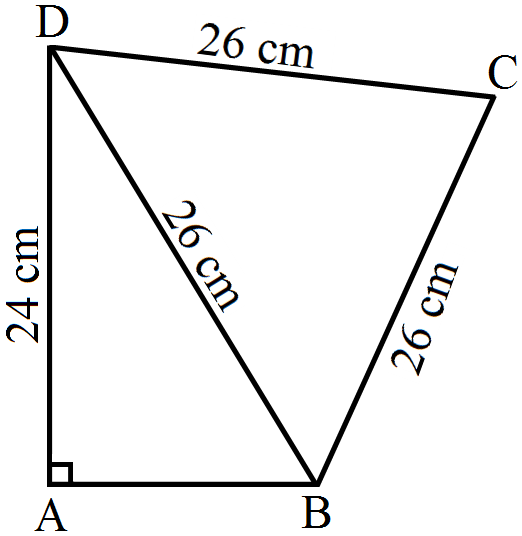
Find the area of the quadrilateral $ABCD$ in which $AD = 24cm$, $\angle\text{BAD} = 90^\circ$ and $BCD$ forms an equilateral triangle whose each side is equal to $26\ cm$. Also find the perimeter of the quadrilateral. $\big[\text{Take}\sqrt{3}=1.73\big]$
For the following statments state whether true$(T)$ or false$(F):$
In a $\triangle\text{ABC},\text{AB}=6\text{cm},\angle\text{A}=45^\circ$ and $\text{AC}=8\text{cm}$ and in a $\triangle\text{DEF},\text{DF}=9\text{cm},\angle\text{D}=45^\circ$and $\text{DE}=12\text{cm},$ then $\triangle\text{ABC}\sim\triangle\text{DEF}.$
The following table gives the distribution of the life time of 400 neon lamps:
Lite time (in hours) Number of lamps
1500-2000 14
2000-2500 56
2500-3000 60
3000-3500 86
3500-4000 74
4000-4500 62
4500-5000 48
Find the median life time of a lamp.
A metallic bucket, open at the top, of height $24\ cm$ is in the form of the frustum of a cone, the radii of whose lower and upper circular ends are $7\ cm$ and $14\ cm$, respectively. Find
  1. The volume of water which can completely fill the bucket,
  2. The area of the metal sheet used to make the bucket.
If $3\tan\theta=4,$ show that $\frac{(4\cos\theta-\sin\theta)}{(2\cos\theta+\sin\theta)}=\frac45.$
A hemispherical bowl of internal radius $9\ cm$ is full of liquid. The liquid is to be filled into cylindrical shaped small bottles each of diameter $3\ cm$ and height $4\ cm$. How many bottles are necessary to empty the bowl?
The difference of two natural numbers is $3$ and the difference of their reciprocals is $\frac{3}{28}.$ Find the numbers.
The cost of harvesting a square field at ₹ $900$ per hectare is ₹ $8100$. Find the cost of putting a fence around it at ₹ $18$ per metre.