MCQ
Yellow light is refracted through a prism producing minimum deviation. If $i_1$ and $i_2$ denote the angle of incidence and emergence for the prism, then ..........
  • $i_1=i_2$
  • B
    $i_1 > i_2$
  • C
    $i_1 < i_2$
  • D
    $i_1+i_2=90$

Answer

Correct option: A.
$i_1=i_2$
a
(a)

At angle of minimum deviation angle of emergence of prism is same as angle of incidence.

Need a full question paper?

Generate a complete, print-ready paper with questions like this in minutes — across 16+ boards, with answer keys.
Start Generating Free

Similar questions

An object 1 cm tall is placed 4cm infront of a mirror. In order to produce an upright image of 3cm height one needs a
The speed of light in air is $3 \times 10^8 m / s$. What will be its speed in diamond whose refractive index is 2.4
A person cannot see objects clearly beyond $2.0 \,m$. The power of lens required to correct his vision will be
Which of these is the best description of a Zener diode?
The slits in a Young's double slit experiment have equal width and the source is placed symmetrically with respect to the slits. The intensity at the central fringe is $I_0$. If one of the slits is closed, the intensity at this point will be:
A proton with a kinetic energy of $2.0\,eV$ moves into a region of uniform magnetic field of magnitude $\frac{\pi}{2} \times 10^{-3}\,T$. The angle between the direction of magnetic field and velocity of proton is $60^{\circ}$. The pitch of the helical path taken by the proton is $..........cm$ (Take, mass of proton $=1.6 \times 10^{-27}\,kg$ and Charge on proton $=1.6 \times 10^{-19}\,kg)$
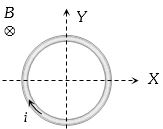
A conducting loop carrying a current $I$ is placed in a uniform magnetic field pointing into the plane of the paper as shown. The loop will have a tendency to
Capacitiors are used in electrical circuits where appliances need more:
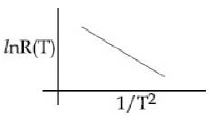
In an experiment, the resistance of a material is plotted as a function of temperature (in some range). As shown in the figure, it is a straight line. One may conclude that:
The resistance of a wire of iron is $10\, ohms$ and temp. coefficient of resistivity is $5 \times {10^{ - 3}}\,^oC$. At $20\,^oC$ it carries $30$ milliamperes of current. Keeping constant potential difference between its ends, the temperature of the wire is raised to $120\,^oC$. The current in milliamperes that flows in the wire is