MCQ
Young's modulus depends upon
  • A
    Stress applied on material
  • B
    Strain produced in material
  • Temperature of material
  • D
    All of these

Answer

Correct option: C.
Temperature of material
c
(c)

Young's modulus is a material property and it also depends on temperature of material.

Need a full question paper?

Generate a complete, print-ready paper with questions like this in minutes — across 16+ boards, with answer keys.
Start Generating Free

Similar questions

A spring is stretched by applying a load to its free end. The strain produced in the spring is
  1. Volumetric.
  2. Shear.
  3. Longitudinal and shear.
  4. Longitudinal.
The satellite of mass $m$ revolving in a circular orbit of radius $r$ around the earth has kinetic energy $E$. Then its angular momentum will be
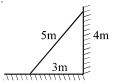
$A$ uniform ladder of length $5m$ is placed against the wall as shown in the figure. If coefficient of friction $\mu$ is the same for both the walls, what is the minimum value of $\mu$ for it not to slip?
A uniform spherical shell gradually shrinks maintaining its shape. The gravitational potential at the centre:
  1. Increases.
  2. Decreases.
  3. Remains constant.
  4. Oscillates.
Two trains travelling on the same track are approaching each other with equal speeds of $40\, m/s$. The drivers of the trains begin to decelerate simultaneously when they are just $2.0\, km$ apart. Assuming the decelerations to be uniform and equal, the value of the deceleration to barely avoid collision should be.........$m/{s^2}$
Age of the universe is about 1010 year, whereas the mankind has existed for 106 year. For how many seconds would the man have existed if age of universe were 1 day?
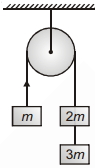
In the figure given below, with what acceleration does the block of mass $m$ will move? (Pulley and strings are massless and frictionless)
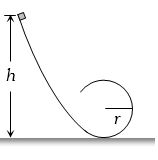
A block follows the path as shown in the figure from height $h$. If radius of circular path is $r$, then relation that holds good to complete full circle is
The number of translational degrees of freedom for a diatomic gas is
The total energy of a particle, executing simple harmonic motion is