MCQ
Young’s modulus of perfectly rigid body material is
  • A
    Zero
  • Infinity
  • C
    ${\rm{1}} \times {\rm{1}}{{\rm{0}}^{{\rm{10}}}}\,N/{m^2}$
  • D
    ${\rm{10}} \times {\rm{1}}{{\rm{0}}^{{\rm{10}}}}\,N/{m^2}$

Answer

Correct option: B.
Infinity
b
(b) From Hooke's law, Young modulus $Y=\frac{S t r e s s}{S t r a i n}$

The Strain produced in a perfectly rigid body is zero i.e Strain$=0$

$\therefore Y=\frac{S t r e s s}{0} \quad \Longrightarrow Y=\infty$

Thus the Young's modulus of perfectly rigid body material is infinite.

Need a full question paper?

Generate a complete, print-ready paper with questions like this in minutes — across 16+ boards, with answer keys.
Start Generating Free

Similar questions

Two particles of masses $m_1$ and $m_2$ $(m_1 > m_2)$, initially at rest, move towards each other under an inverse square law force of attraction. Pick out the correct statement about the centre of mass $(CM)$ of the system
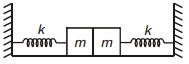
An assembly of identical spring-mass systems is placed on a smooth horizontal surface as shown. At this instant, the springs are relaxed. The left mass is displaced to the/left and theiright mass is displaced to the right by same distance and released. The resulting collision is elastic. The time period of the oscillations of system is
An aluminium rod having a length $100 \,cm$ is clamped at its middle point and set into longitudinal vibrations. Let the rod vibrate in its fundamental mode. The density of aluminium is $2600 \,kg / m ^3$ and its Young's modulus is $7.8 \times 10^{10} \,N / m ^2$. The frequency of the sound produced is .............. $Hz$
The velocity and acceleration vectors of a particle undergoing circular motion are $\overrightarrow{ v }=2 \hat{ i } m / s$ and $\overrightarrow{ a }=2 \hat{ i }+4 \hat{ j } m / s ^2$ respectively at an instant of time. The radius of the circle is $........\,m$
 A rod of length l rotates with a small but uniform angular velocity $\omega$ about its perpendicular bisector. A uniform magnetic field B exists parallel to the axis of rotation. The potential difference between the centre of the rod and an end is:

  1. $\text{zero}$

  2. $\frac{1}{8}\omega\text{Bl}^2$

  3. $\frac{1}{2}\omega\text{Bl}^2$

  4. $\text{B}\omega\text{l}^2$ 

The temperature at which the root mean square velocity of a molecule will be doubled than at $100°C$
Velocity - time graph of a body with uniform velocity is a straight line:
A player kicks a football with an initial speed of $25\, {ms}^{-1}$ at an angle of $45^{\circ}$ from the ground. What are the maximum height and the time taken by the football to reach at the highest point during motion ? (Take g $=10 \,{ms}^{-2}$ )
The displacement of a particle, moving in a straight line, is given by $s = 2{t^2} + 2t + 4$ where $s$ is in metres and $t$ in seconds. The acceleration of the particle is........$ms^{-2}$