MCQ
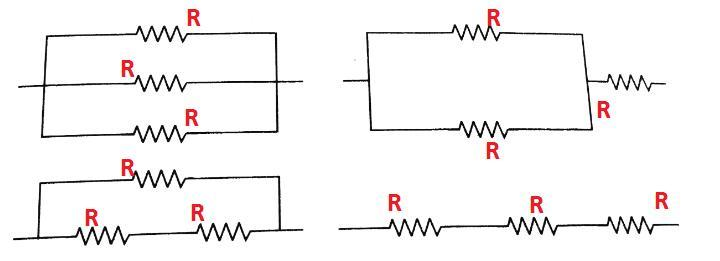
Your are given three equal resistances. In how many combinations can they be arranged?
  • A
    Three
  • Four
  • C
    Five
  • D
    Two

Answer

Correct option: B.
Four
Three equal resistances can be connected in four different combinations:
All three in parallel.
Two in parallel and third in series.
Two in series and third in parallel of both.
All three in series.

Need a full question paper?

Generate a complete, print-ready paper with questions like this in minutes — across 16+ boards, with answer keys.

Start Generating Free

Similar questions

A wave is represented as $e = 10\sin ({10^8}t + 6\sin 1250t)$ then the modulating index is
Assertion : Cyclotron does not accelerate electron.

Reason : Mass of the electrons is very small
Assertion : X-rays cannot be diffracted by means of grating.
Reason : X-rays does not obey Bragg's law.
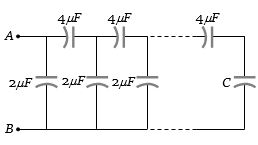
A finite ladder is constructed by connecting several sections of $2\,\mu F,\;4\,\mu F$ capacitor combinations as shown in the figure. It is terminated by a capacitor of capacitance $C$. What value should be chosen for $C$ such that the equivalent capacitance of the ladder between the points $A$ and $B$ becomes independent of the number of sections in between......$\mu F$
A telescope has an objective lens of focal length $150\,\,cm$ and an eyepiece of focal length $5 \,\,cm.$ If a $50\,\,m$ tall tower at a distance of $1\,\,km$ is observed through this telescope in normal setting, the angle formed by the image of the tower is $\theta $, then $\theta $ is close to.....$^o$
The magnitude of acceleration of the electron in the $n$th orbit of hydrogen atom is $a_{ H }$ and that of singly ionised helium atom is $a_{ He }$. The ratio of $a_{ H }: a_{ He }$ is
Which of the following is a unit for intensity of light?
During a nuclear fission reaction:
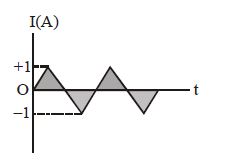
An alternating current of frequency $200\,rad/sec$ and peak value $1\,A$ as shown in the figure, is applied to the primary of a transformer. If the coefficient of mutual induction between the primary and the secondary is $1.5\,H$ , the voltage induced in the secondary will be.....$V$
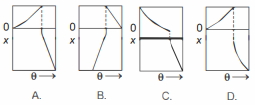
A ray of light originates from inside a glass slab and is incident on its inner surface at an angle $\theta$ as shown below. In this experiment, the location $x$ of the spot where the ray hits the screen is recorded. Which of the following correctly shows the plot of variation of $x$ with the angle $\theta$ ?