MCQ
Zero error of an instrument introduces
  • Systematic errors
  • B
    Random errors
  • C
    Both
  • D
    None

Answer

Correct option: A.
Systematic errors
a
Random errors in experimental measurements are caused by unknown and unpredictable changes in the experiment.

Systematic errors in experimental observations usually come from the measuring instruments.

Thus zero error is recognized as the systematic error (factual).

Need a full question paper?

Generate a complete, print-ready paper with questions like this in minutes — across 16+ boards, with answer keys.
Start Generating Free

Similar questions

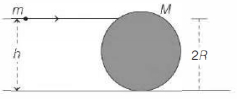
A bullet of mass $m$ is fired horizontally into a large sphere of mass $M$ and radius $R$ resting on a smooth horizontal table. The bullet hits the sphere at a height $h$ from the table and sticks to its surface. If the sphere starts rolling without slipping immediately on impact, then
A body falls from rest in the gravitational field of the earth. The distance travelled in the fifth second of its motion is.........$m$ $(g = 10\,m/{s^2})$
A particle is constrained to move on a straight line path. It returns to the starting point after $10\, sec$. The total distance covered by the particle during this time is $30\, m$. Which of the following statements about the motion of the particle is false
The velocity $v$ of a particle is given by the equation $v = 6t^2 -6t^3$, where $v$ is in $m/sec$ and $t$ is time in $seconds$ then
Three bodies having masses $5\, kg , 4\, kg$ and $2 \,kg$ is moving at the speed of $5\, m / s , 4\, m / s$ and $2 \,m / s$ respectively along $X -$axis. The magnitude of velocity of centre of mass is (in $m/s$)
A Carnot engine whose sink is at $300\, K$ has an efficiency of  $40\%.$ By how much should the temperature of source be increased so as to increase its efficiency by $50\%$ of original efficiency  ..... $K$
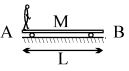
The figure shows a man of mass $m$ standing at the end $A$ of a trolley of mass $M$ placed at rest on a smooth horizontal surface. The man starts moving towards the end $B$ with a velocity $u_{rel}$ with respect to the trolley. The length of the trolley is $L$. The time taken by the man to reach the other end is
A rectangular block is $5 cm × 5 cm × 10cm$  in size. The block is floating in water with $ 5 cm $ side vertical. If it floats with $10 cm $ side vertical, what change will occur in the level of water?
This question has Statement $1$ and Statement $2$. Of the four choices given after the Statements, choose the one that best describes the two Statements.
Statement $1$ : When moment of inertia $I$ of a body rotating about an axis with angular speed $\omega $ increases, its angular momentum $L$ is unchanged but the kinetic energy $K$ increases if there is no torque applied on it.
Statement $2$ : $L = I\omega $, kinetic energy of rotation $ = \frac{1}{2}\,I\omega ^2$
A liquid of density $10^3 \,kg / m ^3$ and coefficient of viscosity $8 \times 10^{-2} \;decapoise$ is flowing in a tube of radius $2 \,cm$ with speed $2 \,m / s$. The Reynold's number is ..........