Question
Zero of the polynomial p(x) = 2x + 5 is:
  1. $\frac{-2}{5}$
  2. $\frac{-5}{2}$
  3. $\frac{2}{5}$
  4. $\frac{5}{2}$

Answer

  1. $\frac{-5}{2}$
Solution:
p(x) = 2x + 5
Now, p(x) = 0
⇒ 2x + 5 = 0
⇒ 2x = -5
$\Rightarrow\text{x}=-\frac{5}{2}$

Need a full question paper?

Generate a complete, print-ready paper with questions like this in minutes — across 16+ boards, with answer keys.
Start Generating Free

Similar questions

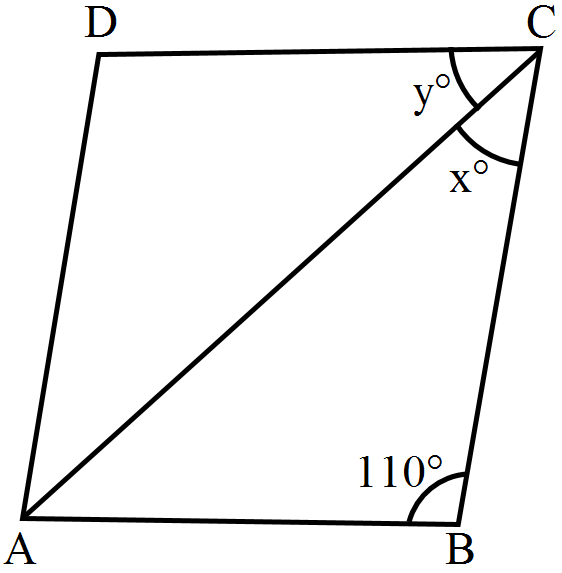
In the given figure$, \text{ABCD}$ is a Rhombus. Find the value of $x$ and $y$?
​​​​​​
Three statements are given below:
  1. In a rectangle ABCD, the diagonal AC bisects $\angle\text{A}$ as well as $\angle\text{C}.$
  2. In a square ABCD, the diagonal AC bisects $\angle\text{A}$ as well as $\angle\text{C}.$
  3. In a rhombus ABCD, the diagonal AC bisects $\angle\text{A}$ as well as $\angle\text{C}.$
Which is true?
Write the correct answer in the following: If $\bar{\text{x}}$ represents the mean of n observations $x_1,_{ }x_2, ... x_n,$ then value of $\sum\limits_{\text{i}=1}^\text {b} \text{x}_\text{i}-\bar{\text{x}}$ is:
If AD is median of $\triangle\text{ABC}$ and P is a point on AC such that $\text{ar}(\triangle\text{ADP}):\text{ar}(\triangle\text{ABD})=2:3,$ then $\text{ar}(\triangle\text{PDC}):\text{ar}(\triangle\text{ABC})$ is:
  1. 1 : 5
  2. 1 : 5
  3. 1 : 6
  4. 3 : 5
$\frac{\sqrt{32}+\sqrt{48}}{\sqrt{8}+\sqrt{12}}=?$
  1. $\sqrt{2}$
  2. 2
  3. 4
  4. 8
If O(0, 0), A(3, 0), B(3, 4), C(0, 4) are four given points then the figure OABC is a:
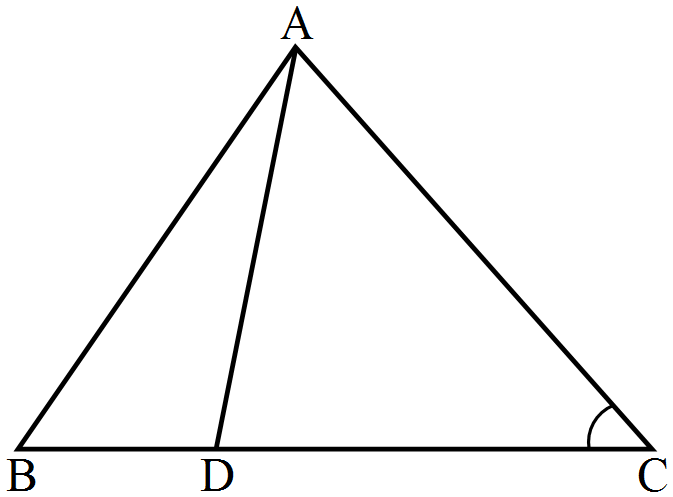
In the given figure, AB > AC. Then which of the following is true?
  1. AB < AD
  2. AB = AD
  3. AB > AD
  4. Cannot be determined
If $\text{x}^3+\frac{1}{\text{x}^3}=110,$ then $\text{x}+\frac{1}{\text{x}}=$
  1. 5
  2. 10
  3. 15
  4. None of these.
The sum of two irrational numbers is.