MCQ
Zinc and mercury do not show variable valency like $d-$ block elements because
  • A
    They are soft
  • Their $d- $ shells are complete
  • C
    They have only two electrons in the outermost subshell
  • D
    Their $d-$ shells are incomplete

Answer

Correct option: B.
Their $d- $ shells are complete
b
(b)$_{30}Zn$ and $_{80}Hg$ have their $d$  orbitals completely filled so they do not show any variable valency.

Need a full question paper?

Generate a complete, print-ready paper with questions like this in minutes — across 16+ boards, with answer keys.

Start Generating Free

Similar questions

For the reaction $PC{l_5}_{(g)}$ $\rightleftharpoons$ $PC{l_3}_{(g)} + C{l_2}_{(g)}$, the forward reaction at constant temperature is favoured by
If the reaction sequence given below is carried out with $15$ moles of acetylene, the amount of the product $D$ formed (in $g$ ) is. . . . . The yields of $A, B, C$ and $D$ are given in parentheses. [Given: Atomic mass of $H =1, C =12 O =16 \quad Cl =35$ ]
Concentration of the $Ag^+$ ions in a saturated solution of $Ag_2C_2O_4$ is $2.2 \times 10^{-4}\, mol\, L^{-1} .$ Solubility product of $Ag_2C_2O_4$ is
CaCO3(s) + 2HCl(aq) → CaCl2(aq) + CO2(g) H2O(l)
Consider the above reaction, what mass of CaCl2 will be formed if 250 mL of 0.76 M HCl reacts with 1000 g of CaCO3?
(Given: Molar mass of Ca, C, O, H and Cl are 40, 12, 16, 1 and 35.5 g mol-1, respectively)
Match the columns and choose correct option
Column $-I$ Column $-II$
$(a)$ $4s$ $(p)$ Circular orbit around nucleus
$(b)$ $4p$ $(q)$ Non directional orbital
$(c)$ $1s$ $(r)$ Angular momentum $=2h/\pi $
$(d)$ $3d$ $(s)$ Radial node is zero
The $\mathrm{pH}$ of an aqueous solution containing $1 \mathrm{M}$ benzoic acid $\left(\mathrm{pK}_{\mathrm{a}}=4.20\right)$ and $1 \mathrm{M}$ sodium benzoate is 4.5 . The volume of benzoic acid solution in 300 $\mathrm{mL}$ of this buffer solution is____ $\mathrm{mL}$.
The volume of $0.1\, N$ dibasic acid sufficient to neutralize $1\, g$ of a base that furnishes $0.04\, mole$ of $OH^-$ in aqueous solution is ............ $\mathrm{mL}$
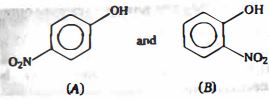
Out of the two compounds shown below, the vapour pressure of $B$ at a particular  temperature is expected to be
The reaction is called $\begin{array}{*{20}{c}}
  {2C{H_3} - C - O{C_2}{H_5}} \\ 
  {||\,\,\,} \\ 
  {O\,\,\,} 
\end{array}$ ${\xrightarrow{{{C_2}{H_5}ONa}}}$  $\begin{array}{*{20}{c}}
  {C{H_3} - C - C{H_2} - C - O{C_2}{H_5}} \\ 
  {||\,\,\,\,\,\,\,\,\,\,\,\,\,\,\,\,\,\,\,\,\,\,\,\,\,\,\,||\,\,\,\,\,\,\,} \\ 
  {O\,\,\,\,\,\,\,\,\,\,\,\,\,\,\,\,\,\,\,\,\,\,\,\,\,\,O\,\,\,\,\,} 
\end{array}$ $ + \,{C_2}{H_5}OH$
Electron affinity is the