Questions · Page 3 of 3

3 Marks Question

Question 1013 Marks
To simulate car accidents, auto manufacturers study the collisions of moving cars with mounted springs of different spring constants. Consider a typical simulation with a car of mass $1000 \ kg$ moving with a speed $18.0 \ km / h$ on a smooth road and colliding with a horizontally mounted spring of spring constant $5.25 \times 10^3 N m ^{-1}$. What is the maximum compression of the spring?
Answer
At maximum compression the kinetic energy of the car is converted entirely into the potential energy of the spring.
The kinetic energy of the moving car is
$K=\frac{1}{2} m v^2$
$=\frac{1}{2} \times 10^3 \times 5 \times 5$
$K=1.25 \times 10^4 J$
where we have converted $18 \ km h ^{-1}$ to $5 m s ^{-1}$ [It is useful to remember that $36 \ km h ^{-1}=10 m s ^{-1}$.
At maximum compression $x_m$, the potential energy $V$ of the spring is equal to the kinetic energy $K$ of the moving car from the principle of conservation of mechanical energy.
$V=\frac{1}{2} k x_m^2$
$=1.25 \times 10^4 J$
We obtain
$x_m=2.00 m$
We note that we have idealised the situation.
The spring is considered to be massless.
The surface has been considered to possess negligible friction.
View full question & answer
Question 1023 Marks
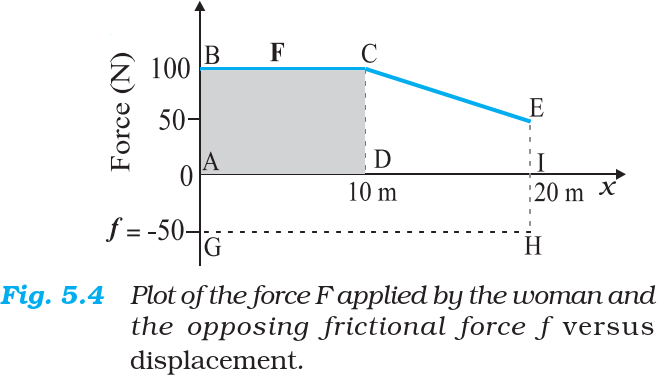
A woman pushes a trunk on a railway platform which has a rough surface. She applies a force of $100 N$ over a distance of $10 m.$ Thereafter, she gets progressively tired and her applied force reduces linearly with distance to $50 N.$ The total distance through which the trunk has been moved is $20 m.$ Plot the force applied by the woman and the frictional force, which is $50 N$ versus displacement. Calculate the work done by the two forces over $20 m.$
Answer
Image
The plot of the applied force is shown in Fig. $5.4.$ At $x=20 m , F=50 N (\neq 0)$.
We are given that the frictional force $f$ is $| f |=50 N$.
It opposes motion and acts in a direction opposite to $F$.
It is therefore, shown on the negative side of the force axis.
The work done by the woman is
$W_F \rightarrow$ area of the rectangle $\text{ABCD} +$ area of the trapezium $\text{CEID}$
$W_F=100 \times 10+\frac{1}{2}(100+50) \times 10$
$=1000+750$
$=1750 J$
The work done by the frictional force is
$W_f \rightarrow$ area of the rectangle $\text{AGHI}$
$W_f=(-50) \times 20$
$=-1000 J$
The area on the negative side of the force axis has a negative sign.
View full question & answer
Question 1033 Marks
It is well known that a raindrop falls under the influence of the downward gravitational force and the opposing resistive force. The latter is known to be proportional to the speed of the drop but is otherwise undetermined. Consider a drop of mass $1.00 g$ falling from a height $1.00 \ km$. It hits the ground with a speed of $50.0\ m s ^{-1}. (a)$ What is the work done by the gravitational force? What is the work done by the unknown resistive force?
Answer
$(a)$ The change in kinetic energy of the drop is
$\Delta K=\frac{1}{2} m v^2-0$
$=\frac{1}{2} \times 10^{-3} \times 50 \times 50$
$=1.25 J$
where we have assumed that the drop is initially at rest.
Assuming that $g$ is a constant with a value $10\ m / s ^2$,
the work done by the gravitational force is,
$W_g =m g h$
$ =10^{-3} \times 10 \times 10^3$
$ =10.0 J$
$(b)$ From the work$-$energy theorem
$\Delta K=W_g+W_r$
where $W_r$ is the work done by the resistive force on the raindrop.
Thus $W_r =\Delta K-W_g$
$ =1.25-10$
$ =-8.75 J$
is negative.
View full question & answer
Question 1043 Marks
Slowing down of neutrons: In a nuclear reactor a neutron of high speed (typically $10^7 m s ^{-1}$ ) must be slowed to $10^3 m s ^{-1}$ so that it can have a high probability of interacting with isotope ${ }_{92}^{235} U$ and causing it to fission. Show that a neutron can lose most of its kinetic energy in an elastic collision with a light nuclei like deuterium or carbon which has a mass of only a few times the neutron mass. The material making up the light nuclei, usually heavy water $\left( D _2 O \right)$ or graphite, is called a moderator.
Answer
The initial kinetic energy of the neutron is
$
K_{1 i}=\frac{1}{2} m_1 v_{1 i}^2
$
while its final kinetic energy from Eq. (5.26)
$
K_{1 f}=\frac{1}{2} m_1 v_{1 f}^2=\frac{1}{2} m_1\left(\frac{m_1-m_2}{m_1+m_2}\right)^2 v_{1 i}^2
$
The fractional kinetic energy lost is
$
f_1=\frac{K_{1 f}}{K_{1 i }}=\left(\frac{m_1-m_2}{m_1+m_2}\right)^2
$
while the fractional kinetic energy gained by the moderating nuclei $K_{2 f} / K_{l i}$ is
$
\begin{array}{c}
f_2=1-f_1 \text { (elastic collision) } \\
=\frac{4 m_1 m_2}{\left(m_1+m_2\right)^2}
\end{array}
$
One can also verify this result by substituting from Eq. (5.27).
For deuterium $m_2=2 m_1$ and we obtain $f_1=1 / 9$ while $f_2=8 / 9$. Almost $90 \%$ of the neutron's energy is transferred to deuterium. For carbon $f_1=71.6 \%$ and $f_2=28.4 \%$. In practice, however, this number is smaller since head-on collisions are rare.
View full question & answer
3 Marks Question - Page 3 - Physics STD 11 Science Questions - Vidyadip