50 questions · timed · auto-graded
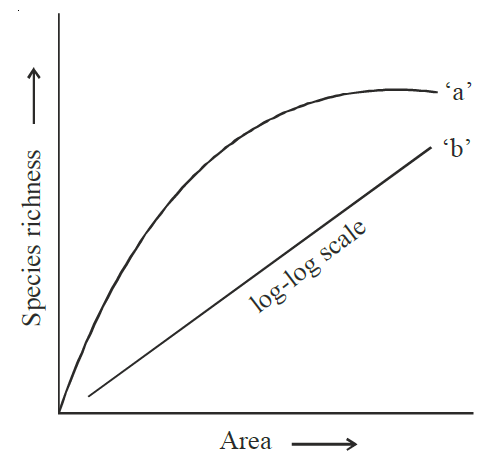
What does 'Z' stand for?
Z (slope of the line) regression co-efficient.
Parthenium/Lantana/Eichhornia invasive plants and pose a threat to indigenous species.
Introduction of African catfish (Clarias gariepinus) to aquaculture is a threat to Indian catfishes.
Specific diversity:
| S. No. | Keystone species | Endangered species |
| (i) | It is a species of lower abundance that plays vital role in sustaining the community. | It is a species of lower abundance that may or may not have a vital role in sustaining the community. |
| (ii) | The species is not threatened, e.g., Ficus. | The species is at high risk of extinction in near future, e.g., Red Panda. |
| | In situ conservation | Ex situ conservation |
| 1. | It means conservation on site, i.e. protecting an endangered species in its natural habitat by maintaining the habitat itself and defending the species from predators and poachers. | It means off-site conservation, i.e. protecting an endangered species by removing it from the threatened habitat and placing it under the care of humans. |
| 2. | This approach emphasizes on the protection of total ecosystem. | This approach restricts to the protection of genetic resources at population and species level. |
| 3. | This approach includes methods of protection like hot spots, national parks, wildlife sanctuaries and biosphere reserves. | It is done through live collections of animals and plants in zoos, botanical gardens, seed banks etc. |
When large habitats are broken up into small fragments due to various human activities, mammals and birds requiring large territories and certain animals with migratory habits are badly affected, leading to their population declines.
Some well-known invasive weed species like Partbenium (carrot grass), Lantana and, water hyacinth (Eichhonia), had caused immense environmental damage and posed threar to our native species. The recent introduction of African catfish (Clarias gariepinus) illegally for aquaculture purpose is posing a threat to the indigenous catfishes of Indian rivers.
These are regions with very high levels of species richness, high degree of endemism (species confined to a region and not found anywhere else) and accelerated habitat loss. Initially, 25 biodiversity hotspots were identified. Now, there are 34 hotspots all over the world.
These hotspots are in India, i.e. Western Ghats and Sri Lanka Indo-Burma and Eastern Himalaya. If all the biodiversity hotspots are put together, they cover less than 2% of the earth's land area, but harbor extremely high diversity. Ongoing mass extinctions could be reduced by 30% through strict protection of these hotspots.
In Situ (On site) Conservation: It is the conservation and protection of the whole ecosystem and its biodiversity at all levels in order to protect the threatened species. However, it is not economically feasible to conserve all the biological wealth at all the existing ecosystems.
Ex-Situ (Off site) Conservation: This approach involves placing the threatened animals and plants in special care units for their protection. Ex-situ conservation includes off site collections and gene bank.
OR
Why should we conserve biodiversity? Why is it a moral as well as social duty to contribute towards its protection?
Uses:
| S. No. | Genetic diversity | Species diversity |
| (i) | It represents the variety of genetic information present in an organism. | It is the variety of species and their relative abundance found within a region. |
| (ii) | It is trait of an organism. | It is trait of a biotic community. |
Three other causes are:
When large habitats are broken up into small fragments due to various human activities, mammals and birds requiring large territories and certain animals with migratory habits are badly affected, leading to their population declines.
Some well-known invasive weed species like Partbenium (carrot grass), Lantana and, water hyacinth (Eichhonia), had caused immense environmental damage and posed threar to our native species. The recent introduction of African catfish (Clarias gariepinus) illegally for aquaculture purpose is posing a threat to the indigenous catfishes of Indian rivers.