Question 11 Mark
Fill in the blanks.
Plants are called as _________ because they fix carbon dioxide.
Plants are called as _________ because they fix carbon dioxide.
Answer
View full question & answer→Autotrophs.
50 questions · timed · auto-graded
Explanation:
View full question & answer→ Explanation: Zooplankton are primary consumers in aquatic food chains that feed upon phytoplankton. Therefore, they are present at the second trophic level in a lake. Explanation: Out of total incident solar radiation, about fifty percent of it forms photosynthetically active radiation (PAR). In aquatic ecosystems, the limiting factor for the productivity is _________. The major reservoir of carbon on earth is ________. = (Gross – Primary Productivity) - (Respiratory Losses). ORQuestion 31 MarkSecondary producers are:
AnswerView full question & answer→
Question 41 MarkThe second trophic level in a lake is-
AnswerView full question & answer→
Question 51 MarkWhat is the percentage of photosynthetically active radiation (PAR), in the incident solar radiation.
AnswerView full question & answer→
Question 61 MarkFill in the blanks.
In an ecosystem dominated by trees, the pyramid (of numbers) is _________ type.AnswerView full question & answer→Spindle.Question 71 MarkFill in the blanks. AnswerView full question & answer→Sunlight.Question 81 MarkFill in the blanks.
Common detritivores in our ecosystem are _________.AnswerView full question & answer→Earthworm, bacteria & fungi of decay and vulture.Question 91 MarkFill in the blanks. AnswerView full question & answer→Oceans.Question 101 MarkWrite a difference between net primary productivity and gross productivity.AnswerView full question & answer→Gross productivity-Rate of production of organic matter during photosynthesis Net primary productivity -Available biomass for the consumption to heterotrophs/GPP-R = NPP.Question 111 MarkState what does ‘standing crop’ of a trophic level represent?AnswerView full question & answer→There is unidirectional movement of energy the higher trophic level and its levels has a certain mass of living material at a particular time called as the standing crop. It represent values for dry blomass (standing crop).Question 121 MarkHow is ‘stratification’ represented in a forest ecosystem?AnswerView full question & answer→Trees occupy vertical stratra, shrubs the second layer and herbs/grasses occupy the bottom layers/vertical distribution of species, at different levels.Question 131 MarkWhat does ecological niche of an organism represent?AnswerView full question & answer→The ecological niche (of an organism) signifies the range of conditions it can tolerate, the resources it utilises, and its functional role in the ecological system.Question 141 MarkWrite the equation that helps in deriving the net primary productivity of an ecosystem.AnswerView full question & answer→Net primary productivity (NPP) is an ecosystem can be derived using the following equation: NPP = GPP-R. Question 151 MarkWhy is the rate of assimilation of energy at the herbivore level called secondary productivity?AnswerView full question & answer→It is because the biomass available to the consumer for consumption is a resultant of the primary productivity from plants.Question 161 MarkHow much of carbon is:
AnswerView full question & answer→
Question 171 MarkWhat is meant by species composition in an ecosystem? AnswerView full question & answer→Species composition refers to all the plant, animal and microbial species present in a given ecosystem.Question 181 MarkDefine primary production.AnswerView full question & answer→It is defined as the amount of biomass or organic matter produced per unit area over a certain time period by plants during photosynthesis.Question 191 MarkName the term used for rate of storage of organic matter not used by heterotrophs.AnswerView full question & answer→Net primary productivity.Question 201 MarkWhy is measurement of biomass in terms of dry weight more accurate than fresh weight?AnswerView full question & answer→Measurement of biomass in terms of dry weight is more accurate because it avoids variations in weights due to seasonal moisture differences.Question 211 MarkWhat does the base tier of the ecological pyramid represent?AnswerView full question & answer→Producers.Question 221 MarkArrange the following as observed in vertical stratification of a forest: Grass, Shrubby plants, Teak, Amaranths.AnswerView full question & answer→Grass (floor of forest) → Amaranthus → Shrubby plants → Teak (tree).Question 231 MarkName the two forms of reservoirs of carbon that regulate the ecosystem carbon cycle.AnswerView full question & answer→Dissolved carbon in oceans and carbon in rocks, sediments and fossils are the two forms of carbon reservoirs.Question 241 MarkWhat does the base tier of ecological pyramid represent?AnswerView full question & answer→Producer or first trophic level.Question 251 MarkMan can be a primary as well as secondary consumer'. Justify this statement.AnswerView full question & answer→Man can be a primary as well as secondary consumer because man eats plants as well as meat of other animals. So, man is herbivores as well as carnivores.Question 261 MarkGPP - R = NPP
What does 'R' represent in the given equation for productivity in an ecosystem?AnswerView full question & answer→R represents the respiratory losses.Question 271 MarkWhat are primary carnivores?AnswerView full question & answer→The herbivores (primary consumers) which depend on plants for their food are called primary carnivores. They are also called secondary consumer.Question 281 MarkWhat does 'R' represent in the given equation for productivity in an ecosystem?
GPP - R = NPPAnswerView full question & answer→In the given equation for productivity in an ecosystem, GPP-R= NPP. 'R' represents the energy utilised by plants or producers in respiration. It is also referred to as respiration losses.Question 291 MarkWhat is detritus?AnswerView full question & answer→Dead organic matter or remains of plant such as leaves, bark, flower and dead remain of animals, including faecal matter constitute detritus.Question 301 MarkWhat is meant by 10% law?AnswerView full question & answer→It states that only 10% energy of a trophic level is transferred to the next higher trophic level.Question 311 MarkWhich two major groups of organisms make up the bulk of decomposers?AnswerView full question & answer→Fungi and bacteria.Question 321 MarkWhy is the assimilation of energy at the herbivore level, called secondary productivity?AnswerView full question & answer→Herbivores are the primary consumers; the rate of assimilation or formation of new biomass at the consumer level is secondary productivity.Question 331 MarkIn the North East region of lndia, during the process of jhum cultlvation, forests are cleared by burning and left for regrowth after a year of cultivation. How would you explain the regrowth of forest in ecological terms?AnswerView full question & answer→It is secondary succession.Question 341 MarkWhat is common to earthworm, mushroom, soil mites and dung beetle in an ecosystem.AnswerView full question & answer→They are all detritivores, i.e., decomposing organisms which feed on dead remains of plants and animals.Question 351 MarkExpand PAR.AnswerView full question & answer→Photosynthetically Active Radiation.Question 361 MarkExpand PAR.AnswerView full question & answer→Photosynthetic Active Radiation.Question 371 MarkWhat is the basic requirement of any ecosystem to function and sustain?AnswerView full question & answer→Constant solar input.Question 381 MarkHow much of carbon is fixed in the biosphere through photosynthesis annually?AnswerView full question & answer→4 × 10¹³kg.Question 391 MarkHow is the net primary productivity of an ecosystem derived?AnswerView full question & answer→Gross primary productivity (GPP) – Respiratory loss (R) = Net primary productivity (NPP); it is the amount of energy/ biomass available in the producers for consumption by herbivores.Question 401 MarkWhat is the approximate value of net primary productivity of the biosphere?AnswerView full question & answer→170 billion tons of (dry weight) organic matter. Question 411 MarkName the basic requirement of any ecosystem to function and sustain.AnswerView full question & answer→Biotic and abiotic factors.Question 421 MarkMention any two reasons why the primary productivity varies in different types of ecosystems?AnswerView full question & answer→The primary productivity varies in different types of ecosystems as:
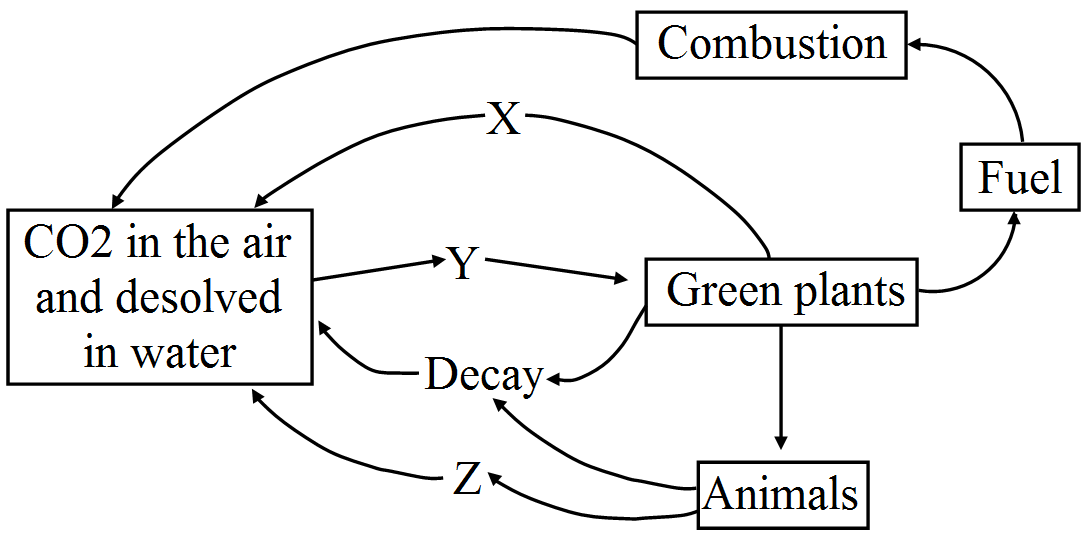
Question 431 MarkAnswerView full question & answer→X and Z- Respiration and Y- Photosynthesis.Question 441 MarkList two factors that determine the vegetation and soil type of an ecosystem.AnswerView full question & answer→Two factors that determine the vegetation and soil type of an ecosystem are:
Question 451 MarkName the natural reservoir of phosphorus and the form in which it is present.AnswerView full question & answer→
Question 461 MarkWhat is meant by humification?AnswerView full question & answer→The process of formation of humus from detritus or organic matter is called humification.Question 471 MarkGive any two examples of xerarch succession.AnswerView full question & answer→
Question 481 MarkWho put a price tag for the ecosystem services? What is its value?AnswerView full question & answer→
Question 491 MarkIn the following table the ecological units are mentioned in the first column vertically and their attributes are mentioned horizontally. Match the ecological units and its attribute and put a tick in the blank with the table:
Attribute $\rightarrow$ Ecological Unit $\downarrow$ Age Flow of Energy Natality Predator prey relationship Individual organism Population Commupity Ecosystem AnswerView full question & answer→
Attribute $\rightarrow$ Ecological Unit $\downarrow$ Age Flow of Energy Natality Predator prey relationship Individual organism $\checkmark$ Population $\checkmark$ Commupity $\checkmark$ Ecosystem $\checkmark$ Question 501 MarkWrite a difference between net primary productivity and gross primary productivity. AnswerView full question & answer→A difference between c and gross primary productivity is:
S. No. gross primary productivity. net primary productivity 1. It is the rate of production of biomass/organic matter by producers during photosynthesis. It refers to the biomass/ organic matter available for the consumption to heterotrophs, left after some respiratory losses.