Questions · Page 2 of 8

M.C.Q [1M]

MCQ 511 Mark
Ecosystem has two components
  • A
    Plants and animals
  • B
    Weeds and trees
  • Biotic and abiotic
  • D
    Frog and men
Answer
Correct option: C.
Biotic and abiotic
c
(c)The ecosystem comprises abiotic and biotic components. The entire living community comprising plants and animals constitute the biotic component whereas the entire physical environment forms the abiotic component.
View full question & answer
MCQ 521 Mark
The importance of ecosystem lies in
  • A
    Cycling of materials
  • B
    Flow of energy
  • Both the above
  • D
    None of the above
Answer
Correct option: C.
Both the above
c
(c)In any ecosystem, communities or living organisms interact with their physical environment in such a way that there is a well defined flow of energy forming clear trophic (food) levels and material cycles within this system.
View full question & answer
MCQ 531 Mark
In an ecosystem which of the following are important components
  • A
    Energy flow and food chain
  • B
    Mineral recycling and energy flow
  • C
    Food chain and decomposers
  • All the above
Answer
Correct option: D.
All the above
d
It’s obvious.
View full question & answer
MCQ 541 Mark
Dynamic aspect of an ecosystem is
  • A
    Producer and energy flow
  • B
    Producer and mineral cycles
  • C
    Consumer and mineral cycles
  • Energy flow and mineral cycles
Answer
Correct option: D.
Energy flow and mineral cycles
d
(d)Because both are continuous process.
View full question & answer
MCQ 551 Mark
Which is adapted for aquatic habit
  • A
    Aldrovenda
  • Vallisneria
  • C
    Sancatia
  • D
    All of these
Answer
Correct option: B.
Vallisneria
b
It’s obvious.
View full question & answer
MCQ 561 Mark
Which of the following are artificial aquatic ecosystems?
  • A
    Large dams and reservoirs
  • B
    Lakes and canals
  • C
    Fishery tanks and Aquaria
  • All of these
Answer
Correct option: D.
All of these
d
All are artificial aquatic ecosystems.
View full question & answer
MCQ 571 Mark
Which is not true regarding ecosystem?
  • A
    Self sufficient unit
  • B
    Cyclic exchange of materials between living beings and environment
  • C
    Only requirement is input of energy
  • Characterized by a major vegetation type
Answer
Correct option: D.
Characterized by a major vegetation type
d
Ecosystem is characterised by minor as well as major vegetation type.
View full question & answer
MCQ 581 Mark
Which of the following represents largest man made ecosystem?
  • A
    Zoo
  • B
    Garden
  • C
    Aquarium
  • Agroecosystem
Answer
Correct option: D.
Agroecosystem
d
Agroecosystem is a basic unit of study in agroecology, and is somewhat arbitrarity defined as a spatially and functionally coherent unit of agricultural activity.
View full question & answer
MCQ 591 Mark
Ecology describes
  • A
    Interactions between living organisms only
  • B
    Interactions between members of a single species only
  • Interactions of organisms among themselves as well as with their surrounding abiotic components
  • D
    Intraspecific competitions only
Answer
Correct option: C.
Interactions of organisms among themselves as well as with their surrounding abiotic components
c
Ecology describes interactions of organisms among themselves as well as with their surrounding abiotic components.
View full question & answer
MCQ 611 Mark
Choose example of man-made ecosystem.
  • A
    Desert
  • B
    Forest
  • Crop fields
  • D
    River
Answer
Correct option: C.
Crop fields
c
View full question & answer
MCQ 621 Mark
A man-made ecosystem is
  • Less in diversity
  • B
    More in diversity
  • C
    Man does not make ecosystem
  • D
    More stable than natural ecosystem
Answer
Correct option: A.
Less in diversity
a
(a)Manmade ecosystem or artificial ecosystem have low diversity and is more vulnerable to sudden changes. Crop ecosystems are man made ecosystems.
View full question & answer
MCQ 631 Mark
A pond is a
  • A
    Biome
  • Natural ecosystem
  • C
    Artificial ecosystem
  • D
    Community of plants and animals
Answer
Correct option: B.
Natural ecosystem
b
It’s obvious.
View full question & answer
MCQ 641 Mark
Which of the following is an artificial ecosystem
  • Rice-field
  • B
    Forest
  • C
    Grassland
  • D
    Lake
Answer
Correct option: A.
Rice-field
a
(a)Artificial ecosystem are man made ecosystem e.g., crop land, orchard, urban.
View full question & answer
MCQ 651 Mark
An ecosystem is a complex interacting system of
  • A
    Individual
  • B
    Population
  • Communities and their physical environment
  • D
    Communities and their soil conditions
Answer
Correct option: C.
Communities and their physical environment
c
(c)Ecosystem is a structural and functional unit of biosphere consisting of community of living beings and the physical environment both interacting and exchanging materials between them.
View full question & answer
MCQ 661 Mark
Which of the following is a man made artificial ecosystem
  • A
    Grassland ecosystem
  • Agro-ecosystem
  • C
    Ecosystem of artificial lakes and dams
  • D
    Forest ecosystem
Answer
Correct option: B.
Agro-ecosystem
b
(b)Because agriculture is a systematic process of plant growing which is produced by man.
View full question & answer
MCQ 671 Mark
A natural ecosystem
  • A
    Depends on man
  • B
    Depends on plants
  • C
    Depends on animals
  • Is auto-operated
Answer
Correct option: D.
Is auto-operated
d
(d)Because in auto-operated ecosystem, plants and animals both balance their activities in mutual manner.
View full question & answer
MCQ 681 Mark
Which one statement is correct regarding man made ecosystem
  • A
    They are highly efficient
  • B
    They are poor in diversity
  • C
    They are vulnerable to drought, floods and diseases
  • All are correct
Answer
Correct option: D.
All are correct
d
It’s obvious.
View full question & answer
MCQ 691 Mark
Major site of decomposition in the soil and water bodies respectively is
  • A
    Bottom and upper layer
  • Upper and bottom layer
  • C
    Upper and bottom layer
  • D
    Bottom and top layer
Answer
Correct option: B.
Upper and bottom layer
b
Major site of decomposition in the soil and water bodies occur on upper and bottom layer respectively.
View full question & answer
MCQ 701 Mark
Decomposition rate is slower if detritus is rich in........
  • Lignin
  • B
    Sugar
  • C
    Nitrogenous material
  • D
    Moisture
Answer
Correct option: A.
Lignin
a
View full question & answer
MCQ 711 Mark
Which is correct for Humus?

$(P)$ It is celleid

$(Q)$ It haning nutrients

$(R)$ Its degradation is not possible

  • $P$ and $Q$
  • B
    $Q$ and $R $
  • C
    Only $Q$
  • D
    Only $R$
Answer
Correct option: A.
$P$ and $Q$
a
View full question & answer
MCQ 721 Mark
The process of which humus is degraded by some microbes to release inorganic nutrients is known as
  • Mineralization
  • B
    Humification
  • C
    Photophosphorylation
  • D
    Pollination
Answer
Correct option: A.
Mineralization
a
The process by which humus is further degraded by some microbes to release inorganic nutrients is called mineralisation
View full question & answer
MCQ 731 Mark
Grazing food chain
  • A
    Provides inorganic matter to detritus food chain
  • Binds the inorganic nutrients into organic matter
  • C
    Is based on energy present in detritus
  • D
    Does not add energy into ecosystem
Answer
Correct option: B.
Binds the inorganic nutrients into organic matter
b
Grazing food chain binds the inorganic nutrients into organic matter.
View full question & answer
MCQ 741 Mark
Mark the correct match
  • A
    Secondary consumer -Zooplankton
  • B
    Primary coloniser -Viruses
  • C
    Nanoecosystem -Valley and forest
  • Omnivores -Cockroaches, Crows
Answer
Correct option: D.
Omnivores -Cockroaches, Crows
d
Omnivores -Cockroaches, Crows.
View full question & answer
MCQ 751 Mark
Energy requirement for maintenance of body _____ with successively higher trophic level.
  • A
    Decreases
  • Increases
  • C
    Remain same
  • D
    Always $10\;\%$
Answer
Correct option: B.
Increases
b
Energy requirement for maintenance of body increases with successively higher trophic level.
View full question & answer
MCQ 761 Mark
A food web
  • A
    Increases variety of food at each trophic level
  • B
    Delicately balances the inter relations amongst organisms
  • C
    Decreases variety of food but increases quantity of food at each trophic level
  • Increases variety as well as quantity of food at each trophic level
Answer
Correct option: D.
Increases variety as well as quantity of food at each trophic level
d
A food web increases variety as well as quantity of food at each trophic level.
View full question & answer
MCQ 771 Mark
Nutrient immobilisation
  • A
    Prevents leaching of nutrients
  • B
    Is incorporation of nutrients in microbes
  • C
    Is incorporation of nutrients in microbes
  • More than one option is correct
Answer
Correct option: D.
More than one option is correct
d
Nutrient immobilization prevents leaching of nutrients.
View full question & answer
MCQ 781 Mark
In tropical rain forest most of the energy in ecosystem flows through
  • A
    Grazing food chain
  • Detritus food chain
  • C
    Parasitic food chain
  • D
    Both $(a)$ and $(c)$
Answer
Correct option: B.
Detritus food chain
b
In tropical rain forest most of the energy in ecosystem flows through detritus food chain.
View full question & answer
MCQ 791 Mark
Find an incorrect statement for $DFC$
  • Starts with solar energy
  • B
    Terminates in $GFC$
  • C
    Requires specific detritivores
  • D
    Plays major role in terrestrial systems
Answer
Correct option: A.
Starts with solar energy
a
Detritus food chain starts with detritus.
View full question & answer
MCQ 801 Mark
Consider the following four statements $(A-D)$ and select the correct option stating which ones are true $(T)$ and
which ones are false $(F)$.
Statements :
$(A)$ Vertical distribution of different species occupying different levels in a community is called stratification.
$(B)$ Net primary productivity minus respiration losses is the gross primary productivity.
$(C)$ Rate of biomass production is called decomposition
$(D)$ Annual net primary productivity of oceans is $55$ billion tons
(A) (B) (C) (D)
  • A
    $F$ $T$ $F$ $T$
  • B
    $T$ $F$ $T$ $F$
  • $T$ $F$ $F$ $T$
  • D
    $F$ $T$ $F$ $F$
Answer
Correct option: C.
$T$ $F$ $F$ $T$
c
Statements $A$ & $D$ are correct
$NPP\; = \;GPP\; -\; R$
Rate of biomass production is called productivity.
View full question & answer
MCQ 811 Mark
Which of the following ecosystems has highest productivity?
  • A
    Tropical deciduous forest
  • B
    Temperate coniferous forest
  • Tropical rain forest
  • D
    Desert shrub
Answer
Correct option: C.
Tropical rain forest
c
Highest productivity ecosystem in tropical rain forest.
View full question & answer
MCQ 821 Mark
Which is not a structural aspect of ecosystem?
  • Productivity
  • B
    Species composition
  • C
    Diversity
  • D
    Life cycle
Answer
Correct option: A.
Productivity
a
Productivity is not a structural component of an ecosystem. It is a functional aspect.
View full question & answer
MCQ 831 Mark
Which of the following food chain shows spindle shaped pyramid of number?
  • A
    Grass $\rightarrow$ Insects $\rightarrow$ Frog
  • B
    Phytoplankton $\rightarrow$ Zooplankton $\rightarrow$ Small fish
  • Tree $\rightarrow$ Birds $\rightarrow$ Hawks
  • D
    Tree $\rightarrow$ Birds $\rightarrow$ Insects $\rightarrow$ Bacteria
Answer
Correct option: C.
Tree $\rightarrow$ Birds $\rightarrow$ Hawks
c
Spindle shaped pyramid of number
Tree $\rightarrow$ Birds $\rightarrow$ Hawks.
View full question & answer
MCQ 841 Mark
Which of the following trophic levels are occupied by sparrow?
  • A
    Primary consumer, primary producer
  • B
    Secondary consumer, top carnivore
  • C
    Primary producer, secondary producer
  • Primary consumer, secondary consumer
Answer
Correct option: D.
Primary consumer, secondary consumer
d
Sparrow is herbivores feed on seeds so belongs as primary consumer and it also feeds on insects so secondary consumer.
View full question & answer
MCQ 851 Mark
Which of the following organisms convert plant matter into animal matter?
  • A
    Earthworm
  • Goat
  • C
    Termites
  • D
    Frog
Answer
Correct option: B.
Goat
b
Goat (Herbivore).
View full question & answer
MCQ 861 Mark
Major conduit of energy in land and aquatic ecosystem is transferred through ______ and ______ respectively.
  • A
    $GFC, DFC$
  • B
    $PFC, GFC$
  • $DFC, GFC$
  • D
    $GFC, GFC$
Answer
Correct option: C.
$DFC, GFC$
c
Major conduit of energy in land and aquatic ecosystem is transferred through detritus food chain and grazing food chain respectively.
View full question & answer
MCQ 871 Mark
If $10,000 \;J$ of energy fall on piece of land, then what is energy available at $T_2$ level?
  • A
    $1000\; J$
  • $10 \;J$
  • C
    $100 \;J$
  • D
    $1 \;J$
Answer
Correct option: B.
$10 \;J$
b
Since $10\;\%$ energy is received by next trophic level. Here $10,000\; J$ fall on earth its $1\;\%$ in producers $i.e.$, $100\; J$ so energy available at $T_2$ will be $10 \;J$ because further transfer is $10\;\%$.
View full question & answer
MCQ 881 Mark
Choose incorrect option w.r.t. amount of living material present in different trophic levels at a given time
  • A
    Can be measured as number
  • B
    Is equivalent to standing crop
  • Is always represented as dry weight only
  • D
    Expressed both as biomass and number
Answer
Correct option: C.
Is always represented as dry weight only
c
Trophic levels -Biomass, number, energy and standing crop.
View full question & answer
MCQ 891 Mark
Trees $\rightarrow$ Birds $\rightarrow$ Lice $\rightarrow$ Bacteria. Thus food chain is
  • A
    Predatory
  • B
    Grazing
  • C
    Detritus
  • Parasitic
Answer
Correct option: D.
Parasitic
d
Trees $\rightarrow$ Birds $\rightarrow$ Lice $\rightarrow$ Bacteria represents parasitic food chain.
View full question & answer
MCQ 901 Mark
Magnitude of primary productivity is affected by
  • A
    Temperature, Availability of nutrients
  • B
    Solar radiations available, Availability of nutrients
  • C
    Photosynthetic capacity of producers
  • All of these
Answer
Correct option: D.
All of these
d
Magnitudes of primary productivity is affected by all these factors.
View full question & answer
MCQ 911 Mark
If a single plant species is removed from a food web, then most likely
  • A
    An animal species will fill the unoccupied niche
  • B
    Other plants will produce enough food for herbivores
  • Dependent herbivores will have to find new food sources
  • D
    Carnivores will be unaffected by the loss
Answer
Correct option: C.
Dependent herbivores will have to find new food sources
c
Herbivores are primary consumers, they are mainly depend on the plants for their food needs. If a single plant species is removed, then they have to find new or other food sources.
View full question & answer
MCQ 921 Mark
Only a small amount of the energy stored in food is available to the next organism in a food chain because
  • A
    There are more producers than consumer in a food chain
  • B
    There are fewer top consumers than producers in a food chain
  • C
    Primary and secondary consumers compete for food
  • Most of the energy is used for life processes
Answer
Correct option: D.
Most of the energy is used for life processes
d
Only $10\; \%$ of the herbivore productivity is utilized for raising productivity of primary carnivores. The rest is consumed in ingestion, respiration, maintenance of body heat and other activities
View full question & answer
MCQ 931 Mark
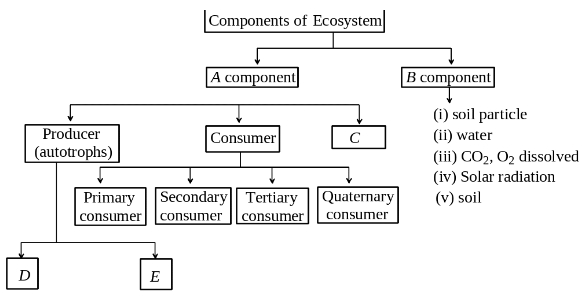
Study the diagram carefully and fill in the blanks

Choose the correct option for $A, B, C, D$ and $E$


  • $A-$Biotic, $B-$Abiotic, $C-$Decomposers, $D-$Photoautotrophs, $E-$Chemoautotrophs
  • B
    $A-$Physical, $B-$Chemical, $C-$Phytoplanktons, $D-$Plants, $E-$Parasites
  • C
    $A-$Biotic, $B-$Abiotic, $C-$Decomposers, $D-$Autotrophs, $E-$Mixotrophs
  • D
    $A-$Physical, $B-$Chemical, $C-$Bacteria and Fungi, $D-$Autotrophs, $E- $Heterotrophs
Answer
Correct option: A.
$A-$Biotic, $B-$Abiotic, $C-$Decomposers, $D-$Photoautotrophs, $E-$Chemoautotrophs
a
$A-$Biotic, $B-$Abiotic, $C-$Decomposers, $D-$Photoautotrophs, $E-$Chemoautotrophs
View full question & answer
MCQ 941 Mark
$A$ : Pyramid of biomass is always upright for tree ecosystem.

$R$ : Total biomass of a tree in a specific area is more than that of herbivores.

  • Assertion and Reason both are correct and also correct explanation.
  • B
    Assertion and Reason both are correct but not explanation of assertion.
  • C
    Assertion is correct, but Reason is incorrect.
  • D
    Both Assertion and Reason are incorrect.
Answer
Correct option: A.
Assertion and Reason both are correct and also correct explanation.
a
Pyramid of biomass is upright for terrestrial ecosystem.
View full question & answer
MCQ 951 Mark
$A $ : Ecological pyramid of biomass is generally inverted in sea.

$R$ : Biomass of fishes far exceeds that of phytoplanktons.

  • Assertion and Reason both are correct and also correct explanation.
  • B
    Assertion and Reason both are correct but not explanation of assertion.
  • C
    Assertion is correct, but Reason is incorrect.
  • D
    Both Assertion and Reason are incorrect.
Answer
Correct option: A.
Assertion and Reason both are correct and also correct explanation.
a
Biomass $\propto$ life span of an organism.
View full question & answer
MCQ 961 Mark
The most common shape of pyramid of number is
  • A
    Inverted
  • B
    Urned
  • C
    Spindle
  • Upright
Answer
Correct option: D.
Upright
d
Pyramid of number is mostly upright.
View full question & answer
MCQ 971 Mark
Consider the following statements about ecological pyramids

$I.$ Charles Elton developed the concept of ecological pyramid

$II.$ After the name these pyramids are also called as Eltonian pyramids

$III.$ It is a graphical representation or pyramid shaped diagram which depicts the number of organisms, biomass and energy at each trophic level

Which of the statements given above are correct?

  • A
    $I\;and\; II$
  • B
    $I\; and\; III$
  • C
    $II\; and \;III$
  • $I, II\; and \;III$
Answer
Correct option: D.
$I, II\; and \;III$
d
There is some sort of relationship between the number, biomass and energy contents of the producers and consumers of different orders in any ecosystem. These relationships, when represented in diagrammatic ways are called ecological pyramids. The concept of pyramid was proposed by Charles Elton $(1927)$ so, they are also called as Eltonian pyramids
View full question & answer
MCQ 981 Mark
The given figure best represents
  • A
    Pyramid of number in parasitic food chain
  • Pyramid of biomass in forest ecosystem
  • C
    Pyramid of number in grassland ecosystem
  • D
    Pyramid of number in forest ecosystem
Answer
Correct option: B.
Pyramid of biomass in forest ecosystem
b
From the given option only b can be correct because pyramid of biomass is upright in that condition only
View full question & answer
MCQ 991 Mark
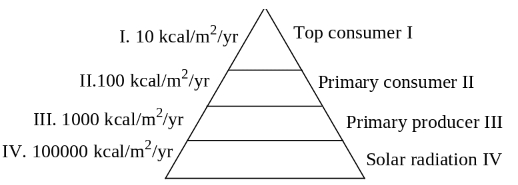
What is the rate of secondary production in the energy pyramid given below?
  • A
    Uncertain
  • $100 \;\mathrm{kcal} / \mathrm{m}^{2} / y r$
  • C
    $10\; \mathrm{kcal} / \mathrm{m}^{2} / \mathrm{yr}$
  • D
    $110\; \mathrm{kcal} / \mathrm{m}^{2} / y r$
Answer
Correct option: B.
$100 \;\mathrm{kcal} / \mathrm{m}^{2} / y r$
b
We know that plant only utilised $1-2\;\%$ of total energy incident on earth. In the given dustion $100000 \mathrm{Kcal} / \mathrm{m}^{2} / y r$ salar radiation is incident on earth. So plant producer utilize $1\; \%$ of $100000 \mathrm{kcalm}^{2} / \mathrm{yr}$ and that $1\; \%$ is$ \frac{100000 \times 1}{100}=1000\; \mathrm{kcal} / \mathrm{m}^{2} / y r$And from produces to the next level only $10 \%$ will goes, so$\frac{1000 \times 10}{100}=100\; \mathrm{kcal} / \mathrm{m}^{2} / \mathrm{yr}$ will be transferred to primary consumer which is called secondary production
View full question & answer
MCQ 1001 Mark
Given below is one of the types of ecological pyramids

This type represents

  • Pyramid of number in a grassland ecosystem
  • B
    Pyramid of energy in forest ecosystem
  • C
    Pyramid of biomass in sea ecosystem
  • D
    Pyramid of biomass in terrestrial ecosystem
Answer
Correct option: A.
Pyramid of number in a grassland ecosystem
a
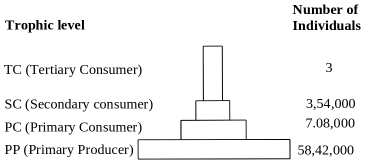
Pyramids of number in grassland ecosystem. The pyramid of numbers deal with the number of primary producers and consumers. It is upright in a grassland and inverted in a tree ecosystem. In a grassland the number of producers is more than the number of top carnivores, whereas in case of a tree, the number of producers is less as compared to consumers
View full question & answer
M.C.Q [1M] - Page 2 - BIOLOGY STD 12 Science Questions - Vidyadip