Questions · Page 1 of 3

1 Marks Question

🎯

Test yourself on this topic

50 questions · timed · auto-graded

Question 11 Mark
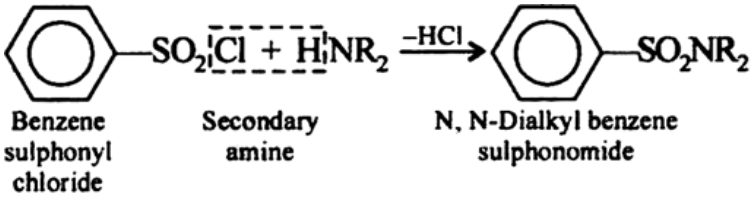
Give a chemical test to distinguish between a primary and a secondary amine.
Answer
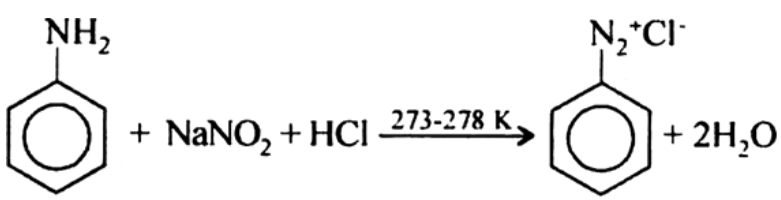
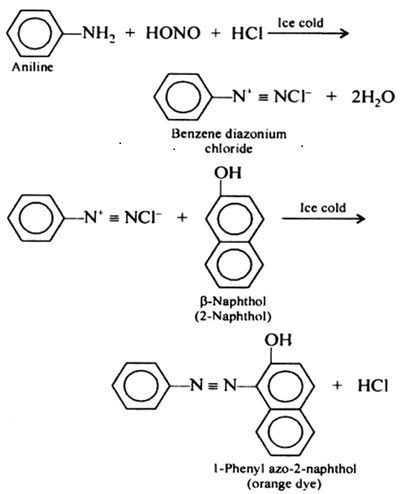
Aromatic primary amine gives orange dye on treating with ice cold NaNO2 + HCl followed by β-naphthol whereas secondary amine does not give this test/or describe carbyl amine test or Hinsberg test.
View full question & answer
Question 31 Mark
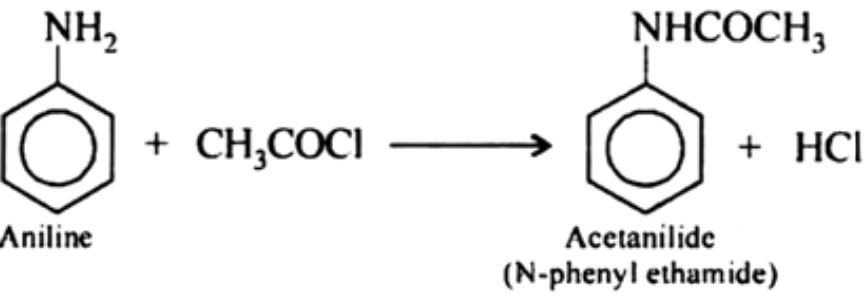
Write short notes on the following:
Acetylation.
View full question & answer
Question 51 Mark
Give one chemical test to distinguish between the following pairs of compounds.
Ethylamine and aniline.
View full question & answer
Question 71 Mark
Write short notes on the following:
Carbylamine reaction.
View full question & answer
Question 81 Mark
Give one chemical test to distinguish between the following pairs of compounds.
Secondary and tertiary amines
View full question & answer
Question 91 Mark
Complete the following reaction:
$\text{C}_6\text{H}_5\text{N}_2\text{Cl}+\text{C}_2\text{H}_5\text{OH}\rightarrow$
Answer
$ \ \ \ \ \ \ \ \ \ \ \ \ \text{C}_6\text{H}_5\text{N}_2\text{Cl} \ \ + \ \ \ \text{C}_2\text{H}_5\text{OH}\rightarrow\text{C}_6\text{H}_6+\text{CH}_3\text{CHO}+\text{N}_2+\text{HCl}\\\text{Benzenediazonium} \ \ \ \ \ \ \ \text{Ethanol} \ \ \ \ \ \ \ \text{Benzene} \ \ \ \ \ \text{Ethanal}\\ \ \ \ \ \ \ \ \ \ \ \ \text{Cloride}$
View full question & answer
Question 101 Mark
Write IUPAC names of following and classify them into primary, secondary, tertiary amines:
CH3NHCH(CH3)2
Answer
CH3NHCH(CH3)2
Methyl isopropyl amine (secondary)
View full question & answer
Question 141 Mark
How will you convert:
Hexanenitrile into 1-aminopentane.
Answer
Hexane nitrite into 1-amino pentane

$\text{CH}_3(\text{CH}_2)\text{CN}\xrightarrow[(\text{Partial hydrolysis})]{\text{H}_2\text{O}/ \text{H}^+}\text{CH}_3(\text{CH}_2)_4\text{CONH}_2\xrightarrow[]{\text{Br}_2/\text{KOH}}\text{CH}_3(\text{CH}_2)_4\text{NH}_2\\\text{Hexane nitrate} \ \ \ \ \ \ \ \ \ \ \ \ \ \ \ \ \ \ \ \ \ \ \ \ \ \ \ \ \ \text{Hexanamide} \ \ \ \ \ \ \ \ \ \ \ \ \ \ \ \ \ \ \ \ \ \ \ \ \ \ \ \ \ \text{I-amino Pentane}$

View full question & answer
Question 161 Mark
Account for the following:
pKb of aniline is more than that of methylamine.
Answer
It is because, in aniline, the NH2 group is attached directly to the benzene ring. It results in the unshared electron pair of the nitrogen atom to be in conjugation with the benzene ring and thus making it less available for protonation.
on another hand, in the case of methylamine (due to the +I effect of a methyl group), the electron density on the N-atom is increased. As a result, aniline is less basic than methylamine. Thus, pkb of aniline is more than that of methylamine.
View full question & answer
Question 171 Mark
Complete the following reaction:
$\text{C}_6\text{H}_5\text{N}_2\text{Cl}+\text{H}_3\text{PO}_2+\text{H}_2\text{O}\rightarrow$
Answer
$\text{C}_6\text{H}_5\text{N}_2\text{Cl}+\text{H}_3\text{PO}_2+\text{H}_2\text{O}\rightarrow\text{C}_6\text{H}_6+\text{N}_2+\text{H}_3\text{PO}_3+\text{HCl}\\\text{Benzenediazonium} \ \ \ \ \ \ \ \ \ \ \ \ \ \ \ \ \ \ \ \ \ \text{Benzene}\\\text{Cloride}$
View full question & answer
Question 181 Mark
Write short notes on the following:
Ammonolysis.
Answer
Ammonolysis: Alkyl halide reacts with ammonia to form primary amine. The reaction of ammonia with alkyl halide is known as ammonolysis.
CH3Cl + NH→ CH3NH2.HCl
CH3NH2.HCl + NH→ CH3NH2 + NH4Cl
View full question & answer
Question 191 Mark
Arrange the following:
In decreasing order of basic strength in gas phase:
C2H5NH2, (C2H5)2NH, (C2H5)3N and NH3
Answer
(C2H5)2NH > C2H5NH > (C2H5)3N > NH3
View full question & answer
Question 201 Mark
How will you convert:
Nitromethane into dimethylamine.
Answer
Nitromethane into dimethylamine
$\text{CH}_3\text{NO}_2+6[\text{H}]\xrightarrow[]{\text{Sn}/\text{HCl}}\text{CH}_3\text{NH}_2\xrightarrow[-\text{HBr}]{\text{CH}_3\text{Br}}\\\text{Nitromethane} \ \ \ \ \ \ \ \ \ \ \ \ \ \ \ \ \ \ \ \text{Methyl}\\ \ \ \ \ \ \ \ \ \ \ \ \ \ \ \ \ \ \ \ \ \ \ \ \ \ \ \ \ \ \ \ \ \ \ \ \ \ \ \ \ \ \ \ \ \ \text{amine}\\ \ \ \ \ \ \ \ \ \ \ \ \ \ \ \ \ \ \ \ \ \ \ \ \ \ \ \ \ \ \ \ \ \ \ \ \ \ \ \ \ \ \ \ \ \ \ \ \ \ \ \ \ \ \ \ \ \ \ (\text{CH}_3)_2\text{NH}\\ \ \ \ \ \ \ \ \ \ \ \ \ \ \ \ \ \ \ \ \ \ \ \ \ \ \ \ \ \ \ \ \ \ \ \ \ \ \ \ \ \ \ \ \ \ \ \ \ \ \ \ \ \ \ \ \ \ \ \ \text{dimethyl amine}$
View full question & answer
Question 211 Mark
Give plausible explanation for each of the following:
Why are amines less acidic than alcohols of comparable molecular masses?
Answer
Oxygen in alcohol is more electro negative than nitrogen in amines. RC—H bond in alcohol is more polar with δ+ charge on.
ROδ-Hδ+ as compared to RN—H bond in Alcohols can loose proton to some extent but are proton acceptors.
$\text{RO}-\text{H}\rightleftharpoons\text{RO}^-+\text{H}^+\\ \ \ \ \ \ \ \ \ \ \ \ \ \ \ \ \ \ \ \ \text{Unstable}$
$\text{R}\stackrel{{. .} }{{\text{N}}}\text{H}_2+\text{H}^+\rightarrow\text{R}\stackrel{{+} }{{\text{N}}}\text{H}_3\\ \ \ \ \ \ \ \ \ \ \ \ \ \ \ \ \ \ \ \ \ \ \ \ \ \ \ \text{Stable}$
View full question & answer
Question 221 Mark
Write short notes on the following:
Hofmann’s bromamide reaction.
Answer
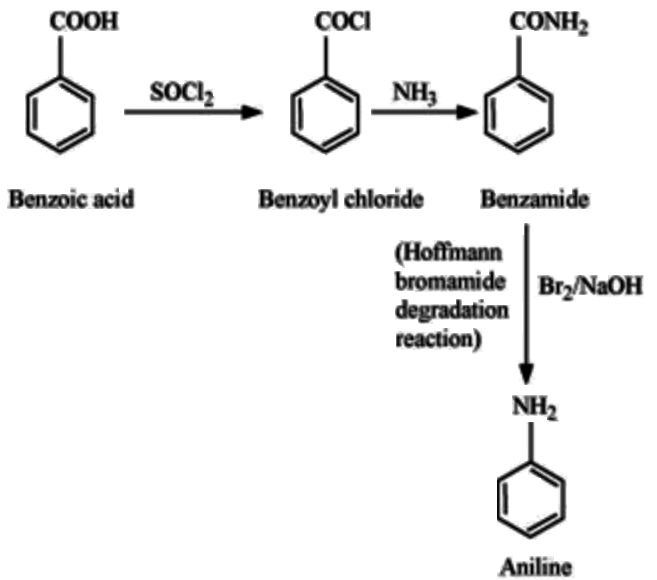
Hoffmann bromamide degradation reaction: Hoffman develops a method for preparation of primary amines by treating an amide with bromine in an aqueous or ethanolic solution of sodium hydroxide.
In this reaction migration of an alkyl or aryl group takes place from carbonyl carbon of the amide to the nitrogen atom. The amine so formed contains one carbon less than that present in the amide.
$ \ \ \ \ \ \ \ \ \ \ \ \ \ \text{O}\\\ \ \ \ \ \ \ \ \ \ \ \ \ ||\\\text{CH}_3-\text{C}-\text{NH}_2+\text{Br}_2+4\text{KOH}\rightarrow{\\\\\\\\\\\\}\text{CH}_3\text{NH}_2\\\text{Ethanamide} \ \ \ \ \ \ \ \ \ \ \ \ \ \ \ \ \ \ \ \ \ \ \text{Methanamine}\\ \ \ \ \ \ \ \ \ \ \ \ \ \ \ \ \ \ \ \ \ \ \ \ \ \ \ \ \ \ \ \ \ +\text{K}_2\text{CO}_3+2\text{KBr}+2\text{H}_2\text{O}$
View full question & answer
Question 231 Mark
Account for the following:
Aniline does not undergo Friedel-Crafts reaction.
Answer
A Friedel-crafts reaction is carried out in the presence of AlCl3. but AlCl3 is acidic in nature, while aniline is a strong base. Thus, aniline reacts with AlCl3 to form a salt. Due to the positive charge on the N-atom, electrophilic substitution in the benzene ring is deactivated.Hence, aniline does not under go the Friedel-crafts reactions.
Aniline does not under Friedel-Craft reaction (alkylation and acetylation) due to the salt formation with aluminium chloride, the Lewis acid which is used as a catalyst. Due to this, the nitrogen of aniline acquires a positive charge and hence acts as a strong deactivating group for further reaction.
View full question & answer
Question 241 Mark
Account for the following:
Gabriel phthalimide synthesis is preferred for synthesising primary amines.
Answer
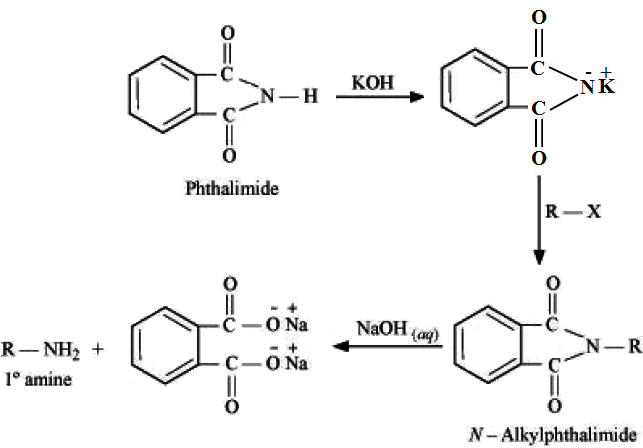
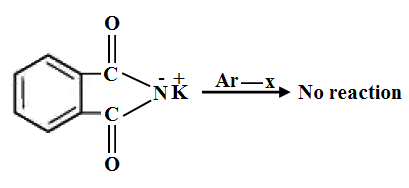
Gabriel phthalimide synthesis results in the formation of primary amine only. secondary or tertiary amines are not formed in this synthesis. thus, the pure primary amine can be obtained. Therefore, Gabriel phthalimide synthesis is preferred for synthesising primary amines.
Phthalimide is alkylated with alkyl or benzyl halide and then hydrolysed or hydrazinolysis to get pure primary amine. In this method, phthalic acid is produced which can be again converted into phthalimide and used over and over again.
View full question & answer
Question 251 Mark
Complete the following reaction:
$\text{C}_6\text{H}_5\text{NH}_2+(\text{CH}_3\text{CO})_2\text{O}\rightarrow$
Answer
$\text{C}_6\text{H}_5\text{NH}_2+(\text{CH}_3\text{CO})_2\text{O}\rightarrow\text{C}_6\text{H}_5-\text{N}-\text{C}-\text{CH}_3+\text{CH}_3\text{COOH}\\\text{Aniline} \ \ \ \ \ \ \ \ \text{acitic anhydride} \ \ \ \ \ \ \ \ \ \ \ \ \ \ \ \ \ | \ \ \ \ \ \ ||\\ \ \ \ \ \ \ \ \ \ \ \ \ \ \ \ \ \ \ \ \ \ \ \ \ \ \ \ \ \ \ \ \ \ \ \ \ \ \ \ \ \ \ \ \ \ \ \ \ \ \ \ \ \ \ \ \ \ \ \ \ \ \ \ \ \text{H} \ \ \ \ \ \text{O}\\ \ \ \ \ \ \ \ \ \ \ \ \ \ \ \ \ \ \ \ \ \ \ \ \ \ \ \ \ \ \ \ \ \ \ \ \ \ \ \ \ \ \ \ \ \ \ \ \ \ \ \ \ \ \ \ \ \ \text{N}-\text{Phenylethanamide}$
View full question & answer
Question 261 Mark
Complete the following reaction:
$\text{C}_6\text{H}_5\text{N}_2\text{Cl}\xrightarrow[(\text{ii})\text{NaNO}_2/\text{Cu}.\Delta]{(\text{i})\text{HBF}_4}$
Answer
$\text{C}_6\text{H}_5\text{N}_2\text{Cl}\xrightarrow[(\text{ii})\text{NaNO}_2/\text{Cu}.\Delta]{(\text{i})\text{HBF}_4}\text{C}_6\text{H}_5\text{NO}_2+\text{N}_2+\text{NaBF}_4\\\text{Benzenediazonium} \ \ \ \ \ \ \ \ \ \ \ \ \text{Nitrobenzene}\\ \ \ \ \ \ \ \text{chloride}$
View full question & answer
Question 271 Mark
What are the hydrolysis products of 
  1. Sucrose
  2. lactose?
Answer
Both sucrose and lactose are disaccharides. Sucrose on hydrolysis gives one molecule each of glucose and fructose but lactose on hydrolysis gives one molecule each of glucose and galactose.

$\text{C}_{12}\text{H}_{22}\text{O}_{11}+\text{H}_2\text{O}\xrightarrow[]{\text{H}_3\text{O}^+} \ \ \ \ \ \ \ \ \text{C}_6\text{H}_{12}\text{O}_6+ \ \ \ \ \ \ \ \ \text{C}_6\text{H}_{12}\text{O}_6\\\text{Sucrose} \ \ \ \ \ \ \ \ \ \ \ \ \ \ \ \ \ \ \ \ \ \ \ \ \ \ \ \ \ \ \ \text{D}-(+)-\text{Glucose} \ \ \ \ \text{D}-(-)-\text{Fructose}$

$\text{C}_{12}\text{H}_{22}\text{O}_{11}+\text{H}_2\text{O}\xrightarrow[]{\text{H}_3\text{O}^+} \ \ \ \ \ \ \ \ \text{C}_6\text{H}_{12}\text{O}_6+ \ \ \ \ \ \ \ \ \text{C}_6\text{H}_{12}\text{O}_6\\\text{Lactose} \ \ \ \ \ \ \ \ \ \ \ \ \ \ \ \ \ \ \ \ \ \ \ \ \ \ \ \ \ \ \ \text{D}-(+)-\text{Glucose} \ \ \ \ \text{D}-(+)-\text{Galactose}$


View full question & answer
Question 281 Mark
Complete the following reaction:
$\text{C}_6\text{H}_5\text{NH}_2+\text{H}_2\text{SO}_4(\text{conc.})\rightarrow$
Answer
$\text{C}_6\text{H}_5\text{NH}_2+\text{conc}.\text{H}_2\text{SO}_4\rightarrow\text{C}_6\text{H}_5\stackrel{{+}}{{\text{N}}}\text{H}_3\text{HS}\stackrel{{-}}{{\text{O}_4}}\\\text{Aniline} \ \ \ \ \ \ \ \ \ \ \ \ \ \ \ \ \ \ \ \ \ \ \ \ \ \ \ \ \ \ \ \ \text{Anilinium hydrogen sulphate}$
View full question & answer
Question 291 Mark
Arrange the following:

 In decreasing order of the pKb values:

C2H5NH2, C6H5NHCH3, (C2H5)2NH and C6H5NH2

Answer
(C2H5)2NH > C2H5NH2 > C6H5NHCH3 > C6H5NH2
View full question & answer
Question 301 Mark
Give one chemical test to distinguish between the following pairs of compounds.
Methylamine and dimethylamine
Answer
Heat both these amines with chloroform and alcohol KOH solution. The compound which gives unpleasant (offensive) smell is methylamine while the compound which does not give any smell is diethylamine.
  $\text{CH}_3\text{NH}_2+\text{CHCl}_3+3\text{KOH}\xrightarrow[]{\text{Heat}}\text{CH}_3\text{N}\stackrel{{\rightarrow}}{{=}}\text{C}\\\text{Methyl amine}\ \ \ \ \ \ \ \ \ \ \ \ \ \ \ \ \ \ \ \ \ \ \ \ \ \ \ \ \ \ \ \ \ \ \ \ \ \ \ \ \text{Methyl}\\\ \ \ \ \ \ \ \ \ \ \ \ \ \ \ \ \ \ \ \ \ \ \ \ \ \ \ \ \ \ \ \ \ \ \ \ \ \ \ \ \ \ \ \ \ \ \ \ \ \ \ \ \ \ \ \ \ \ \ \ \ \ \ \ \ \ \text{isocyanide}\\\ \ \ \ \ \ \ \ \ \ \ \ \ \ \ \ \ \ \ \ \ \ \ \ \ \ \ \ \ \ \ \ \ \ \ \ \ \ \ \ \ \ \ \ \ \ \ \ \ \ \ \ \ \ \ \ \ \ \ \ \ \ \ \ \ \ (\text{offencive smell})\\\ \ \ \ \ \ \ \ \ \ \ \ \ \ \ \ \ \ \ \ \ \ \ \ \ \ \ \ \ \ \ \ \ \ \ \ \ \ \ \ \ \ \ \ \ \ \ \ \ \ \ \ \ \ \ \ \ \ \ \ \ \ \ \ \ +3\text{KCl}+3\text{H}_2\text{o}$
$(\text{CH}_3)\text{NH}+\text{CHCl}_3+3\text{KOH}\xrightarrow[]{\text{Heat}}\text{NO smell}\\ \ {\text{Dimethylamine}}\ \ \ \ \ \ \ \ \ \ \ \ \ \ \ \ \ \ \ \ \ \ \ \ \ \ \ \ \ \ \ \ \ \ \ \ \ \ \ \ \ \ \ \ \ \ \ \ \ \ \ \ \ $
View full question & answer
Question 311 Mark
Arrange the following:
In increasing order of solubility in water:
C6H5NH2, (C2H5)2NH, C2H5NH2.
Answer
C6H5NH2 < (C2H5)2NH < C2H5NH2.
View full question & answer
Question 321 Mark
Complete the following reaction:
$\text{C}_6\text{H}_5\text{NH}_2+\text{CHCl}_3+\text{alc.KOH}\rightarrow$
Answer
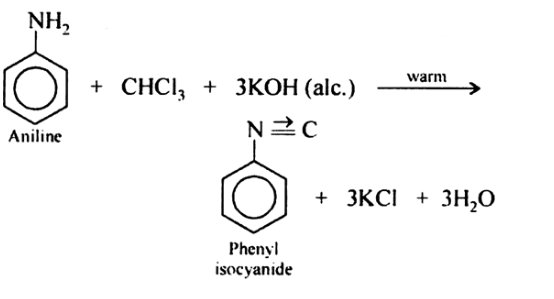
$\text{C}_6\text{H}_5\text{NH}_2+\text{CHCl}_3+\text{alc.KOH}\xrightarrow[]{\text{Carbyamine} \text{ reaction}}3\text{H}_2\text{O}+3\text{KCl}+\text{C}_6\text{H}_5-\text{NC}\\ \ \ \ \ \ \ \ \ \ \ \ \ \ \ \ \ \ \ \ \ \ \ \ \ \ \ \ \ \ \ \ \ \ \ \ \ \ \ \ \ \ \ \ \ \ \ \ \ \ \ \ \ \ \ \ \ \ \ \ \ \ \ \ \ \ \ \ \ \ \ \ \ \ \ \ \ \ \ \ \ \ \ \ \ \ \ \ \ \ \ \ \ \ \ \ \ \ \ \ \ \ \ \ \ \ \ \ \ \ \ \ \text{Phynyl}\\ \ \ \ \ \ \ \ \ \ \ \ \ \ \ \ \ \ \ \ \ \ \ \ \ \ \ \ \ \ \ \ \ \ \ \ \ \ \ \ \ \ \ \ \ \ \ \ \ \ \ \ \ \ \ \ \ \ \ \ \ \ \ \ \ \ \ \ \ \ \ \ \ \ \ \ \ \ \ \ \ \ \ \ \ \ \ \ \ \ \ \ \ \ \ \ \ \ \ \ \ \ \ \ \ \ \ \ \ \ \ \text{isocynide}$
View full question & answer
Question 331 Mark
Arrange the following:
In increasing order of basic strength:
C6H5NH2, C6H5N(CH3)2, (C2H5)2NH and CH3NH2
Answer
CH3NH2 > (C2H5)2 NH > C6H5N(CH3)> C6H5 NH2
View full question & answer
Question 341 Mark
How will you convert:
Ethanoic acid into propanoic acid.
Answer
Conversion of Ethanoic acid into Propanoic acid.
$\text{CH}_3\text{COOH}\xrightarrow[\text{Reduction}]{\text{LiAlH}_4}\text{CH}_3\text{CH}_2\text{OH}\xrightarrow[]{\text{PI}_3}\\\text{Ethanoic} \ \ \ \ \ \ \ \ \ \ \ \ \ \ \ \ \ \ \ \ \ \ \ \ \ \ \ \ \ \ \text{Ethyl} \ \ \ \ \ \ \ \ \ \ \\ \ \text{acid} \ \ \ \ \ \ \ \ \ \ \ \ \ \ \ \ \ \ \ \ \ \ \ \ \ \ \ \ \ \ \ \ \ \ \ \text{alcohol}\\\text{CH}_3\text{CH}_2\text{I}\xrightarrow[]{\text{KCN}}\text{CH}_3\text{CH}_2\text{CN}\xrightarrow[]{2\text{H}_2\text{O}/\text{H}^+}\\\text{Ethyl Iodide} \ \ \ \ \ \ \ \ \ \text{Ethyl cynide}\\ \ \ \ \ \ \ \ \ \ \ \ \ \ \ \ \ \ \ \ \ \ \ \ \ \ \ \ \ \ \ \ \ \ \ \ \ \ \ \text{CH}_3\text{CH}_2\text{COOH}\\ \ \ \ \ \ \ \ \ \ \ \ \ \ \ \ \ \ \ \ \ \ \ \ \ \ \ \ \ \ \ \ \ \ \ \ \ \ \ \ \ \ \ \ \ \text{Propinic acid}$
View full question & answer
Question 351 Mark
Account for the following:
Methylamine in water reacts with ferric chloride to precipitate hydrated ferric oxide.
Answer
Due to the +I effect of  -CH3 group, methylamine is more basic than water. therefore, in water methylamine produces OH-  ions by accepting H+ions form water.
Methyl amine is a base and dissolves in water to produce hydroxide ions.
CH3 NH2 + H2O ⇌ CH3 NH3 + OHΘ
FeCl3 combines with OH- ions to give reddish brown precipitate of Fe (OH)3
FeCl3 + 3OH→ Fe(OH)3
View full question & answer
Question 361 Mark
Give one chemical test to distinguish between the following pairs of compounds.
Aniline and N-methylaniline.
Answer
Aniline and N—Methylaniline Carbylamine test: Heat both the compounds separately with chloroform and alcoholic KOH. The compound which gives an unpleasant or offensive smell in aniline while the compound which does not give any smell is N-Methylaniline.
$\text{C}_6\text{H}_5\text{NH}_2+\text{CHCl}_3+3\text{KOH}\xrightarrow[\ \ \ \ \ \ \ \ \ \ \ \ \ ]{\text{Heat}}\text{C}_6\text{H}_5\stackrel{{\rightarrow}}{{=}}\text{C}\\\text{Aniline}\ \ \ \ \ \ \ \ \ \ \ \ \ \ \ \ \ \ \ \ \ \ \ \ \ \ \ (\text{alc})\ \ \ \ \ \ \ \ \ \text{Phenyl isocyanide}\\ \ \ \ \ \ \ \ \ \ \ \ \ \ \ \ \ \ \ \ \ \ \ \ \ \ \ \ \ \ \ \ \ \ \ \ \ \ \ \ \ \ \ \ \ \ \ \ \ \ \ \ \ \ \ \ \ \ \ (\text{Offencive smell})\\ \ \ \ \ \ \ \ \ \ \ \ \ \ \ \ \ \ \ \ \ \ \ \ \ \ \ \ \ \ \ \ \ \ \ \ \ \ \ \ \ \ \ \ \ \ \ \ \ \ \ \ \ \ \ +3\text{KCl}+3\text{H}_2\text{O}$
$\text{C}_6\text{H}_5\text{NHCH}_3+\text{CHCl}_3+3\text{KOH}\xrightarrow[\ \ \ \ \ \ \ \ \ \ \ \ \ ]{\text{Heat}}\text{No smell}.\\\text{N-methyl}\ \ \ \ \ \ \ \ \ \ \ \ \ \ \ \ \ \ \ \ \ \ \ (\text{alc}) \ \ \ \ \ \ \ \ \ \ \ \ \ \ \ \ \ \ \ \ \ \ \ \ \\\ \ \ \ \ \text{aniline}\ \ \ \ \ \ \ \ \ \ \ \ \ \ \ \ \ \ \ \ \ \ \ \ \ \ \ \ \ \ \ \ \ \ \ \ \ \ \ \ \ \ \ \ \ \ \ \ \ \ \ \ \ \ \ \ \ \ \ \ \ \ \ \ \ \ \ $
View full question & answer
Question 371 Mark
Write IUPAC name of the following compounds and classify them into primary, secondary and tertiary amines.
(CH3CH2)2NCH3
Answer
(CH3CH2)2 NCH3
N - Ethyl - N - methylethanamine (3° amine)
View full question & answer
Question 381 Mark
How will you convert:
Ethanoic acid into methanamine.
Answer
Ethanoic acid into methanamine.
$\text{CH}_3\text{COOH}+\text{HN}_3\xrightarrow[\text{Warm}]{\text{conc}.\ \text{H}_2 \text{SO}_4}\text{CH}_3\text{NH}_2+\text{CO}_2+\text{N}_2\\\text{Ethanoic} \ \ \ \ \ \ \ \text{Hydrazoic} \ \ \ \ \ \ \ \ \ \ \ \ \ \text{Methanamine}\\\text{acid}\ \ \ \ \ \ \ \ \ \ \ \ \ \ \ \text{acid}$
View full question & answer
Question 391 Mark
Arrange the following in increasing order of their basic strength:
C2H5NH2, C6H5NH2, NH3, C6H5CH2NH2 and (C2H5)2NH.
Answer
C6H5NH2 < NH3 < C6H5CH2NH2 <  C2H5NH2<(C2H5)2NH
View full question & answer
Question 401 Mark
How will you convert?
Cl – (CH2)4 –Cl into hexan-1, 6 - diamine?
Answer
$\text{Cl}-(\text{CH}_2)_4-\text{Cl}\xrightarrow[]{\text{Ethanolic NaCN}}\text{N}\equiv\text{C}-(\text{CH}_4)-\text{C}\equiv\text{N}\\ \ \ \ \ \ \ \ \ \ \ \ \ \ \ \ \ \ \ \ \ \ \ \ \ \ \ \ \ \ \ \ \ \ \ \ \ \ \ \ \ \ \ \ \ \ \ \ \ \ \ \ \ \ \ \ \ \ \ \ \ \ \ \ \ \ \ \ \ \ \ \ \ \ \ \ \ \Bigg\downarrow{\text{H}_2/\text{Ni}}\\ \ \ \ \ \ \ \ \ \ \ \ \ \ \ \ \ \ \ \ \ \ \ \ \ \ \ \ \ \ \ \ \ \ \ \ \ \ \ \ \ \ \ \ \ \ \ \text{H}_2\text{N}-\text{CH}_2-(\text{CH}_2)_4-\text{CH}_2-\text{NH}_2\\ \ \ \ \ \ \ \ \ \ \ \ \ \ \ \ \ \ \ \ \ \ \ \ \ \ \ \ \ \ \ \ \ \ \ \ \ \ \ \ \ \ \ \ \ \ \ \ \ \ \ \ \ \ \ \ \ \ \ \text{Hexane- 1,6-diamine}$
View full question & answer
Question 411 Mark
Write IUPAC name of following and classify them into primary, secondary, tertiary amines:
(CH3)2CHNH2
Answer
(CH3)2CHNH2: 1-Methylethanamine (1° amines)
View full question & answer
Question 421 Mark
Write IUPAC names of the following compounds and classify them into primary, secondary and tertiary amines.
(CH3)3CNH2
Answer
(CH3)3CNH2
Tert-butylamine (primary amine)
View full question & answer
Question 431 Mark
Arrange the following:
In increasing order of boiling point:
C2H5OH, (CH3)2NH, C2H5NH2
Answer
Increasing order of given:
(CH3)2NH < C2H5NH2 < C2H5OH
View full question & answer
Question 441 Mark
Arrange the following in increasing order of their basic strength:
C2H5NH2, (C2H5)2NH, (C2H5)3N, C6H5NH2
Answer
C6H5NH2 < C2H5NH2 < (C2H5)3N < (C2H5)2NH
View full question & answer
Question 451 Mark
Complete the following acid-base reaction and name the product:
$\text{CH}_3\text{CH}_2\text{CH}_2\text{NH}_2+\text{HCl}\rightarrow$
Answer
$\text{CH}_3\text{CH}_2\text{CH}_2\text{CH}_2\text{NH}_2\rightarrow\text{CH}_3\text{CH}_2\text{CH}_2\text{NH}_3 \ ^ +\text{Cl}^-\\\text{n-propylamine} \ \ \ \ \ \ \ \ \ \ \ \ \ \ \ \ \ \ \text{n-propylammoniumchloride}$
View full question & answer
Question 481 Mark
How will you convert:
Ethanamine into methanamine.
Answer
Conversion of Ethanamine into Methanamine.
$ \text{C}_2\text{H}_5\text{NH}_2\xrightarrow[]{\text{HONO}}\text{C}_2\text{H}_5\text{OH}\xrightarrow[\text{K}_2\text{Cr}_2\text{O}_7/ \text{H}_2\text{SO}_4]{\text{Oxidation}}\\\text{Ethanamine} \ \ \ \ \ \ \ \ \ \ \ \ \ \ \text{Ethyl} \ \ \ \ \ \ \ \ \ \ \ \ \ \ \ \ \ \ \ \ \ \ \ \ \ \ \ \ \ \ \ \ \\\ \ \ \ \ \ \text{alcohol}\\ \ \ \ \ \ \ \ \ \ \ \ \ \ \ \ \ \ \text{CH}_3\text{CHO}\xrightarrow[]{\text{Oxidation}}\text{CH}_3\text{COOH}\\ \ \ \ \ \ \ \ \ \ \ \ \ \ \ \ \text{Acetaldahyde} \ \ \ \ \ \ \ \ \ \ \text{Acetic acid}\\ \ \ \ \ \ \ \ \ \ \ \ \ \ \ \ \ \ \ \ \ \ \ \ \ \ \ \ \ \ \ \ \ \ \ \ \ \ \ \ \ \ \ \ \ \ \ \ \ \ \ \ \ \ \ \ \ \ \ \Big\downarrow{\text{NH}_3}\\\text{CH}_3\text{NH}_2\xleftarrow[]{\text{Br}_2/\text{KOH}}\text{CH}_3\text{CONH}_2\xleftarrow[]{\text{heat}}\text{CH}_3\text{COONH}_4\\\text{methamine} \ \ \ \ \ \ \ \ \ \ \ \ \ \text{Acetamide} \ \ \ \ \ \ \ \ \ \ \ \ \ \ \ \ \text{Ammonium}\\ \ \ \ \ \ \ \ \ \ \ \ \ \ \ \ \ \ \ \ \ \ \ \ \ \ \ \ \ \ \ \ \ \ \ \ \ \ \ \ \ \ \ \ \ \ \ \ \ \ \ \ \ \ \ \ \ \ \ \ \ \ \ \ \ \ \ \ \ \ \text{acetate}$
View full question & answer
1 Marks Question - Chemistry STD 12 Science Questions - Vidyadip