Questions · Page 1 of 4

M.C.Q [1M]

🎯

Test yourself on this topic

50 questions · timed · auto-graded

MCQ 11 Mark
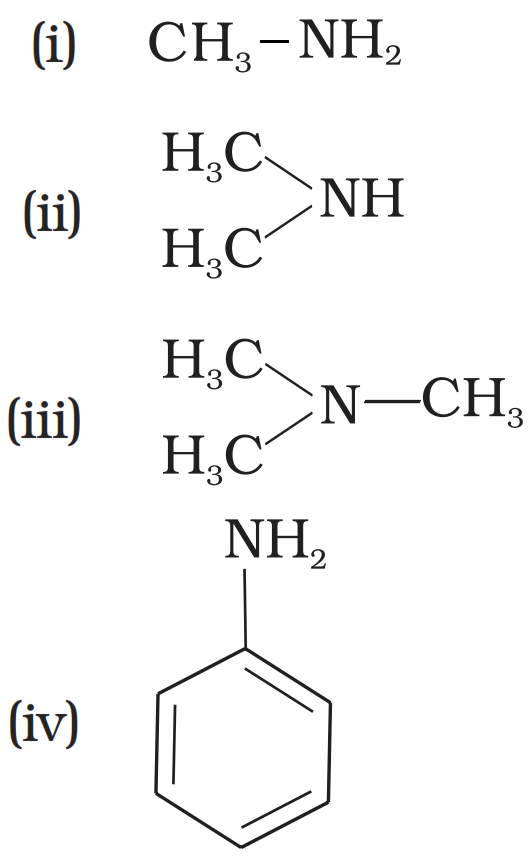
Out of the following, the strongest base in aqueous solution is:
  • A
    Methylamine.
  • B
    Dimethylamine.
  • C
    Trimethylamine.
  • D
    Aniline.
Answer
  1. Dimethylamine.

Explanation:

When we compare the basicity of the aliphatic amines, we would expect the basicity of tertiary amines to be the greatest, followed by secondary amine and then primary amine.

But this is not so. The order of basicity is

NH3​ < primary amine ~ tertiary amine < secondary amine

This is because:

  1. Steric hindrance: The size of an alkyl group is more than that of a hydrogen atom. So, an alkyl group would hinder the attack of a hydrogen atom, thus decreasing the basicity of the molecule. So, the more the number of alkyl groups attached, lesser will be its basicity. 

  2. Solvation of ions: When amines are dissolved in water, they form protonated amines. Also, the number of possibilities for hydrogen bonding also increases. More the number of hydrogen bonding more is the hydration that is released in the process of the formation of hydrogen bonds.

The combined effect of the pushing effect of the alkyl group (+I effect), steric hindrance and the salvation of amines causes the basicity order to be (basicity of tertiary is almost the same as that of primary).

NH3​ < primary amine ~ tertiary amine < secondary amine

So, here Dimethylamine is the strongest base.
View full question & answer
MCQ 21 Mark
On reduction of $CH _3 CH _2 CONH _2$ with $LiAlH _4 / H _2 O$, the compound obtained is -
  • A
    Ethane aimine
  • Propane amine
  • C
    Propanoic acid
  • D
    Propene
Answer
Correct option: B.
Propane amine
B
View full question & answer
MCQ 31 Mark
Which of the following is the most alkaline compound.
  • A
    $\left( C _2 H _5\right)_3 N$
  • $\left( C _2 H _5\right)_2 NH$
  • C
    $C _2 H _5 NH _2$
  • D
    $NH _3$
Answer
Correct option: B.
$\left( C _2 H _5\right)_2 NH$
B
View full question & answer
MCQ 51 Mark
When only two hydrogen atoms are attached to the nitrogen of an amine, it is classified as a ________ amine.
  • A
    Primary
  • B
    Secondary
  • C
    Aliphatic
  • D
    Aromatic
Answer
  1. Primary

Explanation:

When an amine has two hydrogen atoms individually bonded to the nitrogen, it means that the third group is an alkyl or aryl substituent. This is called as a primary or 1° amine as only one H atom is replaced.

View full question & answer
MCQ 61 Mark
In order to prepare a 1° amine from an alkyl halide with simultaneous addition of one CH2 group in the carbon chain, the reagent used as source of nitrogen is ___________.


  • A
    Sodium amide, NaNH2.
  • B
    Sodium azide, NaN3.
  • C
    Potassium cyanide, KCN.
  • D
    Potassium phthalimide, C6H4(CO)2N-K+.  
Answer
  1. Potassium cyanide, KCN.

Explanation:

KCN is used to increase number of carbon atoms.

$\text{RX + KCN}\xrightarrow{\ \ \ \ \ \ }\text{RCN}+\text{KX}$

$\text{R}-\text{CN}+4\text{H}\xrightarrow[]{\text{H}_2/\text{Raney Ni}}\text{RCH}_2\text{NH}_2$

View full question & answer
MCQ 71 Mark
Which of the following is an arylalkyl amine?
  • A
    C6H5NHC6H5
  • B
    C6H5NH2
  • C
    (C6H5CH2)NH
  • D
    (C6H5)3N
Answer
  1. (C6H5CH2)NH

Explanation:

Arylalkyl amines are aromatic amines which are side chain substituted, i.e., the nitrogen is not directly attached to the phenyl group but to a side chain of the benzene ring.

In (C6H5CH2)NH, there are two same groups attached to the nitrogen where it is attached to a benzyl carbon, instead of an aryl carbon.

View full question & answer
MCQ 81 Mark
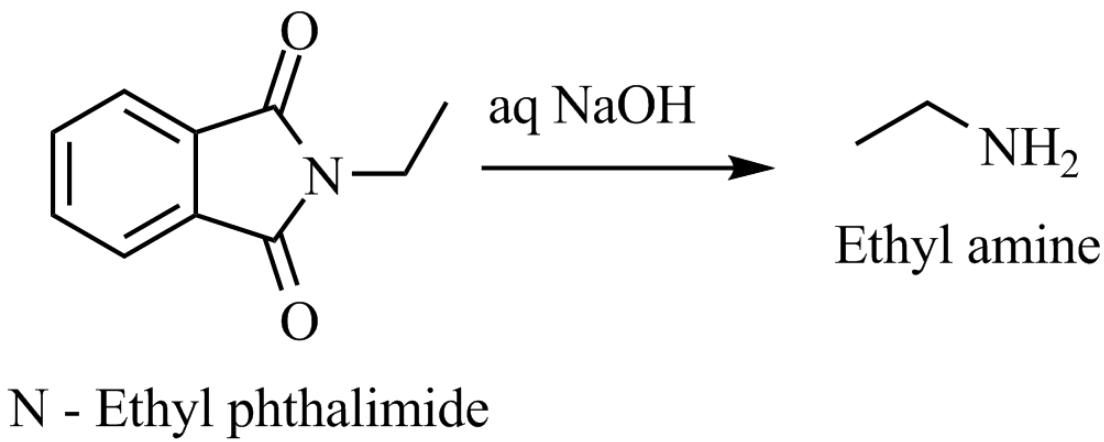
N − Ethyl pthalimide on hydrolysis gives:
  • A
    Methyl alcohol
  • B
    Ethyl amine
  • C
    Dimethyl amine
  • D
    Diethyl amine
Answer
  1. Ethyl amine

Explanation:

The alkaline hydrolysis of N - ethylpthalimide gives ethyl amine.

View full question & answer
MCQ 91 Mark
Which of the following is an Incorrect statement about benzenediazonium chloride?
  • A
    It is prepared by the reaction of aniline with nitrous acid at 273 - 278K.
  • B
    It is a colourless crystalline solid.
  • C
    Alkyl diazonium salts are more stable than arenediazonium salts.
  • D
    Benzene diazonium fluoroborate is water insoluble & stable at room temperature.
Answer
  1. Alkyl diazonium salts are more stable than arenediazonium salts.
View full question & answer
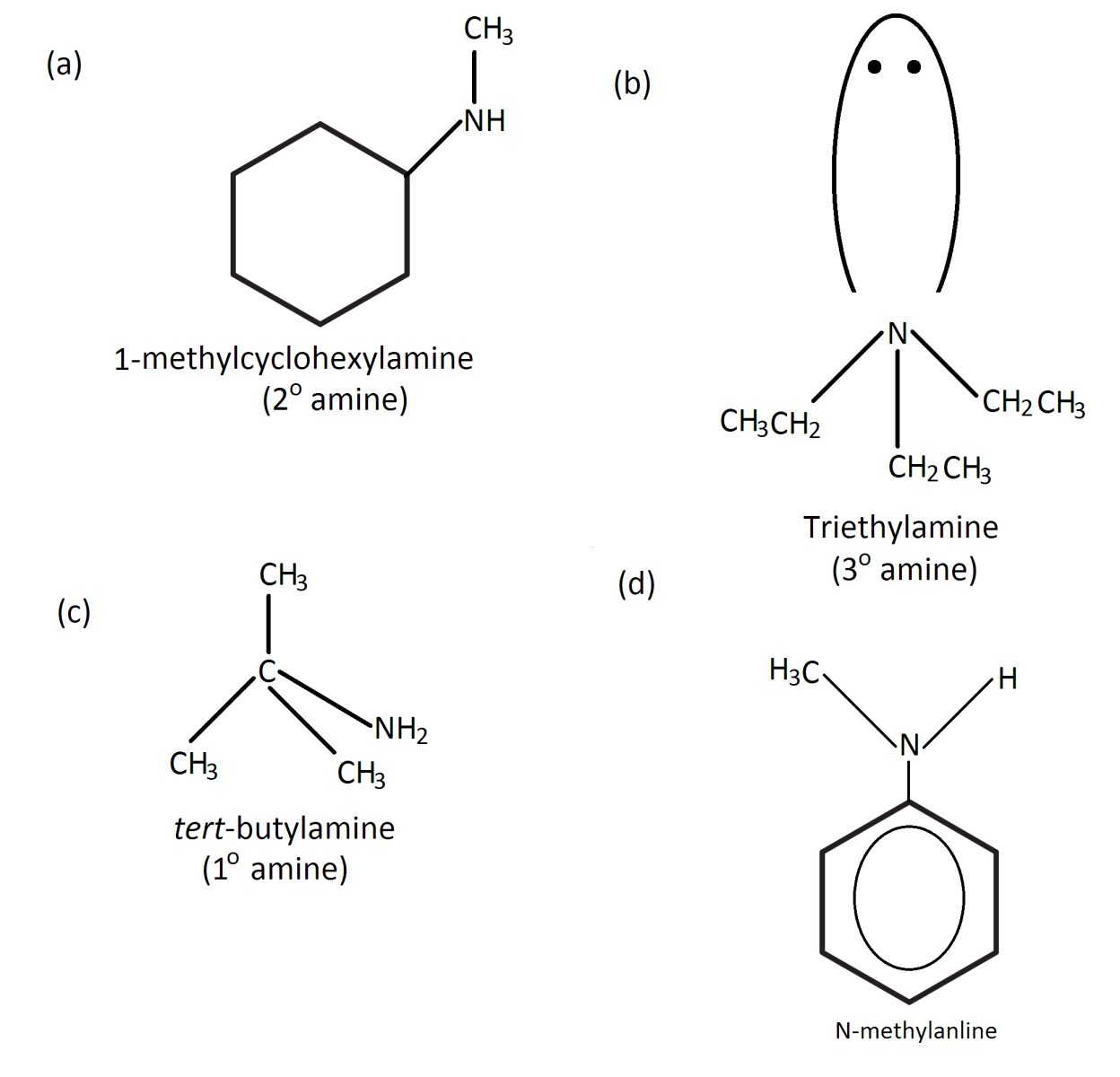
MCQ 101 Mark
Which of the following is a 3° amine?
  • A
    1-methylcyclohexylamine.
  • B
    Triethylamine.
  • C
    tert-butylamine.
  • D
    N-methylaniline.
Answer
  1. Triethylamine.

Explanation:

The structure of given amines are as follows:

View full question & answer
MCQ 111 Mark
Which of these alkyl halides can be used to prepare amines using Gabriel phthalimide synthesis?
  • A
    Vinyl bromide
  • B
    1 - bromo - 3 - methylpentane
  • C
    Bromobenzene
  • D
    2 - bromo - 2, 3 - dimethylbutane
Answer
  1. 1 - bromo - 3 - methylpentane
View full question & answer
MCQ 121 Mark
Amines are the derivatives of:
  • A
    Acids
  • B
    Ammonia
  • C
    Alkanes
  • D
    Esters
Answer
  1. Ammonia

Explanation:

Amines are derivative  of ammonia, wherein one or more hydrogen atoms have been replaced by a substituent such as an alkyl or aryl group (these may respectively be called alkylamines and arylamines; in which both types of substituent are attached to one nitrogen atom may be called alkylarylamines).

View full question & answer
MCQ 131 Mark
Amongst the given set of reactants, the most appropriate for preparing 2°amine is _____.
  • A
    2° R-Br + NH3.
  • B
    2° R-Br + NaCN followed by H2/Pt.
  • C
    1° R-NH2 + RCHO followed by H2/Pt.
  • D
    1° R-Br (2 mol) + potassium phthalimide followed by H3O+/heat.
Answer
  1. 1° R-NH2 + RCHO followed by H2/Pt.

Explanation:

$\text{R}-\text{NH}_2+\text{O}=\text{HCR}\xrightarrow[\text{animation}]{\text{Reductive}}\text{R}-\text{N}=\text{CHR}\xrightarrow[\text{Reductiion}]{\text{H}_2/\text{pt}}\text{RNH}-\text{CH}_2\text{R}$

View full question & answer
MCQ 141 Mark
Which of the following compound gives secondary amine on reduction?
  • A
    Alkyl nitrile
  • B
    Carbylamine
  • C
    Primary amine
  • D
    Secondary nitro compound
Answer
  1. Carbylamine

Explanation:

Here carbylamine is given secondary amine.

View full question & answer
MCQ 151 Mark
Amongest the following the most basic compound is:
  • A
    p - nitro aniline
  • B
    Acetanilide
  • C
    Aniline
  • D
    Benzylamine
Answer
  1. Benzylamine
View full question & answer
MCQ 161 Mark
Which of the following is the IUPAC name of the compound in which one hydrogen of ammonia is replaced by an ethyl group?
  • A
    Ethylamine
  • B
    Aminoethane
  • C
    Ethanamine
  • D
    Ethane amine
Answer
  1. Ethanamine

Explanation:

Ethylamine and aminoethane are the names of CH3CH2NH2 according to the common system and second system respectively.

In the IUPAC system, the naming is done by replacing the ‘e’ of the alkane by amine.

View full question & answer
MCQ 171 Mark
Benzylamine may be alkylated as shown in the following equation:
$\text{C}_6\text{H}_5\text{CH}_2\text{NH}_2+\text{R}-\text{X}\xrightarrow{\ \ \ \ \ \ \ \ }\text{C}_6\text{H}_5\text{CH}_2\text{NHR}$
Which of the following alkylhalides is best suited for this reaction through SN1 mechanism?
  • A
    CH3Br
  • B
    C6H5Br
  • C
    C6H5CH2Br
  • D
    C2H5Br
Answer
  1. C6H5CH2Br

Explanation:

SN1 reaction proceeds through the formation of carbocation since in C6H5CH2Br benzyl carbocation is formed which is stabilized by resonance.

View full question & answer
MCQ 181 Mark
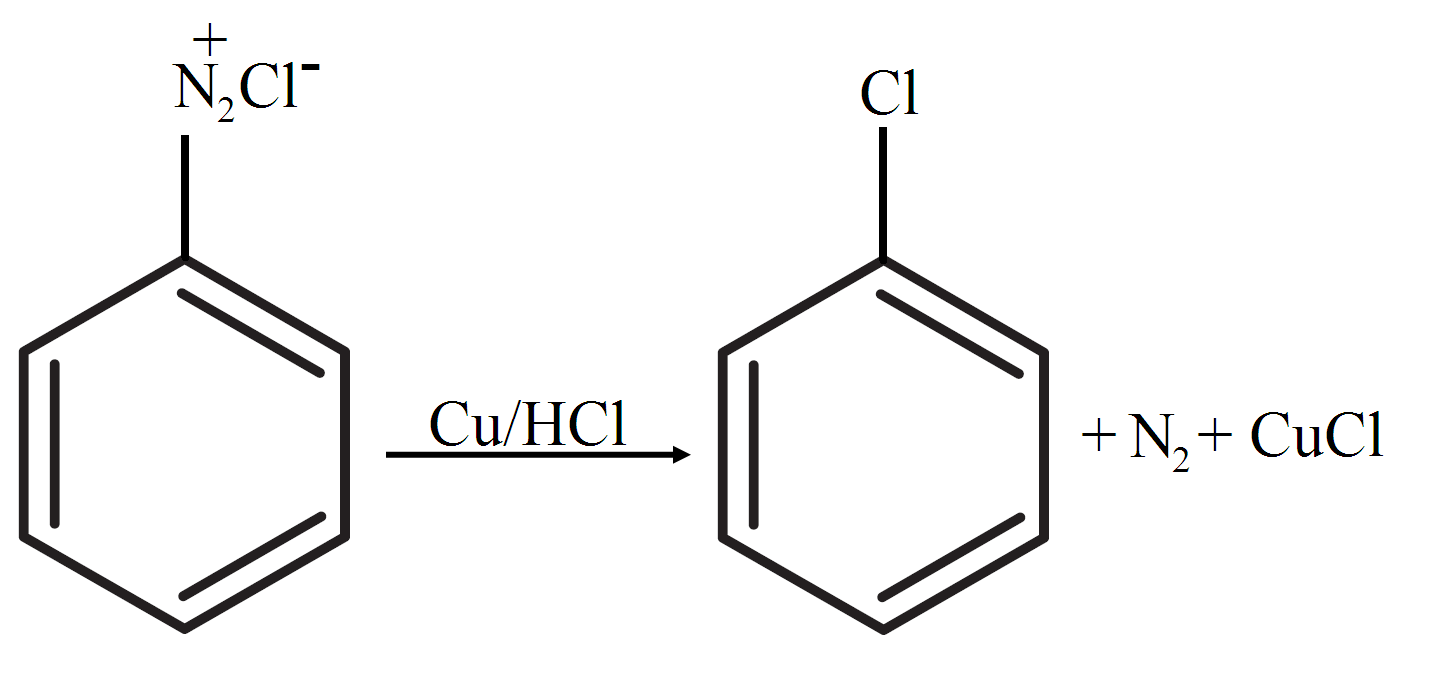
The reaction $\text{Ar}\stackrel{+}{\hbox{N}_2}\text{Cl}^-\xrightarrow{\ \ \text{Cu/HCl}\ \ \ }\text{ArCl}+\text{N}_2+\text{CuCl}$ is named as:
  • A
    Sandmeyer reaction.
  • B
    Gatterman reaction.
  • C
    Claisen reaction.
  • D
    Carbylamine reaction.
Answer
  1. Gatterman reaction.

Explanation:

is named Gatterman reaction.

View full question & answer
MCQ 191 Mark
Aromatic amines are insoluble in water because:
  • A
    Due to the larger hydrocarbon part which tends to retard the formation of H - bonds.
  • B
    Due to the larger hydrocarbon part which tends to retard the formation of H - Nbonds.
  • C
    Due to the larger hydrocarbon part which tends to retard the formation of H - Cbonds.
  • D
    None of these
Answer
  1. Due to the larger hydrocarbon part which tends to retard the formation of H - bonds.

Explanation:

Aromatic amines are insoluble in water because of large hydrocarbon part (hydrophobic) part which retards the formation of H - bonding.


View full question & answer
MCQ 201 Mark
Which of the following species are involved in the carbylamine test?
  • A
    R-NC
  • B
    CHCl3
  • C
    COCl2
  • D
    NaNO2 + HCl
Answer
  1. R-NC
  2. CHCl3

Explanation:

Carbylamine reaction: Amine on reaction with a mixture of CHCl3 and KOH produces alkyl isocyanate.

R-NH2 + CHCl + 3KOH- → RNC + 3KCl + 3H2O Only RNC and CHCl3 are involved in carbylamine reaction.

View full question & answer
MCQ 211 Mark
Aromatic amines are generally:
  • A
    Pleasant in smell.
  • B
    Toxic in nature.
  • C
    Low melting solids.
  • D
    None of these.
Answer
  1. Toxic in nature.

Explanation:

Aromatic amines are

  1. Less basic
  2. Lone pair of N involve in ring resonance
  3. Are toxic in nature.
View full question & answer
MCQ 221 Mark
How many lone pairs of electrons does the nitrogen atom of amines have?
  • A
    0
  • B
    1
  • C
    2
  • D
    3
Answer
  1. 1

Explanation:

The nitrogen of NH3 forms sp3 hybridised orbitals and also a valency of three (as it is attached to three hydrogen atoms).

This results is one the orbitals having a lone pair of electrons, resulting in one unshared electron pair on nitrogen.

View full question & answer
MCQ 231 Mark
Which of the following is the most suitable classification for C6H5NHCH3?
  • A
    Tertiary amine
  • B
    Aliphatic amine
  • C
    Arylalkyl amine
  • D
    Mixed amine
Answer
  1. Mixed amine

Explanation:

In the given amine, there are two substituents, one methyl group and one phenyl group.

Hence, it is a secondary aryl amine and since both the substituent groups are different, it is a mixed amine.

View full question & answer
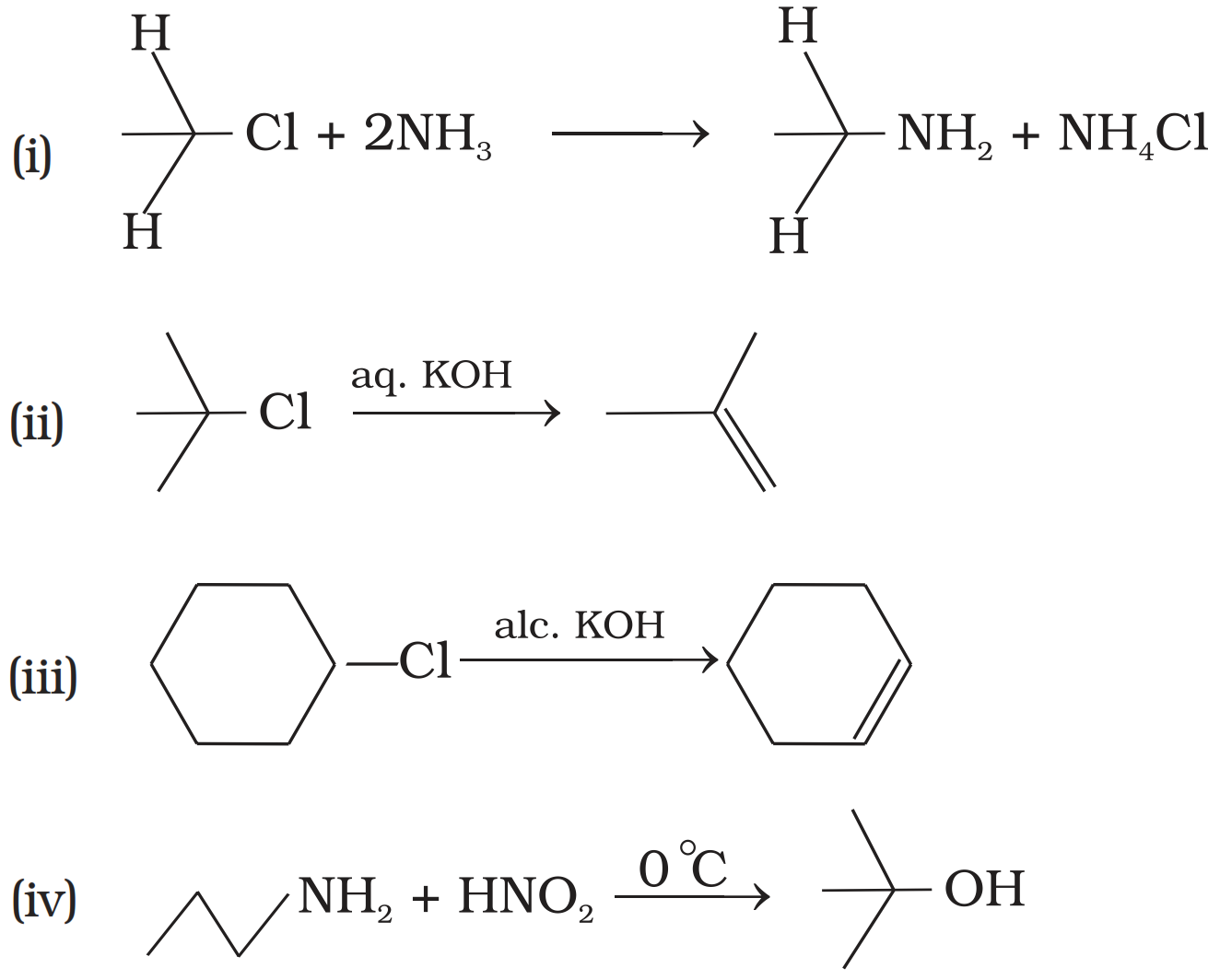
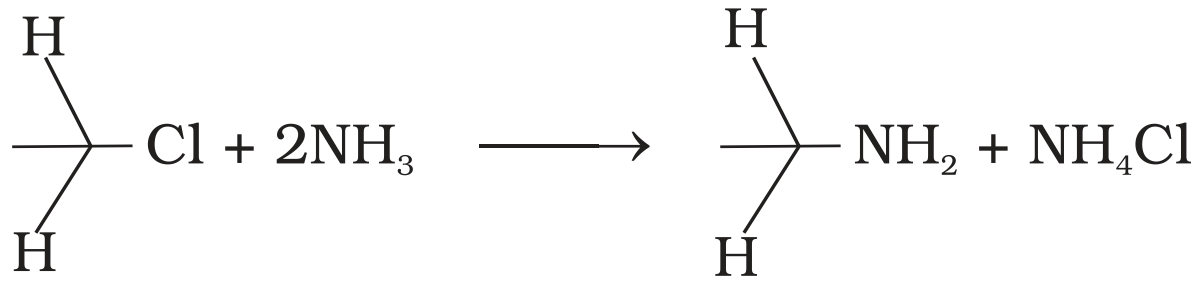
Question 241 Mark
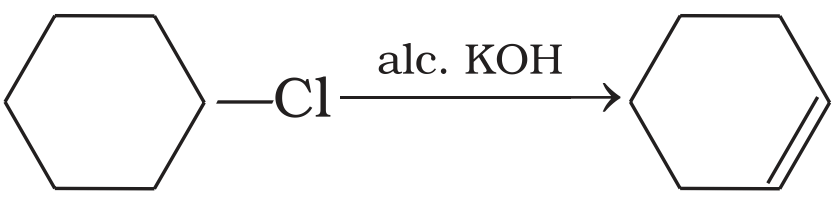
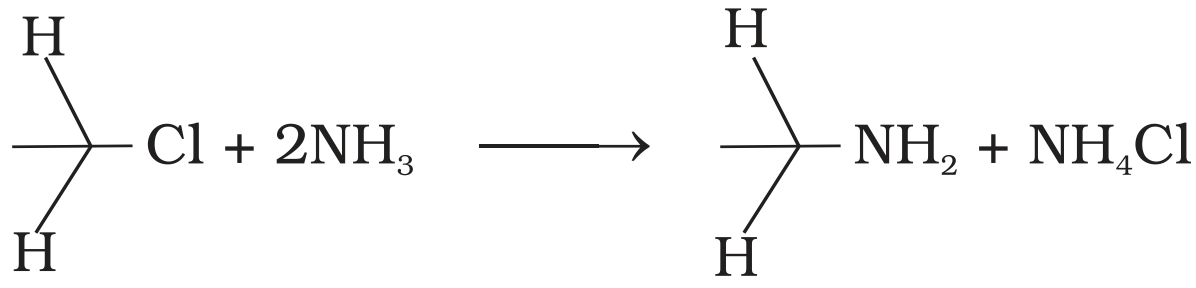
Which of the following reactions are correct?

Answer
  1.  

Explanation:

  1.  

(i) Is a nucleophilic substitution reaction.

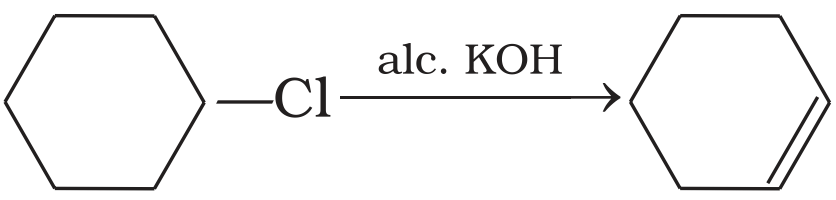
(iii) Is an elimination reaction.

View full question & answer
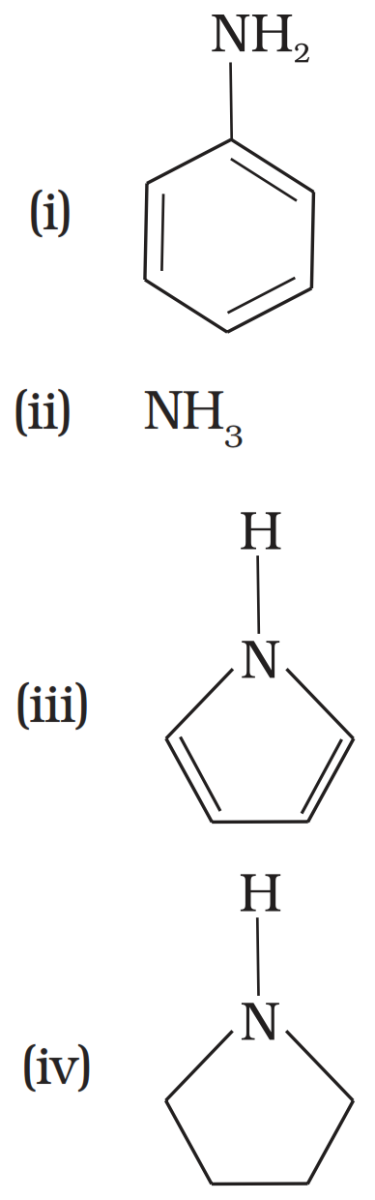
Question 251 Mark
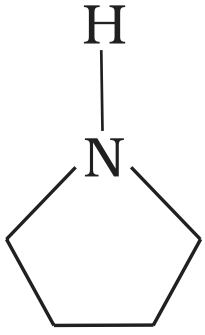
Among the following amines, the strongest Bronsted base is __________.

Answer
  1.  

Explanation:

Aniline is weaker base than NH3 due to delocalization of lone pair of electrons on the N-atom into the benzene ring. Pyrrole (c) is not at all basic because the lone pair of electrons on N-atom is donated towards aromatic sextet formation. Therefore, pyrrolidine (d) has a strong tendency to accept a proton and is hence, the strongest base.
View full question & answer
MCQ 261 Mark
When two alkyl groups are attached to the nitrogen atom in an amine, it is known as a _______ amine.
  • A
    Primary
  • B
    Secondary
  • C
    Tertiary
  • D
    Aromatic
Answer
  1. Secondary

Explanation:

Amines are classified as secondary or 2° when two of the hydrogen atoms of ammonia are replaced by an alkyl group and the third H remains attached as it is.

View full question & answer
MCQ 271 Mark
Which of the following should be most volatile?

  • A
    II.
  • B
    IV.
  • C
    I.
  • D
    III.
Answer
  1. IV.

Explanation:

1° and 2° amines have higher boiling points due to intermolecular H-bonding (and hence less volatile than 3° amines and hydrocarbons of comparable molecular mass).

View full question & answer
Question 281 Mark
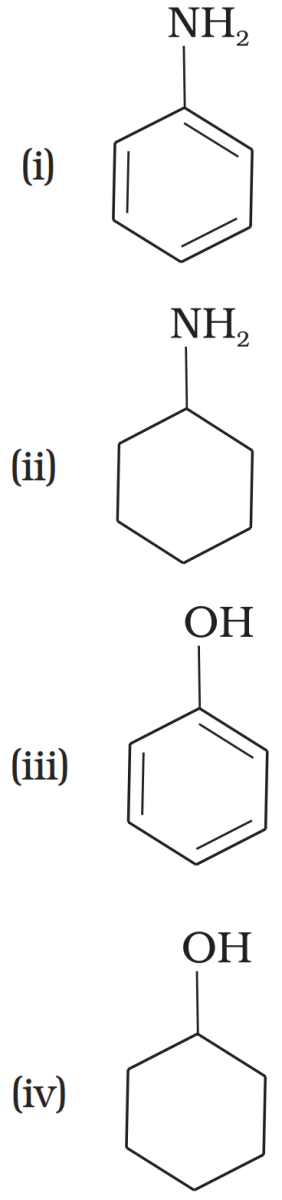
Which of the following compounds is the weakest Brönsted base?

Answer
​ii

Explanation:

Phenol is the weakest Bronsted base as it is the strongest acid among the four choices given above. Stronger the acid weaker is its conjugate base.

View full question & answer
Question 291 Mark
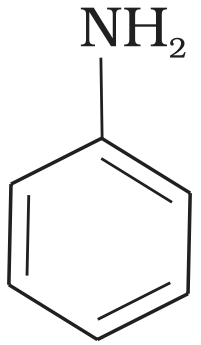
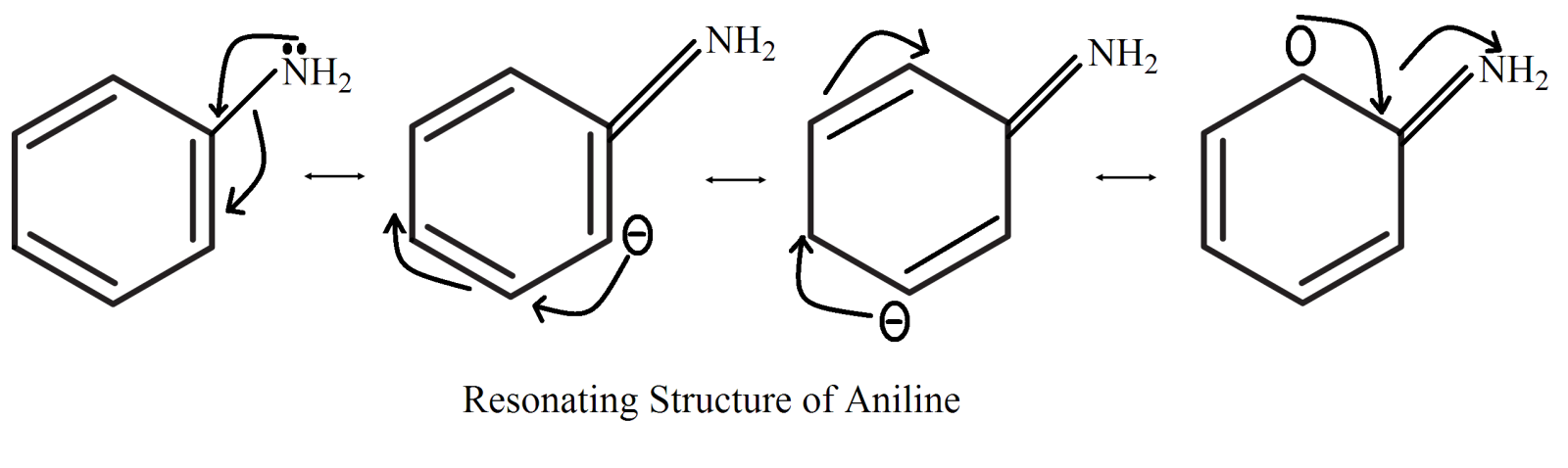
Which of the following is the weakest Brönsted base?

Answer
  1.  

Explanation:

Due to delocalization of lone pair of electrons on the N-atom into the benzene ring, C6H5NH2 is the weakest base.
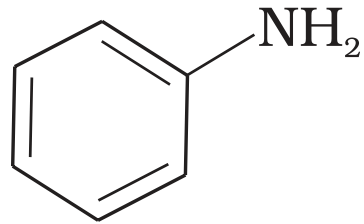
Resonating Structure of Aniline.

View full question & answer
Question 301 Mark
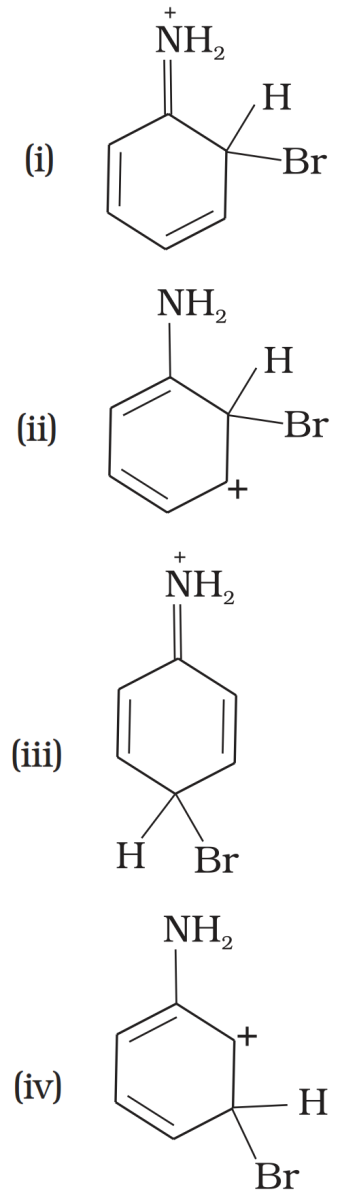
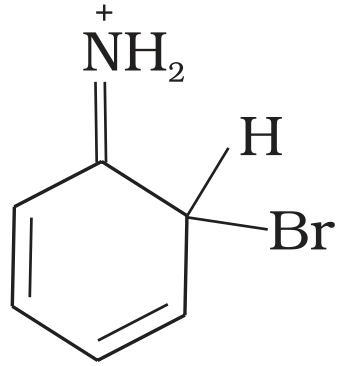
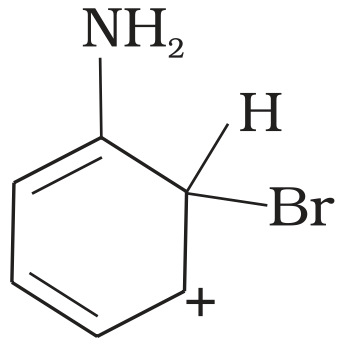
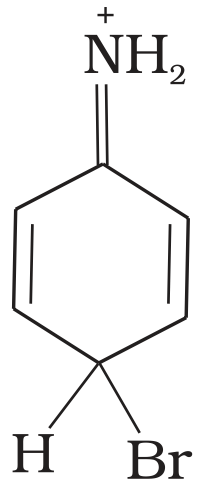
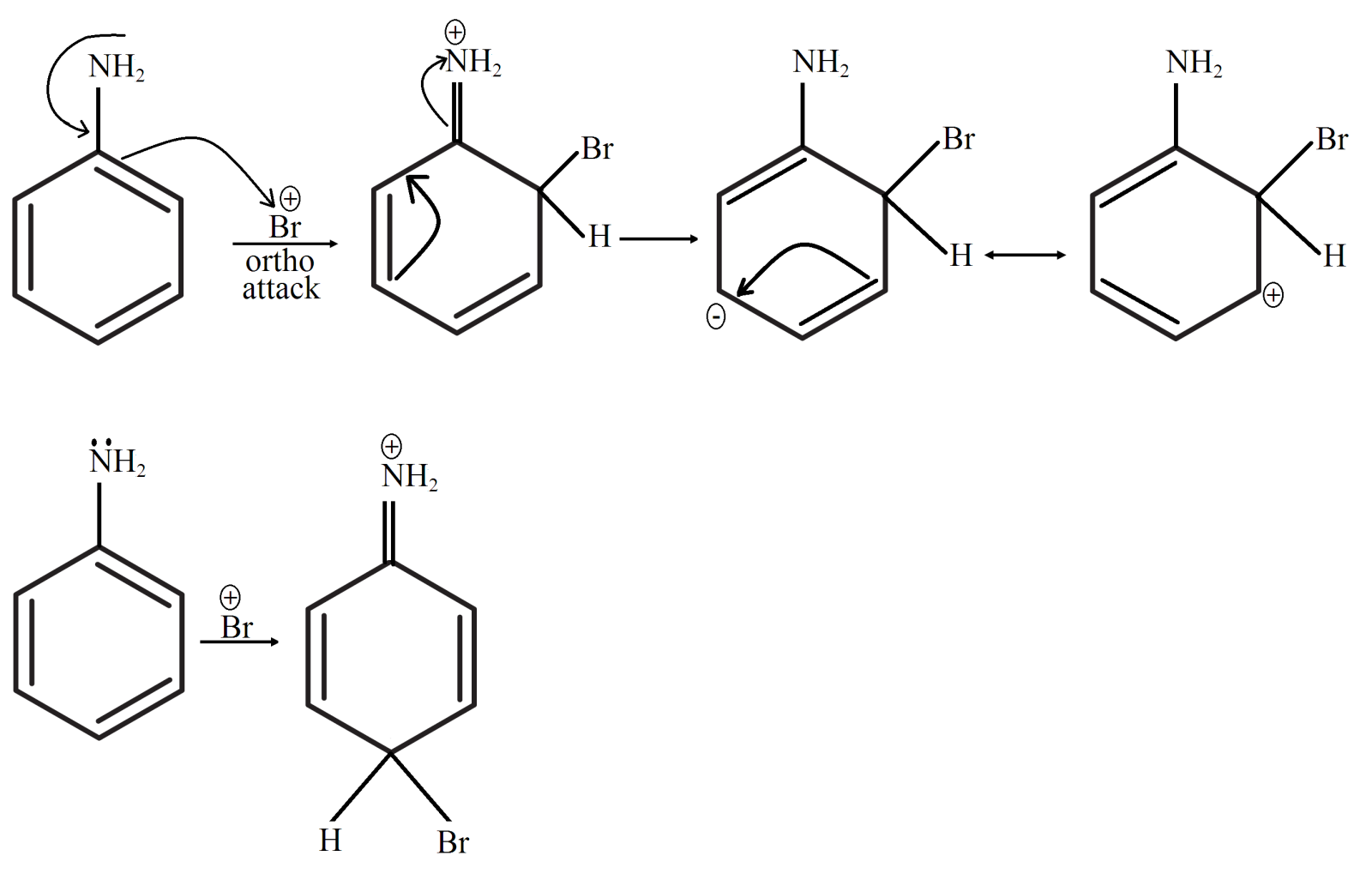
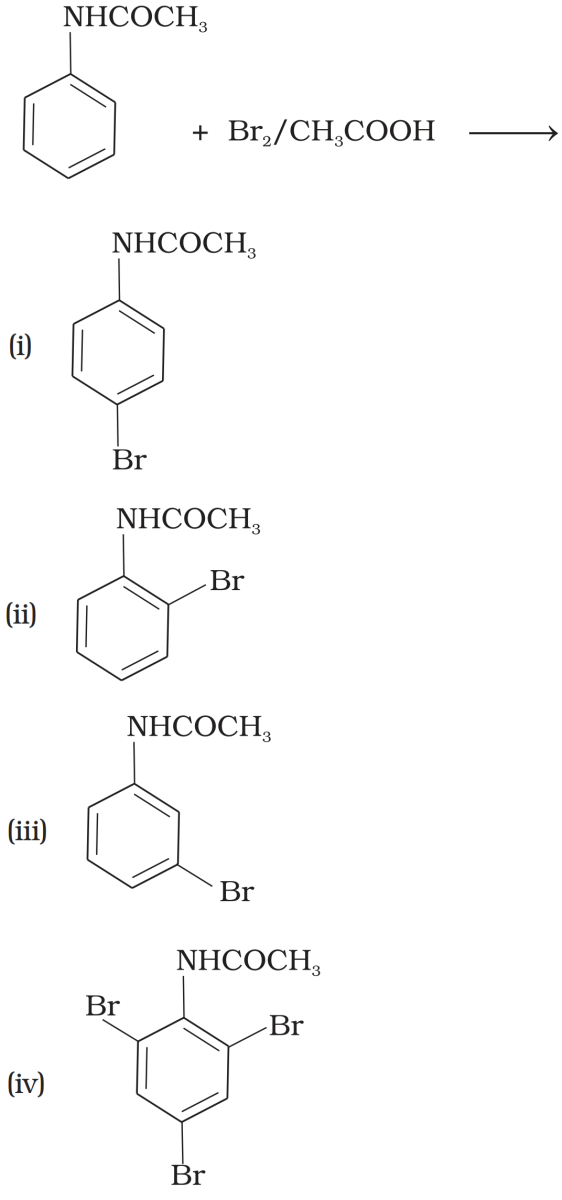
Arenium ion involved in the bromination of aniline is __________.

Answer
  1.  

  1.  

  1.  

Explanation:

Arenium ion involved in the bromination of aniline are as follows:

View full question & answer
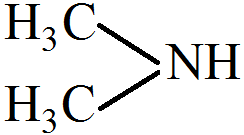
Question 311 Mark
The most reactive amine towards dilute hydrochloric acid is __________.

Answer
  1.  

​​​​​​​Explanation:

The greater will be the strength of base, the greater will be its reactivity towards dilute HCl. Hence, (CH3)2NH has the highest basic strength as it has the highest reactivity.

View full question & answer
MCQ 321 Mark
By the presence of a halogen atom in the ring, basic properties of aniline is:
  • A
    Increased
  • B
    Decreased
  • C
    Unchanged
  • D
    Doubled
Answer
  1. Increased

Explanation:

By the presence of a halogen atom in the ring, basic properties of aniline is increased because it is more electronegative so donation of electron will be easy, so basicity increases.

View full question & answer
MCQ 331 Mark
Which of the following amines can be prepared by Gabriel synthesis.
  • A
    Isobutyl amine.
  • B
    2-Phenylethylamine.
  • C
    N-methylbenzylamine.
  • D
    Aniline.
Answer
  1. Isobutyl amine.
  2. 2-Phenylethylamine.

Explanation:

Only primary aliphatic amines such as (a) (CH3)2CH-CH2NH2 and C6H5CH2NH2 (b) can be prepared by Gabriel synthesis. 2° amines, i.e., C6H5CH2NHCH3 (C) and 1° amine, C6H5NH2 (d), however, cannot be prepared.

View full question & answer
MCQ 341 Mark
In coupling reactions, diazonium ion acts as:
  • A
    Nucleophile
  • B
    Electrophile
  • C
    Solvent
  • D
    None of the above 
Answer
  1. Electrophile

Explanation:

In coupling reaction, diazonium ion acts as electrophile because in diazonium salt +ve charge is there on nitrogen and thus nitrogen is electron deficient.

View full question & answer
MCQ 351 Mark
Which of the following statements is correct?
  • A
    Methyl amine is slightly acidic.
  • B
    Methyl amine is less basic than ammonia.
  • C
    Methyl amine is less basic than dimethyl amine.
  • D
    Methyl amine is less basic than aniline.
Answer
  1. Methyl amine is less basic than dimethyl amine.

Explanation:

Dimethyl amine (Me2​NH) is more basic than MeNH2​, due to (+I) effect of two (Me) groups.

View full question & answer
MCQ 361 Mark
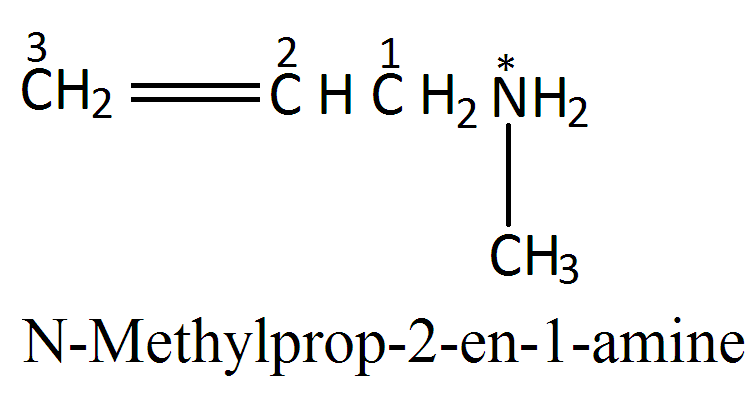
The correct IUPAC name for $\text{CH}_2=\text{CHCH}_2\text{NHCH}_3$ is:
  • A
    Allylmethylamine.
  • B
    2-amino-4-pentene.
  • C
    4-aminopent-1-ene.
  • D
    N-methylprop-2-en-1-amine.
Answer
  1. N-methylprop-2-en-1-amine.

Explanation:

View full question & answer
MCQ 371 Mark
The diazonium salts are the reaction product in presence of excess of mineral acid with nitrous acid and:
  • A
    Primary aliphatic amine
  • B
    Secondary aromatic amine
  • C
    Primary aromatic amine
  • D
    Tertiary alipathic amine
Answer
  1. Primary aromatic amine

Explanation:

The diazonium salts are the reaction product in presence of excess of mineral acid with nitrous acid and primary aromatic amine. 

View full question & answer
MCQ 381 Mark
Aniline is soluble in which of the following organic reagents?
  • A
    Benzene
  • B
    Ether
  • C
    Alcohol
  • D
    All of above
Answer
  1. All of above

Explanation:

Aniline is soluble in, all organic solvents like alchol ether and benzene this is because of low polarity in amines and not a stronger intermolecular H - bonding in itself.

View full question & answer
MCQ 391 Mark
the gas evolved when Methylamine reacts with nitrous acid is __________.
  • A
    NH3
  • B
    N2
  • C
    H2
  • D
    C2H6
Answer
  1. N2

Explanation:

Primary aliphatic amines react with nitrous acid to form aliphatic diazonium salts which being unstable, liberate nitrogen gas quantitatively and alcohol.

View full question & answer
MCQ 401 Mark
Methylamine reacts with HNO2 to form __________.
  • A
    CH3-O-N=O
  • B
    CH3-O-CH3
  • C
    CH3OH
  • D
    CH3CHO
Answer
  1. CH3OH

Explanation:

$\text{R}-\text{NH}_2+\text{HNO}_2\xrightarrow{\ \ \ \ \text{NaNO}_2+\text{HCI}\ \ \ }[\text{R}-\stackrel{+}{\hbox{N}}_2\text{C}\stackrel{-}{\hbox{l}}]\xrightarrow{\ \ \text{H}_2\text{O}\ \ }\text{ROH}+\text{N}_2+\text{HCl}$

View full question & answer
MCQ 411 Mark
Amines are more basic than:
  • A
    Alcohols
  • B
    Ethers
  • C
    Esters
  • D
    All of these
Answer
  1. All of these

Explanation:

-OH, -COOR, -COC group

View full question & answer
MCQ 421 Mark
Benzyl amine is............. basis than aniline while ethyl amine is..............basis than diethyl amine 
  • A
    More, less
  • B
    Less, more
  • C
    Both
  • D
    None 
Answer
  1. More, less

Explanation:

Benzyl amine is more basic than anniline.

while ethyl amine is less basic than diethyl amine.

View full question & answer
MCQ 431 Mark
Which of the following compounds has the lowest boiling point?
  • A
    2 - propanamine
  • B
    Ethylmethylamine
  • C
    1 - propanamine
  • D
    N, N - dimethylmethanamine
Answer
  1. N, N - dimethylmethanamine

Explanation:

N, N - dimethylmethanamine will have the lowest boiling points as it cannot form hydrogen bonds. 

Other amines can form hydrogen bonds and have higher boiling points.

View full question & answer
MCQ 441 Mark
A mixture containing primary, secondary and tertiary amine is treated with diethyl oxalate. Choose the correct statement:
  • A
    The distillate of the mixture after treatment mainly contains 1° amines.
  • B
    Tertiary amine do not react with diethyl oxalate.
  • C
    This is Hinsberg method of separating 1°, 2° and 3° amines.
  • D
    3° amine is removed by filtration.
Answer
  1. Tertiary amine do not react with diethyl oxalate.


View full question & answer
MCQ 451 Mark
Number of isomeric primary amines obtained from C4​H11​N are:
  • A
    3
  • B
    4
  • C
    5
  • D
    6
Answer
  1. 4

Explanation:

The possible isomers are

CH3​CH2​CH2​CH2​NH2

(CH3​)2​ − CH − CH2​NH2

(CH3​)3 ​− NH2​

CH3 ​− CH(NH2​)CH2​ − CH3​

View full question & answer
MCQ 461 Mark
Amongst the following, the strongest base in aqueous medium is ____________.
  • A
    CH3NH2
  • B
    NCCH2NH2
  • C
    (CH3)2NH
  • D
    C6H5NHCH3
Answer
  1. (CH3)2NH

Explanation:

Due to the electron releasing nature of alkyl group, it (R) pushes electrons towards nitrogen and thus makes the unshared electron pair more available for sharing with the proton of the acid. Moreover, the substituted ammonium ion formed from the amine gets stabilised due to dispersal of the positive charge by the +I effect of the alkyl group. Hence, alkylamines are stronger bases than ammonia.

Thus, the basic nature of aliphatic amines should increase with increase in the number of alkyl groups.

View full question & answer
MCQ 471 Mark
Gabriel's phthalimide synthesis is used for the preperation of:
  • A
    Primary aromatic amine
  • B
    Secondary acid
  • C
    Primary aliphatic amine
  • D
    Tertiary amine
Answer
  1. Primary aromatic amine

Explanation:

Gabriel phthalimide synthesis is used for the preparation of aliphatic primary amines. Since ethanamine is the only primary amine among the given compounds,

View full question & answer
MCQ 481 Mark
Which of the following is not a classification of amines?
  • A
    Primary
  • B
    Secondary
  • C
    Tertiary
  • D
    Quaternary
Answer
  1. Quaternary

Explanation:

Amines may be classified as primary, secondary or tertiary depending on whether 1, 2 or 3 hydrogen atoms of NH3 are replaced by alkyl/aryl groups respectively.

Quaternary ammonium compounds are a different class of compounds where all four hydrogen atoms of ammonium salts are replaced by alkyl/aryl groups.

View full question & answer
MCQ 491 Mark
Among the following which is not correct?
  • A
    P methyl benzyl carbonyl is more stable than ethyl benzyl carbonyl.
  • B
    Aniline is more basic than pyridine.
  • C
    Cyclopentadienyl anion is more stable than cyclopentadienyl Carbo cation.
  • D
    K of Ethene 1 ol is more than that of propene 2 en 1 ol.
Answer
  1. Aniline is more basic than pyridine.
View full question & answer
MCQ 501 Mark
The test used to distinguish primary, secondary and tertiary amines is:
  • A
    Sandmayer's reaction
  • B
    Carbylamine reaction
  • C
    Mustard oil test
  • D
    C6​H5​SO2​Cl
Answer
  1. C6​H5​SO2​Cl
View full question & answer
M.C.Q [1M] - Chemistry STD 12 Science Questions - Vidyadip