Questions

4 Marks Questions

🎯

Test yourself on this topic

7 questions · timed · auto-graded

Question 14 Marks
Explain colour in coordination compounds.
Answer
→ One of the most distinctive properties of transition metal complexes is their wide range of colours.
→ This means that some of the visible spectrum is being removed from white light as it passes through the sample, so the light that emerges is no longer white.
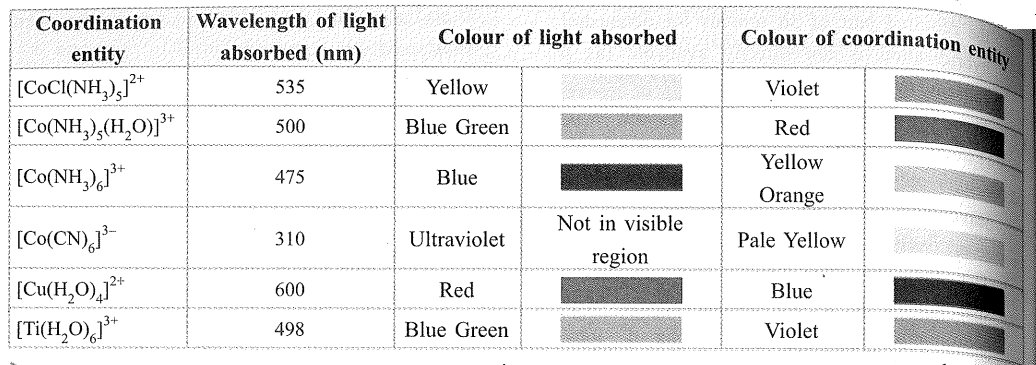
→ The colour of the complex is complementary to that which is absorbed.
→ The complementary colour is the colour generated from the wavelength left over; if green light is absorbed by the complex, it appears red.
Relationship between the Wavelength of Light absorbed and the Colour observed in some Coordination Entities
Image
→ The colour in the coordination compounds can be readily explained in terms of the crystal field theory.
→ Consider, for example, the complex $\left[ Ti \left( H _2 O \right)_6\right]^{3+}$, which is violet in colour.
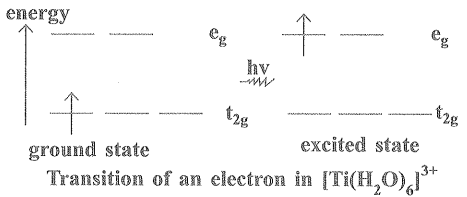
→ This is an octahedral complex where the single electron $\left( Ti ^{3+}\right.$ is a $3 d^1$ system $)$ in the metal d orbital is in the $t_{2 g}$ level in the ground state of the complex.
→ The next higher state available for the electron is the empty $e _{ g }$ level. If light corresponding to the energy of blue green region is absorbed by the complex, it would excite the electron from $t_{2 g}$ level to the e $e _{ g }$ level $\left( t _{2 g}^1 e _{ g }^{\circ} \rightarrow i _{2g}^{\circ} e _g^1\right)$
→ Consequently, the complex appears violet in colour
Image
→ The crystal field theory attributes the colour of the coordination compounds to d-d transition of the electron.
→ It is important to note that in the absence of ligand, crystal field splitting does not occur and hence, the substance is colourless.
→ For example, removal of water from $\left[ Ti \left( H _2 O \right)_6\right] Cl _3$ on heating renders it colourless.
→ Similarly, anhydrous $CuSO _4$ is white, but $CuSO _4 \cdot 5 H _2 O$ is blue in colour.
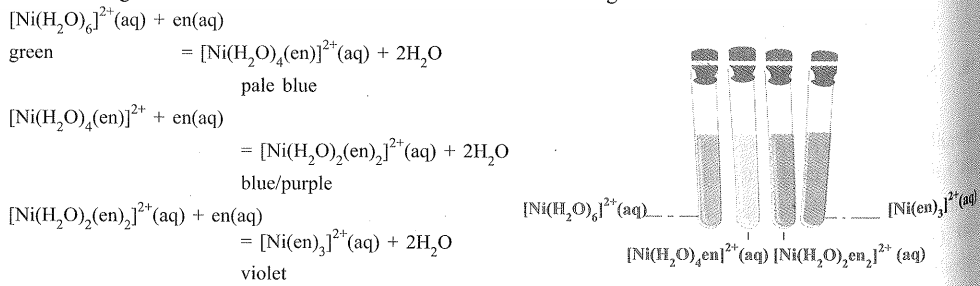
→ The influence of the ligand on the colour of a complex may be illustrated by considering the $\left[ Ni \left( H _2 O \right)_6\right]^{+2}$ complex, which forms when nickel(II) chloride is dissolved in water.
→ If the didentate ligand, ethane-1,2-diamine(en) is progressively added in the molar ratios en:Ni, 1:1, 2:1, 3:1, the following series of reactions and their associated colour changes occur :
Image

View full question & answer
Question 24 Marks
Discuss the nature of bonding in$\left.[CoF _6\right]^{3-}$ coordination entities on the basis of valence bond theory.
Answer
→ In $\left[ CoF _6\right]^{3-}$ oxidation state of cobalt is +3
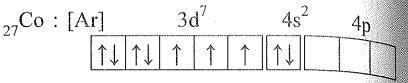
→ Electronic configuration of cobalt in ground state.
Image
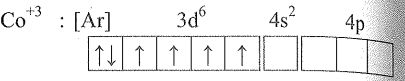
→ Electronic configuration of cobalt in +3 oxidation state.
Image
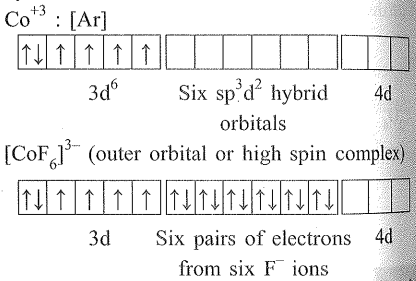
→ F- is weak ligand so 3d orbital does not take place in hybridization
→ In this complex 4d orbital hybridize. So sp3d2 hybridization occurs.
Image
→ The paramagnetic octahedral complex, $\left[ CoF _6\right]^{3-}$ uses outer orbital ( 4 d$)$ in hybridization ( $sp ^3 d^2$ ), It is thus called outer orbital or high spin of spin free complex.
$
\begin{aligned}
\text → { Magnetic Moment } (\mu) & =\sqrt{n(n+2)} \\
&=\sqrt{4(4+2)} \\
& =\sqrt{24} \text { B.M. }
\end{aligned}
$
View full question & answer
Question 34 Marks
Discuss the nature of bonding in [Co(NH3)6]3+ coordination entities on the basis of valence
bond theory
Answer
→ In [Co(NH3)6]3+ ion oxidation number of cobalt is +3.
→ Electronic configuration of cobalt in ground state.
Image
→ Electronic configuration of cobalt in +3 oxidation state.
Image
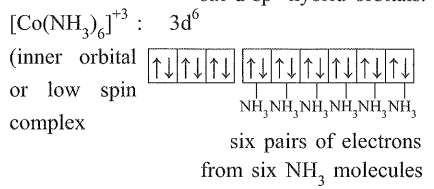
→ NH3 is strong ligand so electrons get paired in d-orbital and d2sp3 hybridization occurs.
Image
six d²sp³ hybrid orbitals
Image
→ Six pairs of electrons, one from each NH3 molecule, occupy the six hybrid orbitals.
→ Thus, the complex has octahedral geometry and is diamagnetic because of the absence of unpaired electron.
→ In the formation of this complex, since the inner d orbital (3d) is used in hybridization, the complex, $\left[ Co \left( NH _3\right)_6\right]^{3+}$ is called an inner orbite or low spin or spin paired complex.
View full question & answer
Question 44 Marks
Explain geometrical isomerism in octahedral Complex.
Answer
→ This type of isomerism arises in heteroleptic complexes due to different possible geometric arrangements of the ligands.
→ Important examples of these behaviour are found with coordination numbers 4 and 6.
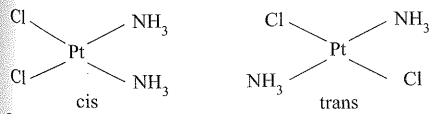
→ In a square planar complex of formula [MX2L2] (X and L are unidentate), the two ligands X may be arranged adjacent to each other in a cis isomer, or opposite to each other in a trans isomer.
Image
Geometrical isomers (cis and trans) of Pt[(NH3)2Cl2]
→ Other square planar complex of the type MABXL (where A, B, X, L are unidentates) shows three isomers-two cis and one trans.
→ Such isomerism is not possible for a tetrahedral geometry.
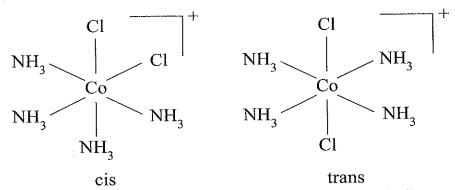
→ In octahedral complexes of formula [MX2L4] in which the two ligands X may be oriented cis or trans to each other
Image
Geometrical isomers (cis and trans) of [Co(NH3)4Cl2]+
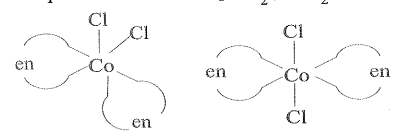
→ This type of isomerism also arises when didentate ligands L-L [e.g., en ] are present in complexes of formula [MX2(L-L)2]
Image
Geometrical isomers (cis and trans) of [CoCl2(en)2]
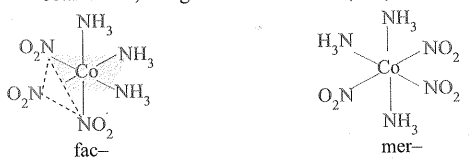
→ Another type of geometrical isomerism occurs in octahedral coordination entities of the type [Co(NH3)3(NO2)3].
→ If three donor atoms of the same ligands occupy adjacent positions at the corners of an octahedral face, it forms the facial (fac) isomer.
→ When the positions are around the meridian of the octahedron, we get the meridional (mer) isomer.
Image
The facial (fac) and meridional (mer) isomers of [Co(NH3)3(NO2)3]
View full question & answer
Question 54 Marks
What is ligand? Explain classification of ligand.
Answer
→ "Ligands are atom or ions which donates electron pairs to the central metal ion."
(OR)
→ "The ions or molecules bound to the central atom/ion in the coordination entity are called ligands."
→ These may be simple ions such as Cl, small molecules such as H2O or NH3, larger molecules such as H2NCH2CH2NH2 or N(CH2CH2NH2)3 or even macromolecules, such as proteins.
Classification of Ligands:
(1) Unidentate ligands:
→ "When a ligand is bound to a metal ion through a single donor atom, the ligand is said to be unidentate."
Example :
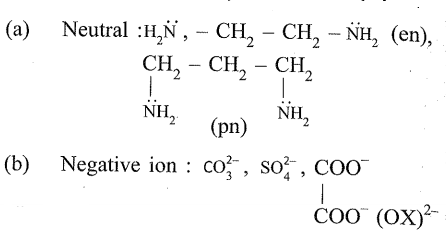
(a) Neutral: $H _2 \ddot{ O }$, : $NH _3,: CO ,: NO , CH _3 \ddot{N}H_2, C _5 H _5\ddot{N}$ (py)
(b) Negative ion: ${ }^{-} OH , F ^{-}, Cl ^{-}, Br ^{-}, I^{-} ,{ }^{-} CN , {}^{-}NH_2,$ $NO _3^{-}, NO _2^{-}, NCH _3 COO ^{-}\left( AcO ^{-}\right), O ^{2-}, S ^2, N^{3-}$
(2) Didentate ligands:
→ "When a ligand is bound to a metal ion through a two donor atom, the ligand is said to be didentate ".
Image
(3) Tridentate ligands:
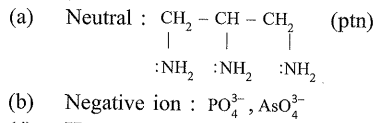
→ "When a ligand is bound to a metal ion through a three donor atom, the ligand is said to be Tridentate,"
Example:
Image
(4) Hexadentate ligands:
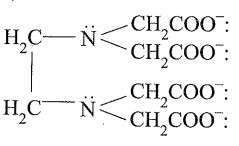
→ When a ligand is bound to a metal ion through a six donor atom, the ligand is said to be hexadendate
Example: Ethylenediaminetetraacetate ion $\left( EDTA ^{4-}\right)$
Image
View full question & answer
Question 64 Marks
Explain magnetic property of coordination compound.
Answer
→ Metal ions with upto three electrons in the d orbitals, like $Ti ^{3+}\left( d ^1\right) ; V ^{3+}\left( d ^2\right) ; Cr ^{3+}\left( d ^3\right) ;$ tuo vacant $d$ orbitals are available for octahed $d^3$ hybridization with 4 s and 4 p orbitals.
→ The magnetic behaviour of these free jons and their coordination entities is similar.
→ When more than three 3d electrons are present, the required pair of 3d orbitals for octahedral hybridization is not directly available (as a consequence of Hund's rule).
→ Thus, for $d ^4\left( Cr ^{2+}, Mn ^{3+}\right), d ^5\left( Mn ^{2+}, Fe ^{3+}\right), d ^6$ $\left( Fe ^{2+}, Co ^{3+}\right)$ cases, a vacant pair of d orbitals results only by pairing of 3 d electrons which leaves two, one and zero unpaired electrons, respectively.
→ The magnetic data agree with maximum spin pairing in many cases, especially with coordination compounds containing d6 ions. However, with species containing d4 and d5 ions there are complications.
→$\left[ Mn ( CN )_6\right]^{3-}$ has magnetic moment of two unpaired electrons while $\left[ MnCl _6\right]^{3-}$ has a paramagnetic moment of four unpaired electrons.
→ $\left[ Fe ( CN )_6\right]^{3-}$ has magnetic moment of a single unpaired electron while $\left[ FeF _6\right]^{3-}$ has a paramagnetic moment of five unpaired electrons.
→ $\left[ CoF _6\right]^{3-}$ is paramagnetic with four unpaired electrons while $\left[ Co \left( C _2 O _4\right)_3\right]^{3-}$ is diamagnetic.
→ This apparent anomaly is explained by valence bond theory in terms of formation of inner orbital and outer orbital coordination entities.
→ $\left[ Mn ( CN )_6\right]^{3-},\left[ Fe ( CN )_6\right]^{3-}$ and $\left[ Co \left( C _2 O _4\right)_3\right]^{3-}$ are inner orbital complexes involving $d ^2 sp ^3$ hybridisation, the former two complexes are paramagnetic and the latter diamagnetic.
→ On the other hand, $\left[ MnCl _6\right]^{3-},\left[ FeF _6\right]^{3-}$ and $\left[ CoF _6\right]^{3-}$ are outer orbital complexes involving $sp ^3 d^2$ hybridisation and are paramagnetic corresponding to four, five and four unpaired electrons.
View full question & answer
Question 74 Marks
Explain different types of Structural isomerism with example.
Answer
(1) Linkage Isomerism:
→ Linkage isomerism arises in a coordination compound containing ambidentate ligand.
→ A simple example is provided by complexes containing the thiocyanate ligand, NCS-, which may bind through the nitrogen to give M-NCS or through sulphur to give M-SCN.
→ Jorgenson discovered such behaviour in the complex $\left[ Co \left( NH _3\right)_5\left( NO _2\right)\right] Cl _2$, which is obtained as the red form, in which the nitrite ligand is bound through oxygen ( - ONO ), and as the yellow form, in which the nitrite ligand is bound through nitrogen $\left(- NO _2\right)$.
$\begin{array}{l}\text { e.g. : }\left[ Co ( ONO )\left( NH _3\right)_5\right]^{2+} \text { and }\left[ Co \left( NO _2\right)\left( NH _3\right)_5\right]^{2+} \\ \quad \quad \quad \quad \text{Red} \quad \quad \quad \quad \quad \quad \quad \quad \quad \quad\text{Yellow} \\\end{array}$
(2) Coordination Isomerism:
→ This type of isomerism arises from the interchange of ligands between cationic and anionic entities of different metal ions present in a complex.
e.g. : $\left[ Co \left( NH _3\right)_6\right]\left[ Cr ( CN )_6\right]$, and $\left[ Cr \left( NH _3\right)_6\right][ Co ( CN )_6$]
(3) Ionisation Isomerism:
→ This form of isomerism arises when the counter ion in a complex salt is itself a potential ligand and can displace a ligand which can then become the counter ion.
e.g. : $\begin{aligned} & \left.\left. [Co \left( NH _3\right)_5\right]\left( SO _4\right)\right] Br \text { and }\left[ Cr \left( NH _3\right)_5 Br \right] SO _4 \\ & {\left[ Pt \left( NH _3\right)_4 Cl _2\right] Br _2 \text { and }\left[ Pt \left( NH _3\right)_4 Br _2\right] Cl _2 } \\ & {\left[ Cr \left( NH _3\right)_4 Cl _2\right] NO _2 \text { and }\left[ Cr \left( NH _3\right)_4 Cl \cdot NO _2\right] Cl }\end{aligned}$
(4) Solvate Isomerism OR Hydrate isomerism:
→ This form of isomerism is known as 'hydrate isomerism' in case where water is involved as a solvent.
→ This is similar to ionization isomerism.
→ Three isomeric forms of $CrCl _3 \cdot 6 H _2 O$ are known
(1) $\left[ Cr \left( H _2 O \right)_6\right] Cl _3$ (violet).
(2) $\left[ Cr \left( H _2 O \right)_5 Cl \right] Cl _2 \cdot H _2 O$ (grey green).
(3) $\left[ Cr \left( H _2 O \right)_4 Cl _2\right] Cl \cdot 2 H _2 O$ (green)
View full question & answer
4 Marks Questions - Chemistry STD 12 Science Questions - Vidyadip