Question 14 Marks
Explain Daniell cell with diagram and explain different condition when external potential is applied in opposite direction.
Answer
View full question & answer→→ Daniell cell is a voltaic cell in which chemical energy convert into electrical energy.
→ In Daniell cell Zn metal rod act as anode and Cu metal rod act as cathode.
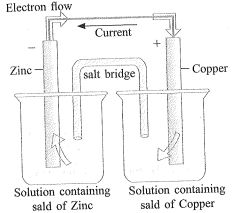
→ In Daniell cell the following reaction occurs.
$
Zn ( s )+ Cu ^{+2}( aq ) \rightarrow Zn ^{+2}( aq )+ Cu ( s )
$
→ When concentration for $Cu ^{+2}$ and $Zn ^{+2}$ ion is unit $(1 M )$ then cell potential of this cell is 1.1 V
→ such a device is called galvanic or a voltaic cell.
(1) Condition - a $\left( E _{\text {ext }}<1.1 V\right)$
→ If an external opposite potential is applied and increased slowly, we find that the reaction continues to take place till the opposing voltage reaches the value 1.1V
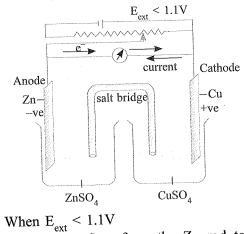
When $E _{ ext }<1.1 V$
(i) Electrons flow from the Zn rod to the Cu rod hence current flows from the Cu to Zn.
(ii) Zinc dissolves at anode and copper deposits at cathode.
(2) Condition - b $($ Eext $=1.1 V)$
→ The reaction stops altogether and no current flows through the cell.
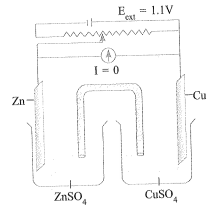
When $E _{\text {ext }}=1.1 V$
(i) No flow of electrons or current
(ii) No chemical reaction observed.
(3) Condition - c (Eext > 1.1V)
→ Any further increase in the external potential again starts the reaction but in the opposite direction.
→The cell now functions as an electrolytic cell, a device for using electrical energy to carry non- spontaneous chemical reactions.
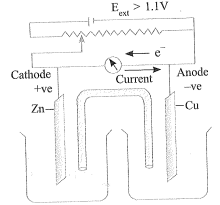
When $E _{ ext }>1.1 V$
(i) Electrons flow from Cu to Zn, and current flows from Zn to Cu.
(ii) Zinc is deposited at the zinc electrode and copper dissolves at copper electrode.
→ In Daniell cell Zn metal rod act as anode and Cu metal rod act as cathode.
→ In Daniell cell the following reaction occurs.
$
Zn ( s )+ Cu ^{+2}( aq ) \rightarrow Zn ^{+2}( aq )+ Cu ( s )
$
→ When concentration for $Cu ^{+2}$ and $Zn ^{+2}$ ion is unit $(1 M )$ then cell potential of this cell is 1.1 V
→ such a device is called galvanic or a voltaic cell.
(1) Condition - a $\left( E _{\text {ext }}<1.1 V\right)$
→ If an external opposite potential is applied and increased slowly, we find that the reaction continues to take place till the opposing voltage reaches the value 1.1V
When $E _{ ext }<1.1 V$
(i) Electrons flow from the Zn rod to the Cu rod hence current flows from the Cu to Zn.
(ii) Zinc dissolves at anode and copper deposits at cathode.
(2) Condition - b $($ Eext $=1.1 V)$
→ The reaction stops altogether and no current flows through the cell.
When $E _{\text {ext }}=1.1 V$
(i) No flow of electrons or current
(ii) No chemical reaction observed.
(3) Condition - c (Eext > 1.1V)
→ Any further increase in the external potential again starts the reaction but in the opposite direction.
→The cell now functions as an electrolytic cell, a device for using electrical energy to carry non- spontaneous chemical reactions.
When $E _{ ext }>1.1 V$
(i) Electrons flow from Cu to Zn, and current flows from Zn to Cu.
(ii) Zinc is deposited at the zinc electrode and copper dissolves at copper electrode.