Questions

M.C.Q [1M]

🎯

Test yourself on this topic

12 questions · timed · auto-graded

MCQ 11 Mark
Which of the following reactions of glucose can be explained only by its cyclic structure?
  • A
    Glucose is oxidised by nitric acid to gluconic acid.
  • Pentaacetate of glucose does not react with hydroxylamine
  • C
    Glucose reacts with hydroxylamine to form an oxime.
  • D
    Glucose forms pentaacetate.
Answer
Correct option: B.
Pentaacetate of glucose does not react with hydroxylamine
(b) Pentaacetate of glucose does not react with hydroxylamine.
Explanation: The pentaacetate of glucose does not react with the hydroxylamine indicating the absence of free -CHO group. This property of the glucose can be explained only by its own cyclic structure.
View full question & answer
MCQ 21 Mark
Aniline does not undergo Friedel - Crafts reaction because:
  • A
    Anilium ion deactivates any further reaction
  • Aluminium chloride reacts with Aniline
  • C
    All of these
  • D
    AlCl3 act as a catalyst
Answer
Correct option: B.
Aluminium chloride reacts with Aniline
(b) Aluminium chloride reacts with Aniline
Explanation: $AlCl _3$ being a lewis acid reacts with the lone pair of $- NH _2$ group of aniline forming an adduct $\left( C _6 H _5 NH _2{ }^{+} AlCl _3\right)$ which deactivates the benzene system hence no friedal craft reaction occurs.
View full question & answer
MCQ 31 Mark
Williamson's synthesis is used for the preparation of
  • A
    aldehydes
  • ethers
  • C
    alkyl halides
  • D
    alcohols
Answer
Correct option: B.
ethers
(b) ethers
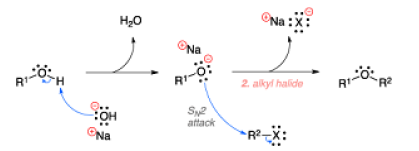
Explanation: The Williamson ether synthesis is an organic reaction, forming an ether from an organohalide and deprotonated alcohol (alkoxide). This reaction was developed by Alexander Williamson in 1850. Typically it involves the reaction of an alkoxide ion with a primary alkyl halide via an SN2 reaction.
Image
View full question & answer
MCQ 41 Mark
The reduction of ethanenitrile with sodium and alcohol gives:
  • 1-aminoethane
  • B
    Ethanamide
  • C
    1-aminopropane
  • D
    Ethanoic acid
Answer
Correct option: A.
1-aminoethane
(a) 1-aminoethane
Explanation: 1-aminoethane
View full question & answer
MCQ 51 Mark
Silver ornaments turn black by the presence of which gas in the atmosphere?
  • H2S
  • B
    O2
  • C
    Cl2
  • D
    N2
Answer
Correct option: A.
H2S
(a) H2S
Explanation: Silver ornaments turns black coming in contact with H2S due to formation of Ag2S. The chemical equation for this change can be represented as given below:
2Ag(s) + H2S(g) Ag2S(s) + H2(g)
View full question & answer
MCQ 61 Mark
CH3CONH2 on reaction with NaOH and Br2 in alcoholic medium gives:
  • $CH _3 NH _2$
  • B
    $CH _3 CH _2 NH _2$
  • C
    $CH _3 COONa$
  • D
    $CH _3 CH _2 Br$
Answer
Correct option: A.
$CH _3 NH _2$
(a) CH3NH2
Explanation: Product formed is CH3NH2
View full question & answer
MCQ 71 Mark
Image
  • A
    1-Bromo-2-ethyl-2-methylethane
  • 1-Bromo-2-methylbutane
  • C
    2-Methyl-1-bromobutane
  • D
    1-Bromo-2-ethylpropane
Answer
Correct option: B.
1-Bromo-2-methylbutane
(b) 1-Bromo-2-methylbutane
Explanation: First, we need to identify the longest carbon chain. Once we do that, the actual structure should read $CH _3- CH _2$ $- CH \left( CH _3\right)- CH _2- Br$. - Br , the functional halide group is attached to the first carbon atom (1- Bromo), so we start the numbering from that position. The methyl group branch is bond to the second carbon atom in the chain(2-methyl). The number of carbons in the unbranched parent chain is four, thus giving the name butane. The IUPAC is named 1-Bromo-2methylbutane.
View full question & answer
MCQ 81 Mark
Chlorobenzene is formed by the reaction of chlorine with benzene in the presence of AlCl3. Which of the following species attacks the benzene ring in this reaction?
  • A
    $AlCl _3$
  • B
    $\left[ AlCl _4\right]^{-}$
  • $Cl ^{+}$
  • D
    $Cl ^{-}$
Answer
Correct option: C.
$Cl ^{+}$
(c) $Cl ^{+}$
Explanation:
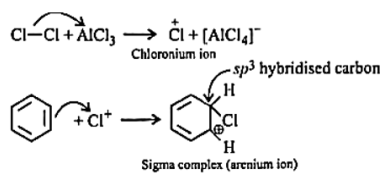
Aluminum chloride $\left( AlCl _3\right)$ is a Lewis acid catalyst and works in the same way as $FeCl _3$ does. Benzene $\left( C _6 H _6\right)$ is converted into chlorobenzene by chlorination of benzene in the presence of $AlCl _3$. The reaction occurs by an electrophilic substitution reaction. $Cl _2$ forms a coordination complex with $AlCl _3$, forming $Cl ^{+} AlCl _4{ }^{-}$complex, which gives a slight positive charge to Cl , and $AlCl _4{ }^{-}$is negatively charged. This $Cl ^{+}$then reacts with the aromatic double bond of the benzene ring to form an additional product, followed by deprotonation to form chlorobenzene and $AlCl _3$ and HCl as the side products.
Image
View full question & answer
MCQ 91 Mark
The reaction A → B is a second order process when the initial concentration of A is 0.50 M, the half life is 8.0 minutes. What is the half life if the initial concentration of A is 0.10 M?
  • 40.0 minutes
  • B
    1.6 minutes
  • C
    8.0 minutes
  • D
    16.0 minutes
Answer
Correct option: A.
40.0 minutes
(a) 40.0 minutes
Explanation: For second-order reaction:
$
t_{1 / 2}=\frac{2 k}{[R]} \Rightarrow k=\frac{t_{1 / 2}[R]}{2}
$
Applying this equation,
$
\begin{array}{l}
\frac{t_{1 / 2}[R]}{2}=\frac{t_{1_{1 / 2}}\left[R^{\prime}\right]}{2} \\
\frac{8.0 \times 0.50}{2}=\frac{t_{1 / 2}^{\prime} \times 0.10}{2} \\
t_{1 / 2}^{\prime}=\frac{8 \times 0.50}{0.10}=40
\end{array}
$
View full question & answer
MCQ 101 Mark
  • A
    Order with respect to A(g) - Second Order with respect to B(g) - First
  • B
    Order with respect to A(g) - Zero Order with respect to B(g) - Second
  • C
    Order with respect to A(g) - First Order with respect to B(g) - Zero
  • Order with respect to A(g) - Second Order with respect to B(g) - Zero
Answer
Correct option: D.
Order with respect to A(g) - Second Order with respect to B(g) - Zero
(d) Order with respect to A(g) - Second
Order with respect to B(g) - Zero
Explanation: Order with respect to A(g)
Second Order with respect to B(g) - Zero
View full question & answer
MCQ 111 Mark
  • A
    (a) (i), (b) (ii), (c) - (iii), (d) - (iv)
  • B
    (a) (iv), (b) - (ii), (c) - (iii), (d) - (i)
  • C
    (a) (i), (b)(ii), (c) - (iii), (d) - (iv)
  • (a) (ii), (b) - (iv), (c) - (i), (d) - (iii)
Answer
Correct option: D.
(a) (ii), (b) - (iv), (c) - (i), (d) - (iii)
(d) (a)-(ii), (b) - (iv), (c) - (i), (d) - (iii)
Explanation: (a)-(ii), (b)-(iv), (c) - (i), (d) - (iii)
View full question & answer
MCQ 121 Mark
The compound which forms acetaldehyde when heated with dilute NaOH is:
  • A
    1, 2 dichloroethane
  • B
    1, 1, 1 trichloroethane
  • C
    1 chloroethane
  • 1, 1 dichloroethane
Answer
Correct option: D.
1, 1 dichloroethane
(d) 1, 1 dichloroethane
Explanation: $CH _3 CHCl _2+ OH ^{-} \rightarrow CH _3 CH ( OH )_2 \rightarrow CH _3 CHO + H _2 O$
Gem diols like $\left( CH _3 CH ( OH )_2\right.$ ) are generally not stable. The $2- OH$ group attached to the same C removes $H _2 O$ and forms carbonyl compounds.
View full question & answer