Question 13 Marks
View full question & answer→Questions
3 Marks Question
🎯
Test yourself on this topic
8 questions · timed · auto-graded
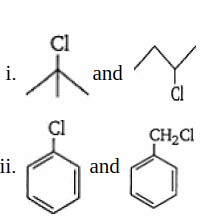
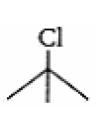 will react faster.
Question 23 Marks
Calculate the potential of hydrogen electrode in contact with a solution whose PH is 10.
Question 33 Marks
Determine the value of equilibrium constant (Kc) and $\Delta G^\theta$ for the following reaction.
$\begin{array}{l}N i(s)+2 A g^{+}(a q) \rightarrow N i^{2+}(a q)+2 A g(s) \\ E^\theta=1.05 V\left(1 F=96500 C mol^{-1}\right)\end{array}$
Answer
View full question & answer→We have,
$N i(s)+2 A g^{+}(a q) \rightarrow N i^{2+}(a q)+2 A g(s)
$
For the reaction $n =2, E_{\text {cell }}^\theta=1.05 V$
$
\begin{array}{l}
\Delta G^\theta=-n F E^\theta \\
\Delta G^\theta=-2 \times 96500 C \times 1.05 V \\
\Delta G^\theta=-202.65 kJ mol^{-1}
\end{array}
$
For Equilibrium constant, we have,
$
\begin{array}{l}
\Delta G^\theta=-2.303 R T \log K_c \\
\log K_c=-\frac{\Delta G^{\Theta}}{2.303 R T} \\
=-\frac{20250}{2.303 \times 8.314 \times 298} \\
K_c=\operatorname{Antilog}(35.5161) \\
K_c=3.284 \times 10^{35}
\end{array}
$
$N i(s)+2 A g^{+}(a q) \rightarrow N i^{2+}(a q)+2 A g(s)
$
For the reaction $n =2, E_{\text {cell }}^\theta=1.05 V$
$
\begin{array}{l}
\Delta G^\theta=-n F E^\theta \\
\Delta G^\theta=-2 \times 96500 C \times 1.05 V \\
\Delta G^\theta=-202.65 kJ mol^{-1}
\end{array}
$
For Equilibrium constant, we have,
$
\begin{array}{l}
\Delta G^\theta=-2.303 R T \log K_c \\
\log K_c=-\frac{\Delta G^{\Theta}}{2.303 R T} \\
=-\frac{20250}{2.303 \times 8.314 \times 298} \\
K_c=\operatorname{Antilog}(35.5161) \\
K_c=3.284 \times 10^{35}
\end{array}
$
Question 43 Marks
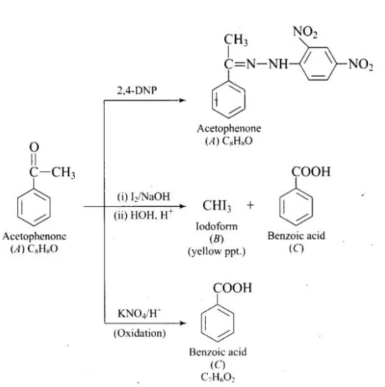
An aromatic compound A (Molecular formula C8H8O) gives positive 2, 4-DNP test. It gives a yellow precipitate of compound B on treatment with iodine and sodium hydroxide solution. Compound A does not give Tollen's or Fehling's test. On drastic oxidation with potassium permanganate it forms a carboxylic acid C (Molecular formula C7H6O2), which is also formed along with the yellow compound in the above reaction. Identify A, B and C and write all the reactions involved.
Answer
View full question & answer→The molecular formula of the compound is C8H8O. As A does not give Tollens or Fehling's test. It must be a ketone. It gives a positive test with 2, 4-DNP, and iodoform test. It means it is methyl ketone. B is iodoform and C is benzoic acid.
Question 53 Marks
Write the structures of the major products expected from the following reactions:
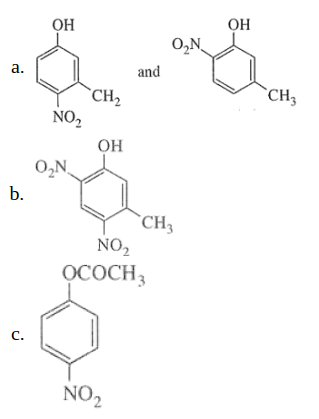
a. Mononitration of 3-methylphenol
b. Dinitration of 3-methylphenol
c. Mononitration of phenyl methanoate
a. Mononitration of 3-methylphenol
b. Dinitration of 3-methylphenol
c. Mononitration of phenyl methanoate
Answer
View full question & answer→The combined influence of -OH and -CH3 groups determine the position of the incoming group. Keeping in view that both -OH and -CH3 are o- and p-directing groups, the following products are obtained:
Question 63 Marks
Give equations of the following reactions:
i. Oxidation of propan-1-ol with alkaline KMnO4 solution.
ii. Bromine in CS2 with phenol.
iii. Dilute HNO3 with phenol.
iv. Treating phenol with chloroform in presence of aqueous NaOH.
i. Oxidation of propan-1-ol with alkaline KMnO4 solution.
ii. Bromine in CS2 with phenol.
iii. Dilute HNO3 with phenol.
iv. Treating phenol with chloroform in presence of aqueous NaOH.
Question 73 Marks
The rate constant for a first order reaction is 60s-1. How much time will it take to reduce the concentration of the reactant $\frac{1}{10}$th its initial value?
Answer
View full question & answer→Given, $k=60 s^{-1},[R]_o=100 M$ and $[R]=100 M \times \frac{1}{10}=10 M$
$
\begin{array}{l}
t=\frac{2.303}{k} \log \frac{[R]_0}{[R]}=\frac{2.303}{k} \log \left[\frac{100}{10}\right] \\
t=\frac{2.303}{60} \log 10=0.0384 s
\end{array}
$
\begin{array}{l}
t=\frac{2.303}{k} \log \frac{[R]_0}{[R]}=\frac{2.303}{k} \log \left[\frac{100}{10}\right] \\
t=\frac{2.303}{60} \log 10=0.0384 s
\end{array}
$
Question 83 Marks
When a steady current of 2A was passed through two electrolytic cells A and B containing electrolytes ZnSO4 and CuSO4 connected in series, 2g of Cu were deposited at the cathode of cell B. How long did the current flow? What mass of Zn was deposited at cathode of cell A?
[Atomic mass: Cu = 63.5 g mol-¹, Zn = 65 g mol-1; 1F = 96500 C mol-¹]
[Atomic mass: Cu = 63.5 g mol-¹, Zn = 65 g mol-1; 1F = 96500 C mol-¹]
Answer
View full question & answer→Steady current = 2A
copper deposited at cathode of cell B = 2g
Cell B contains CuSO4 and reaction may be represented as,
$CuSO _4 \rightarrow Cu ^{2+}+ SO _4^{2-}$
The reaction happens at cathode as,
Cu2+ + 2e- → Cu
So, 1 mol Cu deposited by 2F charge
63.5 g Cu→ 2 × 96500
2g Cu → x
$x =\frac{2 \times 2 \times 96500}{63.5}=6078.74 C$
we know formula
Q = It
6078.74=2 x t
$t =\frac{6078.74}{2}=3039.37 Sec$
From faraday's second law of electrolysis,
$\begin{array}{l}\frac{\omega t \text { of } C u}{\omega t \text { of } Z n}=\frac{E q \omega t C u}{E q \cdot \omega t Z n} \\ \frac{2}{x}=\frac{63.5 / 2}{65 / 2} \\ x=\frac{2}{0.9769}=2.047 g\end{array}$
weight of Zn deposited = 2.047 g
copper deposited at cathode of cell B = 2g
Cell B contains CuSO4 and reaction may be represented as,
$CuSO _4 \rightarrow Cu ^{2+}+ SO _4^{2-}$
The reaction happens at cathode as,
Cu2+ + 2e- → Cu
So, 1 mol Cu deposited by 2F charge
63.5 g Cu→ 2 × 96500
2g Cu → x
$x =\frac{2 \times 2 \times 96500}{63.5}=6078.74 C$
we know formula
Q = It
6078.74=2 x t
$t =\frac{6078.74}{2}=3039.37 Sec$
From faraday's second law of electrolysis,
$\begin{array}{l}\frac{\omega t \text { of } C u}{\omega t \text { of } Z n}=\frac{E q \omega t C u}{E q \cdot \omega t Z n} \\ \frac{2}{x}=\frac{63.5 / 2}{65 / 2} \\ x=\frac{2}{0.9769}=2.047 g\end{array}$
weight of Zn deposited = 2.047 g