Questions

3 Marks Question

🎯

Test yourself on this topic

8 questions · timed · auto-graded

Question 13 Marks
i. Determine the units of rate constant for first and zero order reaction.
ii. Show that time required for the completion of 99% of the first order reaction is twice the 90% of completion of the reaction.
Answer
i. $K =( mol )^{1- n } L ^{ n -1} s^{-1}$
For zero order, $n =0$
So, $K=( mol )^{1-0} L^{0-1} s^{-1}= s ^{-1} mol L ^{-1}$
For first order, $n =1$
$
\begin{array}{l}
K=(mol)^{1-n} L^{n-1} s^{-1} \\
\text { So, } K=(mol)^{1-1} L^{1-1} s^{-1} \\
=s^{-1}
\end{array}
$
ii. For a first order reaction,
$
\begin{array}{l}
t=\frac{2.303}{K} \log \frac{[A]_0}{[A]} \\
{[A]_0=a,[A]=a-\frac{a \times 99}{100}=0.01 a} \\
t(99 \%)=\frac{2.303}{K} \log \frac{a}{0.01 a} \\
=\frac{2.303}{K} \log 100 \\
=\frac{2.303}{K} \times 2 \ldots \text { (i) }
\end{array}
$
For $90 \%$ completion of reaction,
$
\begin{array}{l}
{[A]=a-\frac{a \times 99}{100}=0.1 a} \\
t(90 \%)=\frac{2.303}{K} \log \frac{a}{0.1 a} \\
=\frac{2.303}{K} \times 1 \ldots .(i)
\end{array}
$
Dividing equation (i) by equation (ii), we get
$
t(99 \%)=2 \times t(90 \%)
$
Hence, the time taken to complete 9% of the first order reaction is twice the time required for the completion of 90% of the reaction.
View full question & answer
Question 23 Marks
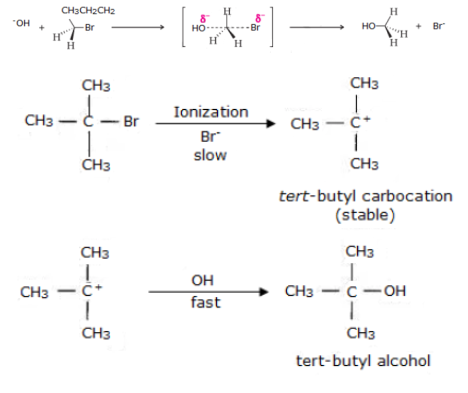
Tert-Butylbromide reacts with aq. NaOH by SN1 mechanism while n-butylbromide reacts by SN2 mechanism. Why?
Answer
Tert-butylbromide undergoes substitution by SN1 unimolecular substitution mechanism because it is able to form a stable carbocation in the first step after cleavage of the halide group. The carbocation then reacts with the nucleophile OH-. On the other hand, primary halide n-butylbromide cannot form a stable carbocation so it undergoes SN2 bimolecular substitution mechanism,which is a one-step substitution that involves the attack of OH- and simultaneous leaving of X- to form n-butyl alcohol.
Image
View full question & answer
Question 43 Marks
Calculate the emf of the cell
$Mg ( s )\left| Mg ^{+2}(0.1 M )\right| \mid Cu ^{+2}\left(1 \times 10^{-3} M \mid Cu ( s )\right)$
Given, $\left.E _{C u^{2+} / C u}^{\ominus}=+0.34 V, E _{M g^{+2} / M g}^{\ominus}=-2.37 V\right)$
Answer
We have
$
Mg(s)\left|Mg^{+2}(0.1 M)\right| \mid Cu^{+2}\left(1 \times 10^{-3} M \mid Cu(s)\right)
$
Half cell reactions of this cell are:
At Cathode (Reduction):
$
C u^{2+}(a q)+2 e^{-} \rightarrow C u(s)
$
At Anode (Oxidation):
$
M g(s) \rightarrow M g^{2+}(a q)+2 e^{-}
$
For this cell, we have, $n =2$ moles of electrons.
$
\begin{array}{l}
\text { (Given, } E_{Cu 2+}^{\ominus} / Cu \\
\left.E_{\text {cell }}^{\ominus}=+0.34 V, E_{Mg^{+2} / Mg}^{\ominus}=-2.37 V\right) \\
E_{\text {cell }}^{\ominus}=E_{\left(C Cu^{2+} / Cu\right)}^{\ominus}-E_{\left(Mg^{2+} / Mg\right)}^{\ominus}-E_{\text {oxidation }}^{\ominus} \\
=0.34-(-2.37) V \\
=2.71 V
\end{array}
$
According to Nernst equation
$
\begin{array}{l}
E_{\text {cell }}=E_{\text {cell }}^{\ominus}-\frac{0.059}{n} \log \frac{\left[Mg^{2+}\right]}{\left[Cu^{2+}\right]} \\
E_{\text {cell }}=E_{\text {cell }}^{\ominus}-\frac{0.059}{2} \log \left[\frac{0.1}{10^{-3}}\right] \\
=2.71-0.0295 \log 10^2 \\
=2.71-0.0295 \times 2 \\
=2.651 \\
\therefore E_{\text {cell }}=2.651 V
\end{array}
$
View full question & answer
Question 53 Marks
Write the Nernst equation and calculate emf of the following cell at 298 K:
$\begin{array}{l} Cr \left| Cr ^{3+}(0 \cdot 1 M ) \| Fe ^{2+}(0 \cdot 01 M )\right| Fe \\ \text { Given : } E _{ Cr ^{3+} / Cr }^{\ominus}=-0 \cdot 75 V \\ E _{ Fe ^{2+} / Fe }^{\ominus}=-0 \cdot 45 V \\ (\log 10=1)\end{array}$
Answer
$\begin{array}{l}E_{\text {cell }}=E_{\text {cell }}^0-\frac{0.059}{6} \log \frac{\left[ Cr ^{3+}\right]^2}{\left[ Fe ^{2+}\right]^3} \\ E_{\text {cell }}^0=-0.45-(-0.75) \\ =0.30 V \\ E_{\text {cell }}=0.3-\frac{0.059}{6} \log \frac{(0-1)^2}{(0.01)^3} \\ =0 \cdot 3-.00985 \log \frac{\left(10^{-1}\right)^2}{\left(10^{-2}\right)^3} \\ =0.3-.00985 \times 4 \log 10 \\ =0.3-0.0394 \\ =0.2606 V\end{array}$
View full question & answer
Question 63 Marks
Predict the products formed when cyclohexanecarbaldehyde reacts with following reagents.
i. PhMgBr and then H3O+
ii. Tollens' reagent
iii. Semicarbazide and weak acid
iv. Excess ethanol and acid
v. Zinc amalgam and dilute hydrochloric acid
View full question & answer
Question 73 Marks
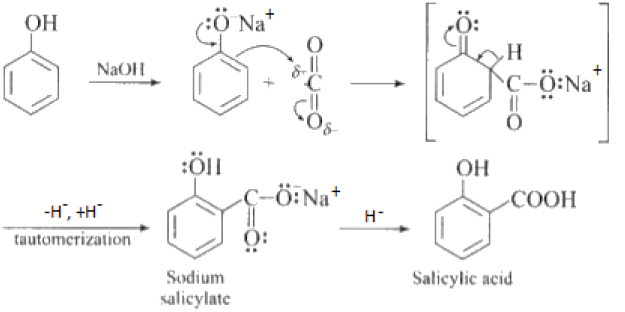
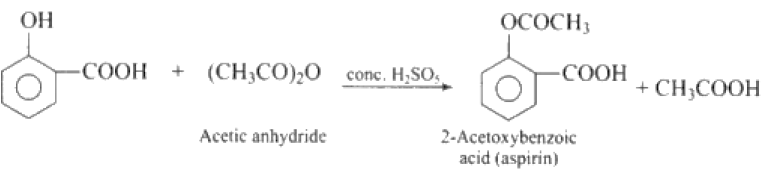
How can phenol be converted to aspirin?
Answer
Phenol is converted into salicylic acid. The reaction is usually carried out by allowing sodium phenoxide to absorb carbon dioxide and then heating the product to 400 K and 4-7 atm pressure. The first unstable intermediate is formed which undergoes a proton shift to form sodium salicylate. The subsequent acidification of sodium salicylate gives.
Image
Then aspirin is obtained by acetylating salicylic acid with acetic anhydride and conc. H2SO4Image
The preparation of Aspirin from salicylic acid is an example of an electrophilic substitution reaction in which carbon dioxide is an electrophile.
View full question & answer
Question 83 Marks
How much charge is required for the following reductions:
i. 1 mol of $Al ^{3+}$ to Al ?
ii. 1 mol of $Cu ^{2+}$ to Cu ?
iii. 1 mol of $MnO _4^{-}$to $Mn ^{2+}$ ?
Answer
i. $A l^{3+}+3 e^{-} \rightarrow A l$
Therefore, Required charge $=3 F$
$
\begin{array}{l}
=3 \times 96487 C \\
=289461 C
\end{array}
$
ii. $C u^{2+}+2 e^{-} \rightarrow C u$
Therefore, Required charge $=2 F$
$
\begin{array}{l}
=2 \times 96487 C \\
=192974 C
\end{array}
$
iii. $MnO _4^{-} \rightarrow Mn ^{2+}$
i.e., $M n^{7+}+5 e^{-} \rightarrow M n^{2+}$
Therefore, Required charge $=5 F$
$
\begin{array}{l}
=5 \times 96487 C \\
=482435 C
\end{array}
$
View full question & answer
3 Marks Question - Chemistry STD 12 Science Questions - Vidyadip