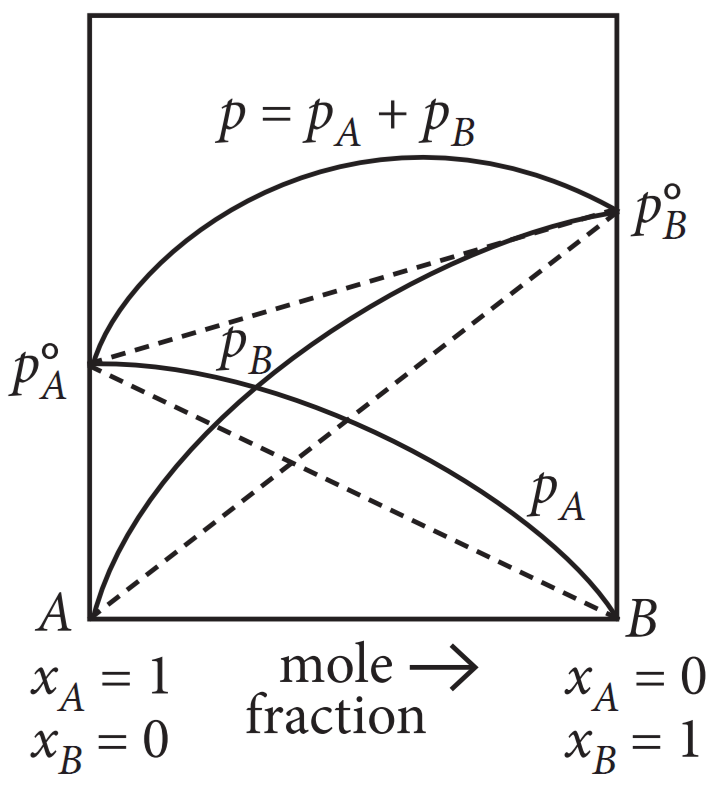
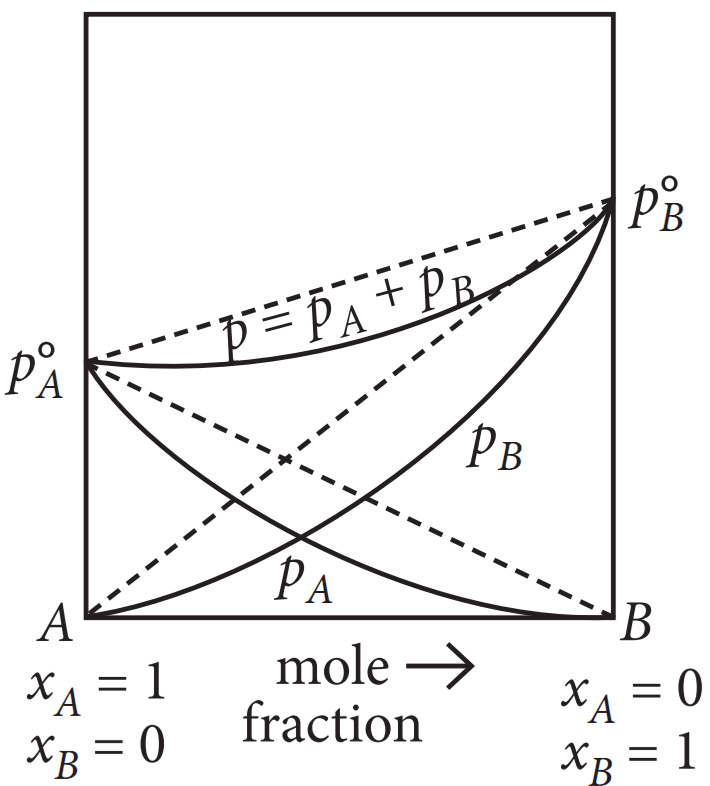
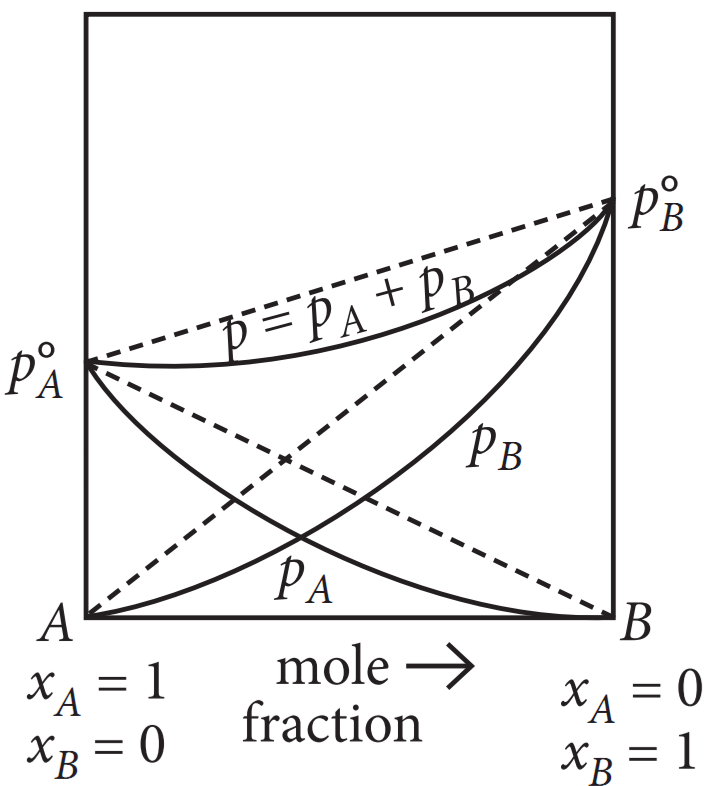
The solubility of gases increases with increase of pressure. William Henry made a systematic investigation of the solubility of a gas in a liquid. According to Henry's law "the mass of a gas dissolved per unit volume of the solvent at constant temperature is directly proportional to the pressure of the gas in equilibrium with the solution". Dalton during the same period also concluded independently that the solubility of a gas in a ti quid solution depends upon the partial pressure of the gas. If we use the mole fraction of gas in the solution as a measure of its solubility, then Henry's law can be modified as "the partial pressure of the gas in the vapour phase is directly proportional to the mole fraction of the gas in the solution"
The following questions are multiple choice questions. Choose the most appropriate answer:
- Henry's law constant for the solubility of methane in benzene at 298K is 4.27 x 105mm Hg. The solubility of methane in benzene at 298K under 760mm Hg is:
- 4.27 × 10⁻⁵
- 1.78 × 10⁻³
- 4.27 × 10⁻³
- 1.78 × 10⁻⁵
- The partial pressure of ethane over a saturated solution containing 6.56 × 10⁻²g of ethane is I bar. If the solution contains 5.00 × 10⁻²g of ethane then what will be the partial pressure (in bar) of the gas?
- 0.762
- 1.312
- 3.81
- 5.0
- KH (K bar) values for Ar(g), CO2(g), HCHO(g) and CH4(g) are 40.39, 1.67, 1.83 × 10⁻⁵ and 0.413 respectively. Arrange these gases in the order of their increasing solubility. Arrange these gases in the order of their increasing solubility.
- HCHO < CH4 < CO2 < Ar
- HCHO < CO2 < CH4 < Ar
- Ar < CO2 < CH4 < HCHO
- Ar < CH4 < CO2 < HCHO
- When a gas is bubbled through water at 298K, a very dilute solution of the gas is obtained. Henry's law constant for the gas at 298K is 150 kbar. If the gas exerts a partial pressure of 2 bar, the number of millimoles of the gas dissolved in IL of water is:
- 0.55
- 0.87
- 0.37
- 0.66
- Which of the following statements is correct?
- KH increases with increase of temperature.
- KH decreases with increase of temperature.
- KH remains constant with increase of temperature.
- KH first increases then decreases, with increase of temperature.
- (b) 1.78 × 10⁻³
Explanation:
$\text{K}_\text{H}=4.17\times10^5\text{mm HG}$
$\text{p}=760\text{mm Hg}$
According to Henry's law, $\text{P}=\text{K}_\text{H}\times\text{X}_{\text{CH}_4}$
$\text{X}_{\text{CH}_4}=\frac{\text{P}}{\text{K}_\text{H}}=\frac{760}{4.27\times10^5}=1.78\times10^{-3}$
- (a) 0.762
Explanation:
According to Henry's law, m = KH × p
6.56 × 10-2 = KH × 1
For another case, 5 × 10-2 = 6.56 × 10⁻² × p
$\text{p}=\frac{5\times10^{-2}}{6.56\times10^{-2}}=0.762\text{ bar}$
- (c) Ar < CO2 < CH4 < HCHO
Explanation:
Higher the value of KH at a given pressure, the lower is the solubility of the gas.
- (c) 0.37
Explanation:
The mole fraction of the gas in solution,
$\text{x}=\frac{\text{p}}{\text{K}_\text{H}}=\frac{1}{150\times10^3}$
If n is the number of moles of gas in a solution of I L of water containing 55.5 mol then,
$\text{x}=\frac{\text{n}}{\text{n+55.5}}\text{ or,}\frac{\text{n}}{55.5}=\frac{1}{150\times10^3}$
$[\text{n} + 55.5\approx55.5,\text{as n is very small}]$
$\text{n}=\frac{55.5}{150}\times10^{-3}=0.37\text{ millimoles}$
- (a) KH increases with increase of temperature.