Electromotive forces of two cells are $\varepsilon_1$ and $\varepsilon_2$ and their internal resistances are $r_1$ and $r_2$ Both cells are joined in lateral combination. Write equivalent electromotive force of this combination.
A negligibly small current is passed through a wire of length 15 m and uniform cross-section 6.0 x 10⁻⁷ m2 ,and its resistance is measured to be 5.0 Ω. What is the resistivity of the material at the temperature of the experiment?
Answer
Given: Length of the wire, $l=15 m$ Area of cross-section of the wire, $A =6.0 \times 10^{-7} m^2$ Resistance of the wire, $R =5.0 \Omega$ Resistivity of the wire, $\rho=$ ? We know$\rho=\frac{RA}{l}$ $=\frac{5.0 \times 6.0 \times 10^{-7}}{15 m}=\frac{30 \times 10^{-7}}{15}$ $=2 \times 10^{-7} \Omega m$
The storage battery of a car has an emf of 12 V. If the internal resistance of the battery is 0.4 $\Omega$, what is the maximum current that can be drawn from the battery?
Answer
Maximum current can be taken from the battery when external resistance in the circuit is zero Maximum current, $\quad I =\frac{ E }{ R +r}$ Putting $R =0$ $I _{\max }=\frac{ E }{0+r}=\frac{ E }{r}$ or$I_{\max }=\frac{12 V}{0.4 \Omega}=30 A$
A current of I ampere is flowing in a conductor. The same current is flowing in a semiconductor also. If temperature of both is increased, what will be effect on the current flowing through them?
Answer
In conductor, the magnitude of current will decrease but in semiconductor it will increase.
If potential difference across the ends of any conductor in increased from V to 3 V, then how will drift velocity of electron change?
Answer
Since, drift velocity, $v_d=\left(\frac{e \tau}{m l}\right) V$ $\Rightarrow \quad v_d \propto V$times. On doing V to 3 V , drift velocity will become three
How does conductance of a semi-conductor changes with increase in temperature?
Answer
Since, resistance of a semiconductor decreases with increase in temperature, so its conductance $\left(\frac{1}{R}\right)$ with increase in temperature.
A resistor R is joined across a cell of internal resistance r and electromotive force E. Now a potentiometer measures potential difference V across the ends of the cell. Write an expression for r in terms of E, V and R.
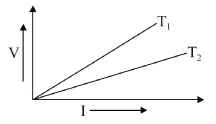
V-I graph of wire of any metal at two different temperatures $T _1$ and $T _2$ are shown in the given figure. Which of the two temperatures is higher and why?
Answer
Slope of V-I graph is $\frac{V}{I}=$ R. It means lesser the slope: more is the magnitude of resistance. Resistance of any metal increases with increase in temperature. Hence, $T_1>T_2$.
Resistivities of two conductors of same metal shown in the figure are $\rho_1 \Omega m$ and $\rho_2 \Omega m$. Write the ratio of $\rho_1$ and $\rho_2$ will be $1: 1$.
Answer
We know that the resistivity depends on the substance of the conductor. Here both the conductors are of same substance. Hence the ratio of $\rho_1$ and $\rho_2$ will be $1: 1$.
What is the importance of Kirchhoff's laws related to electric circuit?
Answer
In complex electric circuits where more than one electromotive force sources are present, Ohm's law cannot be applied. In such circuits, only Kirchhoff's laws can be applied.
What is the effect on specific conductance of any electrolyte with increase in temperature?
Answer
With increase in temperature, due to increase in number of ions in electrolyte and their mobility, its specific conductance will increase due to decrease in its resistivity.
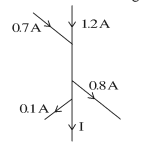
According to Kirchhoff's law $0.7 A+1.2 A=0.1 A+0.8 A+ I$ $\Rightarrow \quad 1.9 A=0.9+ I$ $\Rightarrow \quad I =1.9-0.9$ $\Rightarrow \quad I =1.0 A$ Ans.
What is the effect on the magnitudes of resistance and resistivity of deforming the shape of a substance?
Answer
Resistance will change as it depends on physical condition of the substance. Resistivity will remain the same because it depends on the nature of the substance.
What is the concept of direction of electric current ?
Answer
The direction of electric current in metals is taken opposite to the direction of free electrons. In liquids and gases, the direction is taken in the direction of positive ions or opposite to the direction of negative charge carriers.
For any conductor, ratio of drift velocity and electric field inside the conductor remains constant at the given temperature. This constant quantity is known as mobility $(\mu)$ of charge carrier (electron) $ \text { mobility }(\mu)=\frac{\text { drift velocity }}{\text { electric field }}=\frac{e \tau}{m} $
If physical conditions remain constant, the magnitude of current flowing in a conductor is proportional to the potential difference V across the ends of the conductor. $V \propto I$ $V = IR$ Where R is a constant.
What is the effect on the resistance due to increase in the temperature?
Answer
Due to small change in temperature, there is no change in thermal expansion but for more change in temperature of resistance, ratio of length and area of crosssection will decrease which will affect the resistance.
Write corresponding values for X and Y on decreasing the length to half of conductors X and Y where $X =4$ and $Y =4 \Omega$ and $Y =48 \times 10^{-8} \Omega m$.
Answer
We know that resistance is proportional to the length $R \propto l$ When length is reduced to half, magnitude of resistance will also become half which means $X ^{\prime}=2 \Omega$ Resistivity does not depend on length or area of crosssection of wire, hence $Y ^{\prime}=48 \times 10^{-8} \Omega m$.
Magnitude of current flowing in the perpendicular direction of unit area of cross-section is known as current density J. Current density $J =\frac{ i }{\Delta S }$, where, $\Delta S$ is area of cross-section. If the direction of flow of charge is inclined at an angle with the perpendicular, then current density, $J=\frac{i}{\Delta S \cos\theta}$ or $I=\vec{J} \cdot \overrightarrow{\Delta S}$
If one coulomb of charge passes through any conductor in one second, then magnitude of current flowing in the conductor is one ampere. 1 A = 1 coulomb/1 second.
If a graph is drawn between different potential differences applied across the ends of the conductor and their corresponding values of current, then what type of graph is obtained?
Drift velocity is inversely proportional to what? and it does not depend on what?
Answer
Drift velocity is inversely proportional to applied potential difference on the conducting rod and drift velocity of electrons in the conductor does not depends on length of the conductor.