Question types

Electric Charges and Fields question types

207 questions across 7 question groups — pick any mix to generate a Physics paper with step-by-step answer keys.

207
Questions
7
Question groups
5
Question types
Sample Questions

Electric Charges and Fields questions

One sample from each question group in this chapter. Select any group above to see the full set with answer keys.

Q 1M.C.Q [1M]1 Mark
The electric flux on a Gaussian spherical surface of radius 15 cm, drawn with a point charge as the centre, is ф. If the radius of this surface is tripled, then the electric flux passing through the surface will be:
  • A
    Zero
  • B
    Infinity
  • C
  • ф

Answer: D.

View full solution
Q 3M.C.Q [1M]1 Mark
The SI value of electrical conductivity of free space or vacuum is:
  • A
    $9 \times 10^{\circ} Nm ^2 / C ^2$
  • B
    $-9 \times 10^{\circ} Nm ^2 / C ^2$
  • $8.854 \times 10^{-12} C ^2 N^{-1} m^{-2}$
  • D
    $8.854 \times 10^{12} C ^2 N^{-1} m^{-2}$

Answer: C.

View full solution
Q 4M.C.Q [1M]1 Mark
The SI unit of electric flux is:
  • $NC ^{-1} m^2$
  • B
    $NC ^{-1} m^-2$
  • C
    $N ^{-1} C ^{-1} m^{-2}$
  • D
    $N ^{-1} C ^{1} m^{2}$

Answer: A.

View full solution
Q 5M.C.Q [1M]1 Mark
The magnitude of the electric field due to a point charge at a distance of 4.0 m is 9 N/C. Distance of this point charged substance due to electric field of magnitude 16 N/C will be:
  • A
    1 m
  • B
    2 m
  • 3 m
  • D
    6 m

Answer: C.

View full solution
What is the net flux of uniform elecrtric field of Exercise 1.14 through a cube of side 20 cm oriented so that its faces are parallel to the coordinate planes ?
View full solution
An electric dipole with dipole moment $4 \times 10^{-9}$ Cm is aligned at $30^{\circ}$ with the direction of a uniform electric field of magnitude $5 \times 10^4 N C ^{-1}$. Calculate the magnitude of the torque acting on the dipole.
View full solution
Q 163 Marks Question3 Marks
A system has two charges $q_A=2.5$$\times 10^{-7} C$ and $q_B=-2.5 \times 10^{-7} C$ located at points A: $(0$,$0,-15 cm)$and $B :( 0 , 0 ,+15 cm)$, respectively. What are the total charge and electric dipole moment of the system?
View full solution
Q 173 Marks Question3 Marks
When a glass rod is rubbed with a silk cloth, charges appear on both. A similar phenomenon is observed with many other pairs of bodies. Explain how this observation is consistent with the law of conservation of charge.
View full solution
Q 183 Marks Question3 Marks
(a) Explain the meaning of the statement "electric charge of a body is quantised". (b) Why can one ignore quantisation of electric charge when dealing with macroscopic i.e., large scale charges?
View full solution
Q 203 Marks Question3 Marks
A conducting sphere of radius 10 cm has an unknown charge. If the electric field 20 cm from the centre of the sphere is $1.5 \times 10^3 N / C$ and directed radially inward, what is the net charge on the sphere?
View full solution
Two large, thin metal plates are parallel and close to each other. On their inner faces, the plates have surface charge densities of opposite signs and of magnitude $17.0 \times 10^{-22} C / m ^2$. What is E: (a) in the outer region of the first plate, (b) in the outer re-gion of the second plate, and (c) between the plates?
View full solution
A uniformly charged conducting sphere of 2.4 m diameter has a surface charge density of$80.0 \mu C / m ^2$.
(a) Find the charge on the sphere.
(b) What is the total electric flux leaving the sur-face of the sphere?
View full solution
The electrostatic force on a small sphere of charge $0.4 \mu C$ due to another small sphere of charge $-0.8 \mu C$ in air is 0.2 N (a) What is the distance between the two spheres? (b) What is the force on the second sphere due to the first?
View full solution
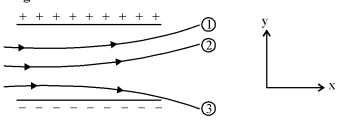
Figure shows track of three charged particles in a uniform elecrostatic field. Give the signs of the three charges. Which particle has the highest charge to mass ratio?
Image
View full solution
(a) Two insulated charged copper spheres A and B have their centres separated by a distance of 50 cm. What is the mutual force of electrostatic repulsion if the charge on each is 6.5 x $10^{-7} C$ ? The radii of A and B are negligible compared to the distance of separation.
(b) What is the force of repulsion if each sphere is charged double the above amount, and the distance between them is halved?
View full solution
Write the statement of Gauss's law for electrostatics. Draw a diagram and derive an expression for the electric field due to a uniformly charged infinite plane sheet at a point near it.In the given figure, write the value of electric flux emerging from the surface :

Image
View full solution
Prove that due to a charged layer of infinite expansion, the value of the electric field at any point near it does not depend on the area of the surface and the distance from the layer . i.e., the electric field remains uniform at points near the layer.###Write Gauss'law.By applying this rule,find the value of the electric field due to a uniformly charged infinite plane sheet at any point near the sheet.
View full solution
Two point charges $q_A=3 \mu C$and $q _{ B }=$$-3 \mu C$ are located 20 cm apart in vacuum.
(a) What is the electric field at the midpoint O of the line AB joining the two charges?
(b) If a negative test charge of magnitude $1.5 \times$$10^{-9} C$ is placed at this point, what is the force experi-enced by the test charge?
View full solution
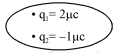
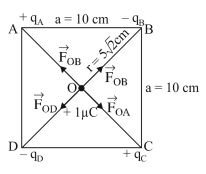
Four point charges $q_{ A }=2 \mu C$,$q_{ B }=-5 \mu C , q_{ C }=2 \mu C$ and $q_{ D }=-5 \mu C$ are located at the of a square ABCD of side 10 cm. Wht is the force on a charge of $1 \mu C$ placed at the centre of the square?
Image
View full solution

Generate a Electric Charges and Fields paper free

Pick question groups from the list above, set marks and difficulty, and export a branded PDF with step-by-step answer keys. First 3 chapters free — no signup.

Download App