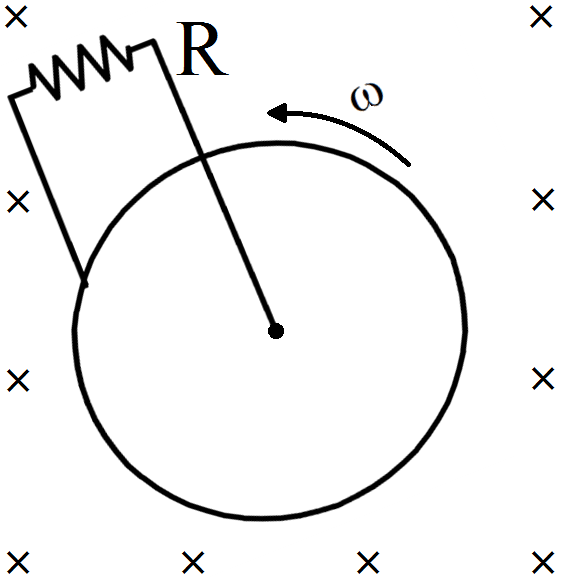
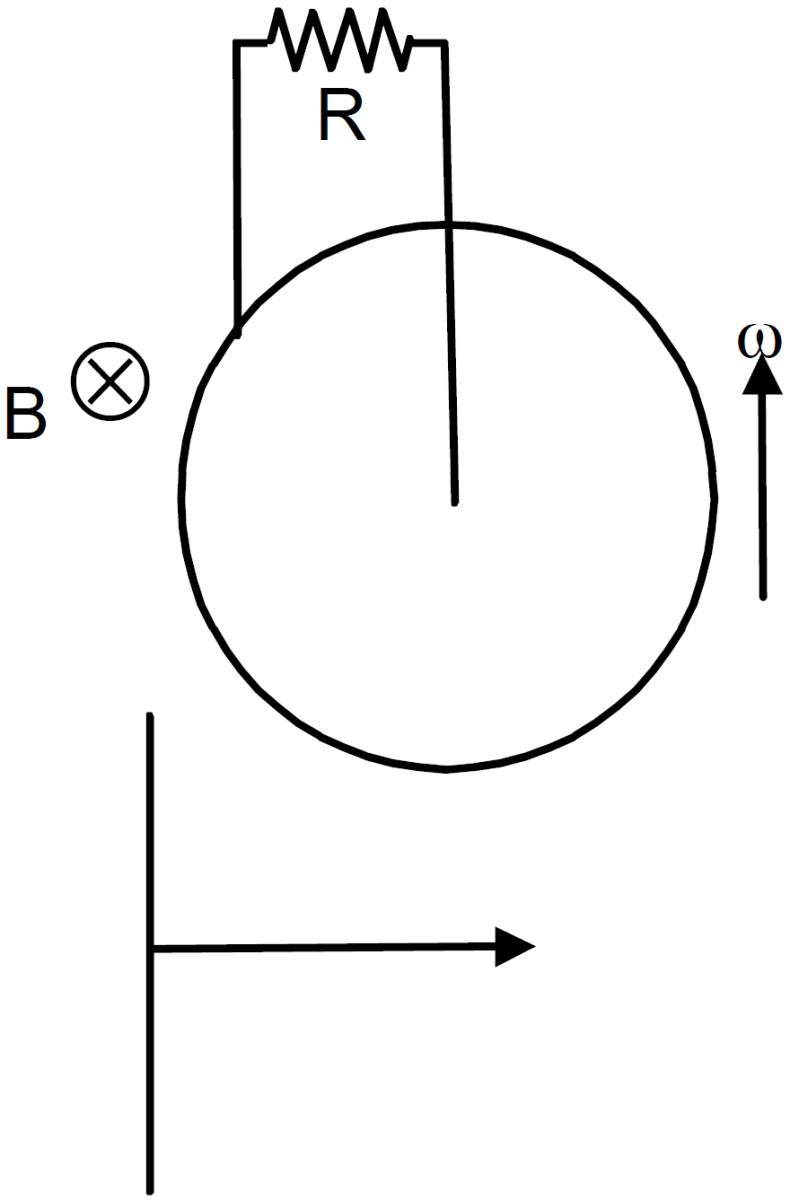
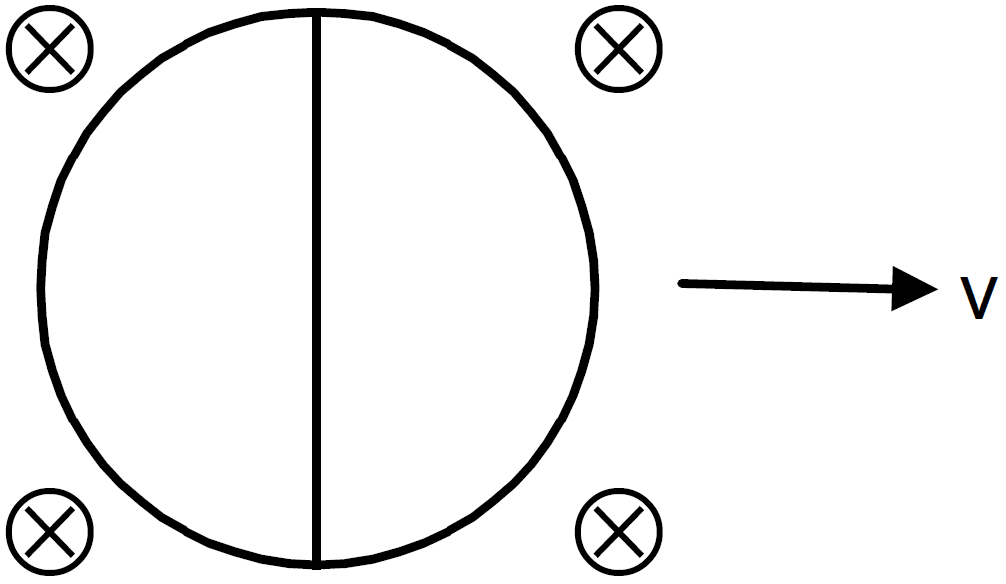
Loops repel each other as loops have current in same direction thus they have same pole as magnet.
18 questions · timed · auto-graded

Initial current passing = i
Hence initial emf = ir
Emf due to motion of ab = Blv
Net emf = ir - Blv
Net resistance = 2r
Hence current passing $=\frac{\text{ir}-\text{Blv}}{2\text{r}}$

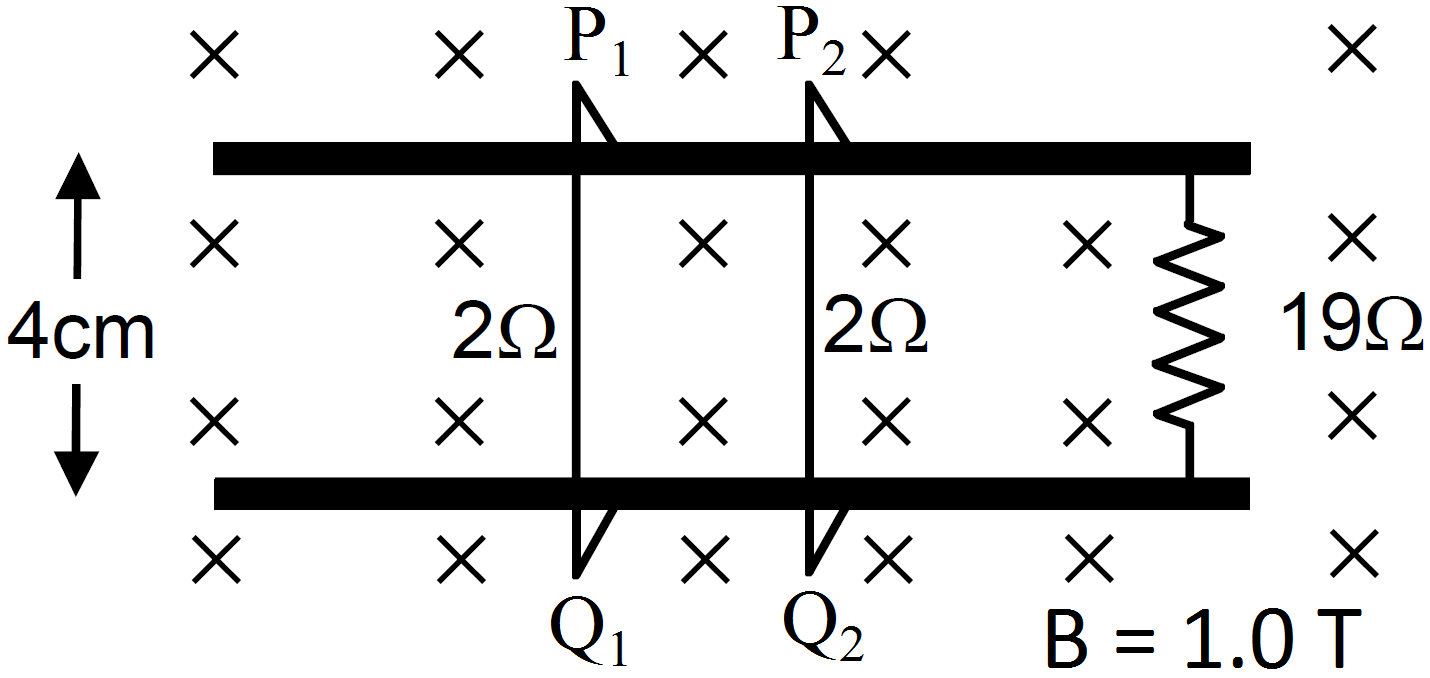
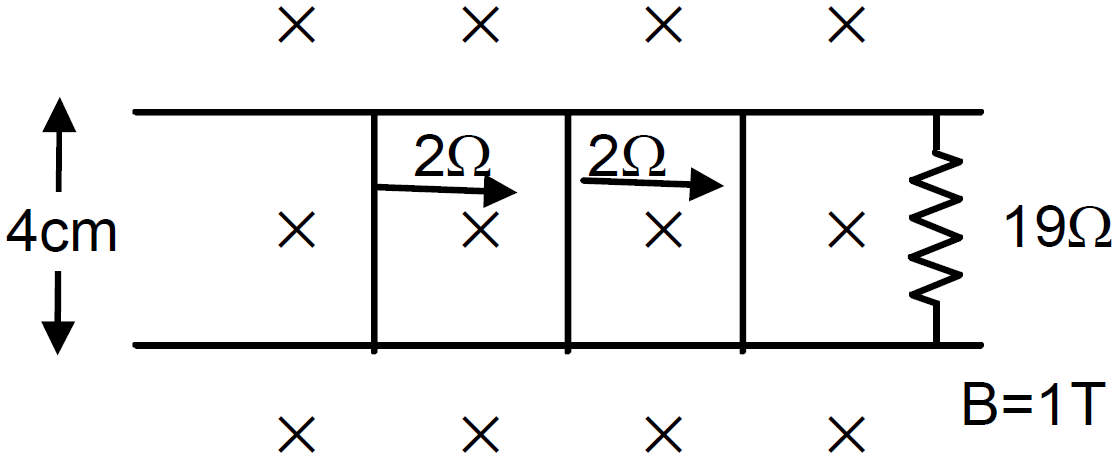
$\therefore$ Net emf $=\text{Blv}=1\times4\times10^{-2}\times5\times10^{-2}=20\times10^{-4}$
Net resistance $=\frac{2\times2}{2+2}+19=20\Omega$
Net current $=\frac{20\times10^{-4}}{20}=0.1\text{mA}$
$\therefore$ Net current = 0
$\therefore\text{e}=\text{BA}\omega$
$\Rightarrow\text{e}=0.010\times25\times10^{-4}\times80\times\frac{2\pi\times\pi}{60}$
$\Rightarrow\text{e}=0.66\times10^{-3}=6.66\times10^{-4}\text{V}$
The average of the squares of emf induced is given by
$\text{e}_{\text{av}^2}=\frac{\int\limits_{0}^{\text{T}}\text{B}^2\text{A}^2\omega^2\sin^2\omega\text{t} \ \text{dt}}{\int\limits_{0}^{\text{T}}\text{dt}}$
$\Rightarrow\text{e}_{\text{av}^2}=\frac{\text{B}^2\text{A}^2\omega^2\int\limits_{0}^{\text{T}} \sin^2\omega\text{t} \ \text{dt}}{\int\limits_{0}^{\text{T}}\text{dt}}$
$\Rightarrow\text{e}_{\text{av}^2}=\frac{\text{B}^2\text{A}^2\omega^2\int\limits_{0}^{\text{T}} (1-\cos2\omega\text{t} )\ \text{dt}}{ \ 2\text{T}}$
$\Rightarrow\text{e}_{\text{av}^2}=\frac{\text{B}^2\text{A}^2\omega^2 }{ 2\text{T}}\Big[\frac{\text{t}-\sin2\omega\text{t}}{ \ 2\omega}\Big]_{0}^{\text{T}}$
$\Rightarrow\text{e}_{\text{av}^2}=\frac{\text{B}^2\text{A}^2\omega^2}{ \ 2\text{T}}\Big[\text{T}-\frac{\sin4\pi-\sin0}{2\omega}\Big]=\frac{\text{B}^2\text{A}^2\omega^2}{2}$
$\Rightarrow\text{e}_{\text{av}^2}=\frac{(6.66\times10^{-4})2}{2}$
$=22.1778\times10^{-8}\text{V}^2 \ \big[\because\text{BA}\omega=6.66\times10^{-4}\text{V}\big]$
$\Rightarrow\text{e}-{\text{av}^2}=2.2\times10^{-7}\text{V}^2$
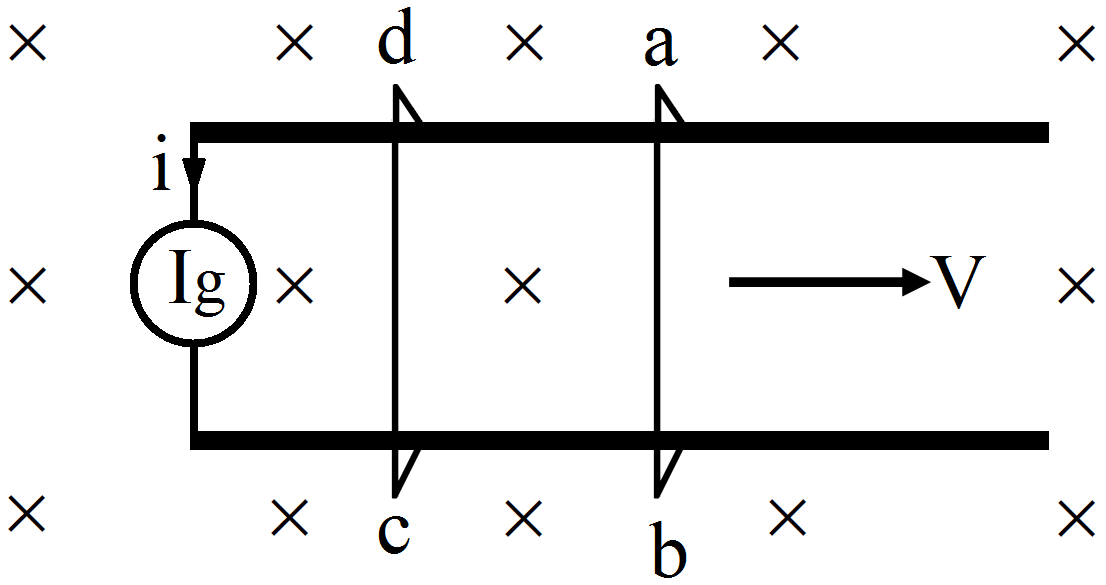
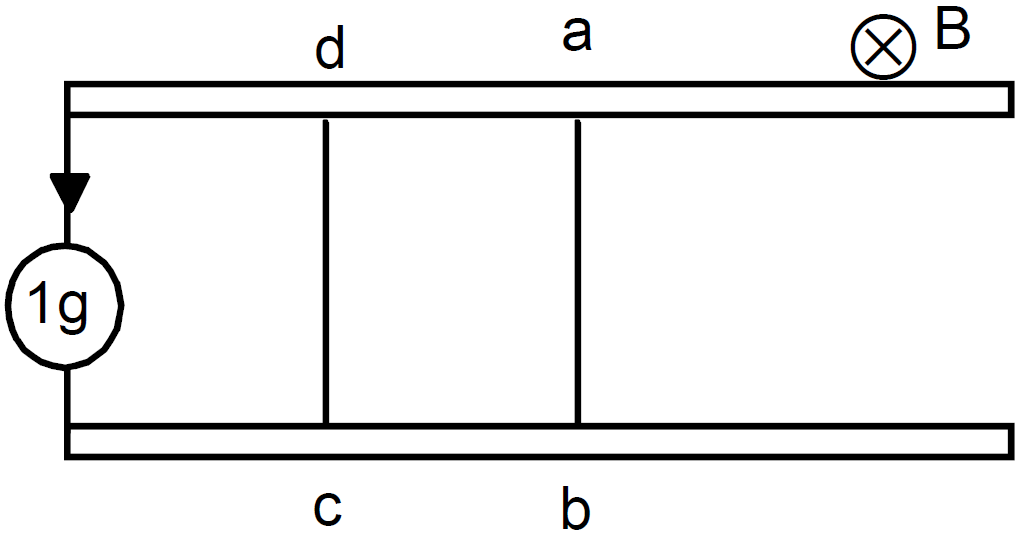
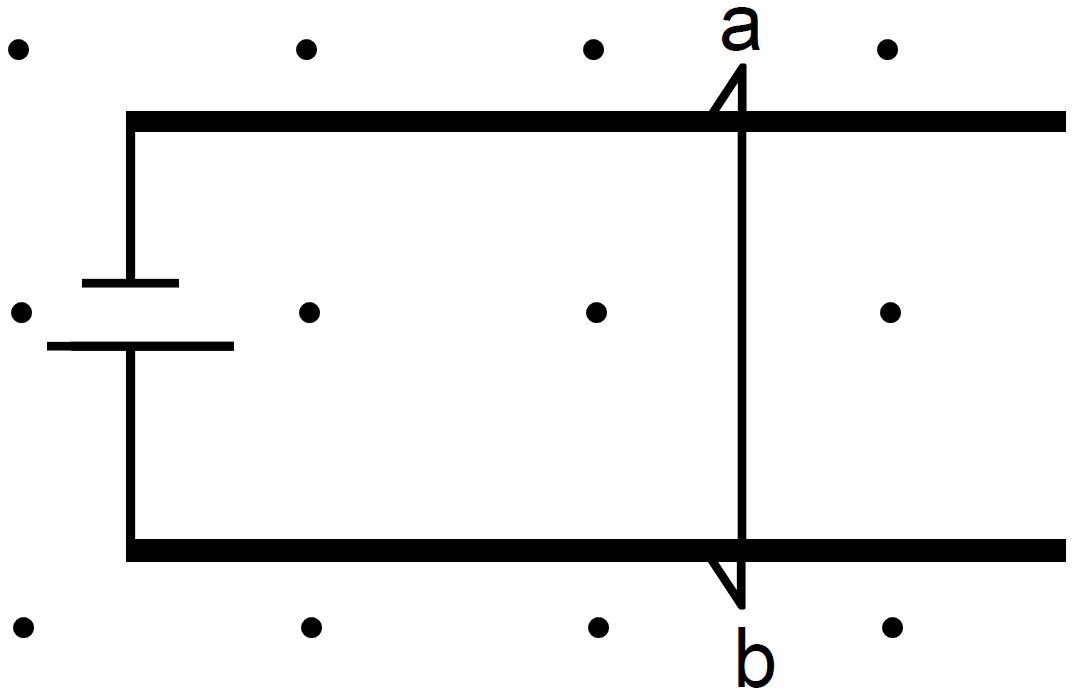
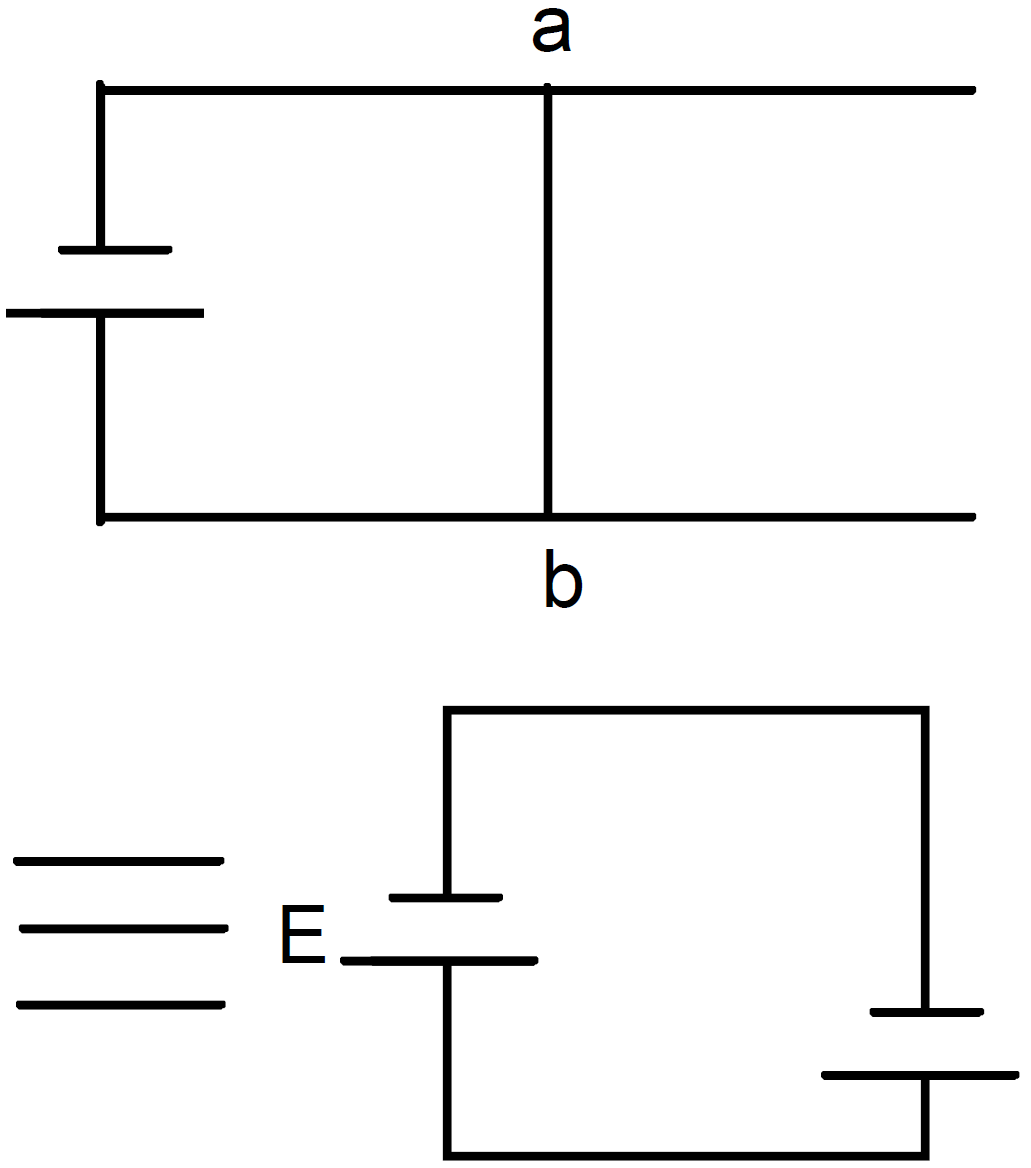
At the given instant, the net emf across the wire (e) is E - Bvl. $\text{i}=\frac{\text{E}-\text{Bvl}}{\text{r}}$
The direction of the current is from b to a.
$\text{F}=\text{ilB}=\Big(\frac{\text{E}-\text{Bvl}}{\text{r}}\Big)$ towards right
The net force on the wire becomes zero. Thus, the wire moves with a constant velocity v.
$\therefore\text{v}=\frac{\text{E}}{\text{Bl}}$

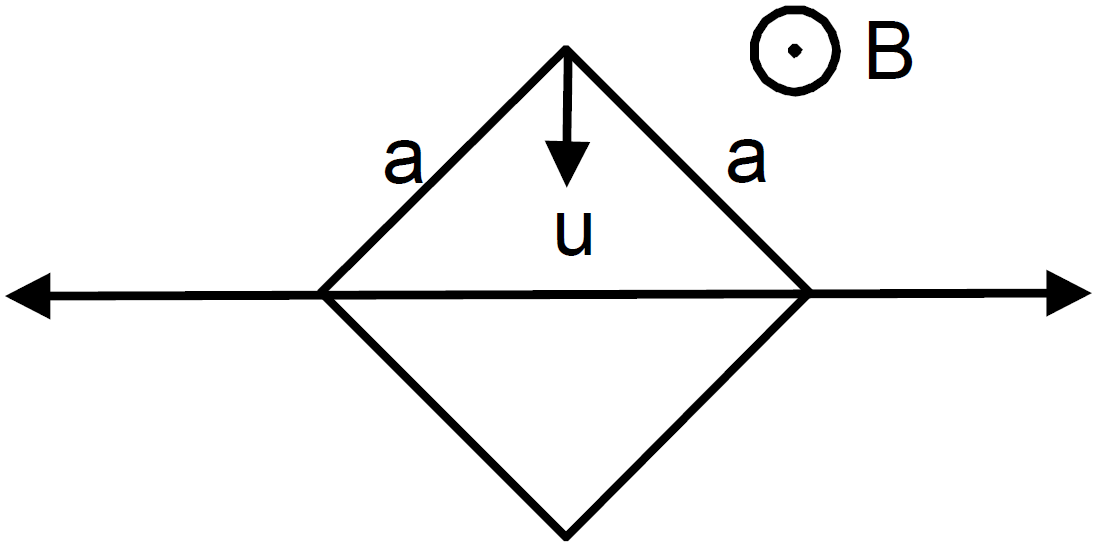
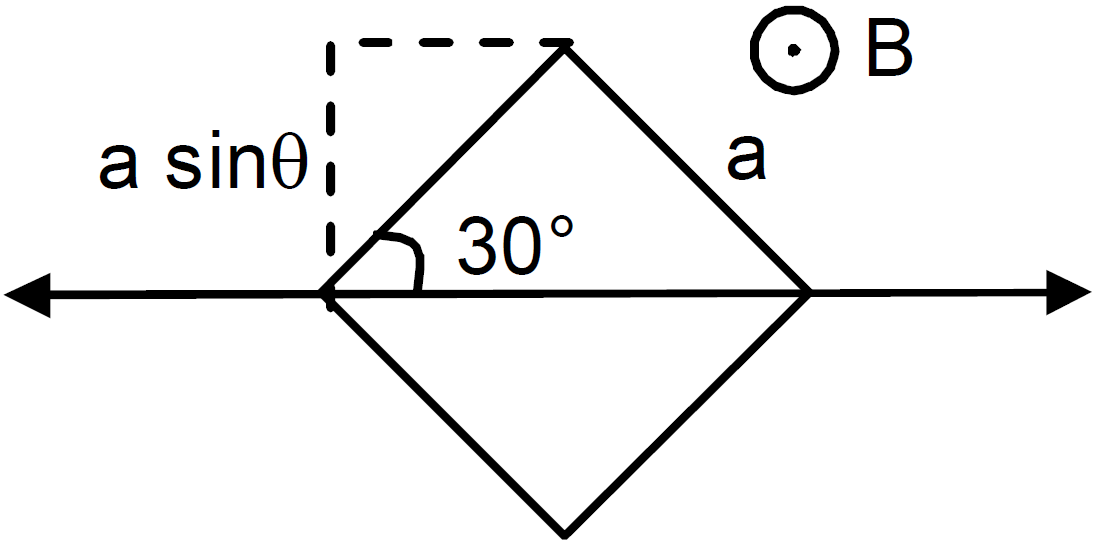
So, $\text{I}=\text{a}\sin\theta \ 30^{\circ}=\frac{\text{a}}{2}$
Net ‘a’ charge $=4\times\frac{\text{a}}{2}=2\text{a}$
So, induced emf $=\text{B}\delta\text{l}=2\text{auB}$
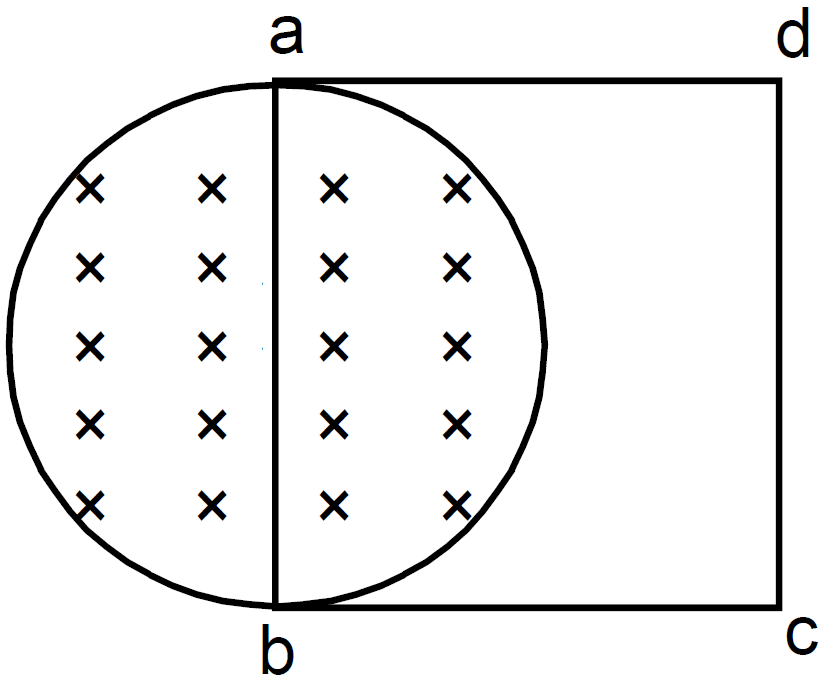
$\text{q}=\frac{\Delta\phi}{\text{R}}$
Here,
$\Delta\phi=$ Change in the flux
R = Resistance of the coil
$\therefore \ \text{q}=\frac{\Delta\phi}{\text{R}}$
$=\frac{\text{B}(\text{a}^2-0)}{\text{R}}$
$=\frac{\text{B}\text{a}^2}{\text{R}}$

We know
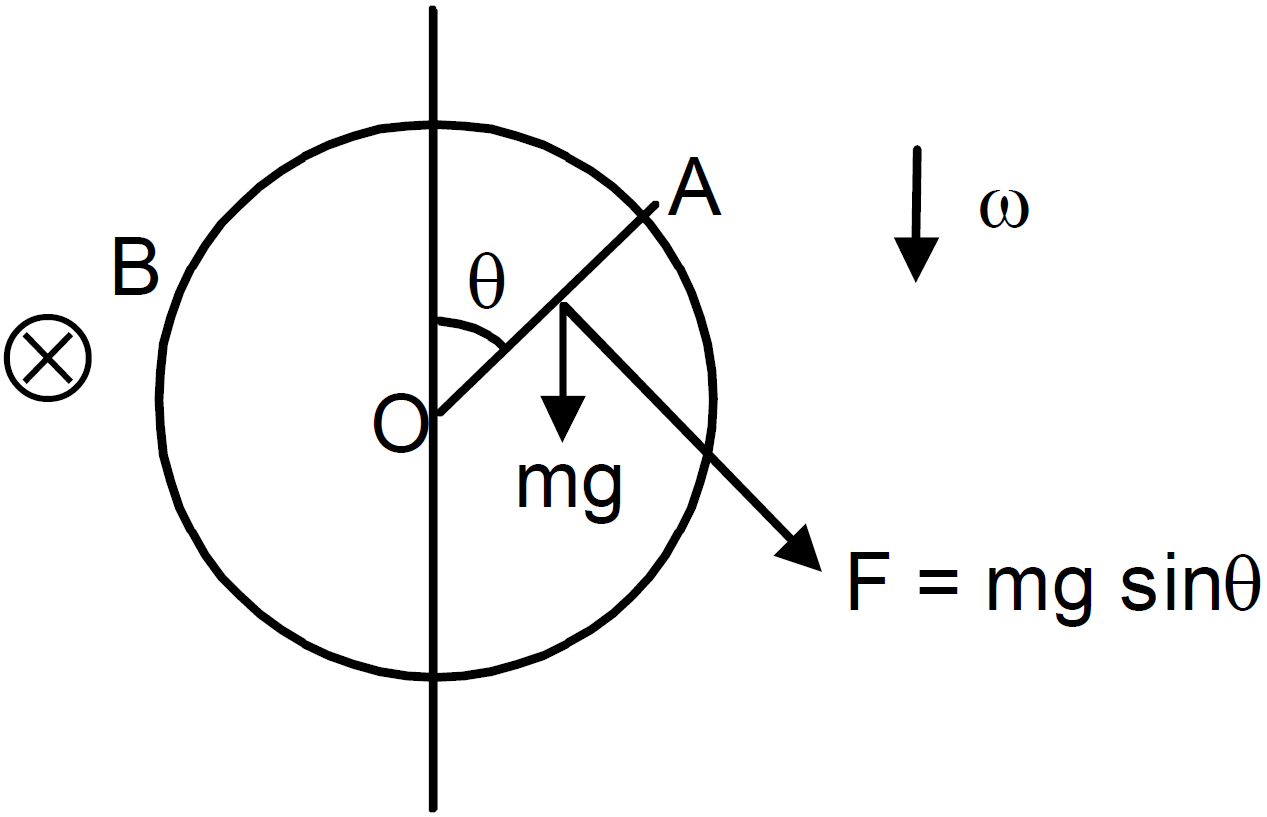
$\text{F}=\frac{\text{B}^2\text{a}^3\omega}{2\text{R}}=\text{il}\text{B}$
Component of mg along $\text{F}=\text{mg } \sin \theta$
Net force $=\frac{\text{B}^2\text{a}^3\omega}{2\text{R}}-\text{mg }\sin\theta$

$\text{B}=0.40\text{T},\omega=10 \ \text{rad}/',\text{r}=10\Omega$
$\text{r}=5\text{cm}=0.05\text{m}$
Considering a rod of length 0.05m affixed at the centre and rotating with the same
$\omega$.$\text{V}=\frac{\text{L}}{2}\times\omega=\frac{0.05}{2}\times10$
$\text{e}=\text{BLV}=0.40\times\frac{0.05}{2}\times10\times0.05=5\times10^{-3}\text{V}$
$\text{L}=\frac{\text{e}}{\text{R}}=\frac{5\times10^{-3}}{10}=0.5 \ \text{mA}$
It leaves from the centre.
$\text{i}=\frac{\text{e}}{\text{R}}=2\text{A}, \text{H}=\text{i}^2\text{RT}$
$=4\times25\times0.25=25\text{J}$
$\text{e}=50\text{V}, \ \text{T}=0.25\text{s}$
$\text{i}=\frac{\text{e}}{\text{R}}=2\text{A}, \text{H}=\text{i}^2\text{RT}=25\text{J}$
Since energy is a scalar quantity
Net thermal energy developed = 25J + 25J = 50J.
Emax = VB2R
$ \text{i}=\text{i}_{0}(1-\text{e}^{\frac{-t}{\tau}})=\frac{4}{20}\Big(1-e^\frac{-0.2}{0.1}\Big) $
$= 0 .17\text{A}$
$\phi$ througth the coil
$\phi=\text{N.B.A}$
$\phi=\text{N.}\mu_0\text{ni}\pi\text{R}^2$
$=\frac{\text{d}}{\text{dt}}\big(\mu_0\text{n}\text{N}\pi\text{R}^2\text{i}\big)$
$=\mu_0\text{nN}\pi\text{R}^2\frac{\text{d}}{\text{dt}}(\text{i}_0\sin\omega\text{t})$
$=\mu_0\text{nN}\pi\text{R}^2\text{i}_0\cos\omega\text{t}\times\omega$
$\text{e}=\mu_0\text{nN}\pi\text{R}^2\text{i}_0\omega\cos\omega\text{t}$
$\text{E}=\mu_0\text{nN}\pi\text{R}^2\frac{\text{d}\text{i}}{\text{dt}}$
$\text{M}=\mu_0\text{nN}\pi\text{R}^2$