Question 11 Mark
Why is it easier to swim in sea water than in fresh water?
Answer
View full question & answer→Density of sea water is more.
23 questions · timed · auto-graded
Let the external Edge of the cubical box be a m.
Total surface area of the cube = 6a?
The volume of the iron in the box = 6a2 × 1 × 10-2
= 6 × 10⁻² a2m2
Now, The mass of iron in the box = Volume x density
= 6 × 10⁻² × a2 × 8000
= 48a2kg
Weight = 48 × 10 = 480N.
The volume of the water displaced = a2cm2 [lt will be equal to volume of cube displaced].
$\therefore$ Upthrust = a2 × 1000 × 10
= 104a2
Now, 104a2 = 480
a = 48 × 10-2m.
Therefore, a = 4.8cm.
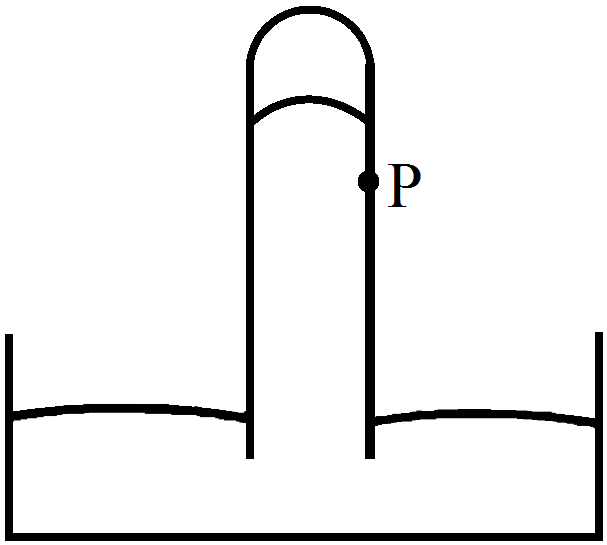
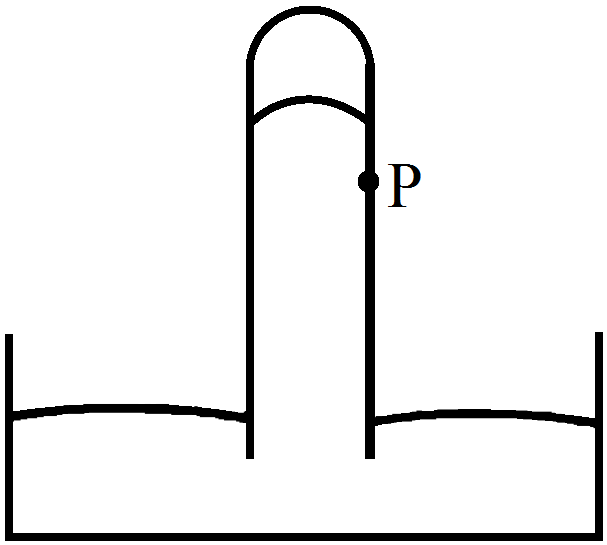 No, as pressure inside is less than atmospherise.
$\Rightarrow\text{v}_\text{A}\times\text{d}\times\text{h}_\text{A}+\text{v}_\text{B}\times\text{d}\times\text{h}_\text{B}=\text{v}_\text{G}\times\text{d}\times\text{h}_\text{G}$
$\Rightarrow20\times12+16\times8=\text{v}_\text{G}\times16$
$\Rightarrow\text{v}_\text{G}\times16=368$
$\Rightarrow\text{v}_\text{G}=\frac{368}{16}=23\text{Km}/\text{h}$
Now, the lead piece does not displace the water, as per as our
mathematical calculations in last question. Only the wooden block
displaces.
Thus, the mass = 250cm2 × 1g/cm2
= 250g
$\therefore$ Upthrust = 250 × g.
Now, (200 + a) × g = 250g
where, a is the mass of the metal lead.
a = 250 - 200
a = 50g
Let the mass of the lead piece be a kg.
Therefore, the total mass of the wood and the lead = 0.2 + akg. Density of lead = Density of water × specific gravity
= 1000 × 11.3 = 11300
Now, The volume of the lead piece $=\frac{\text{a}}{11300}\text{m}^3$
When the wooden block is just allowed to float in water, it displaces a
volume of water equal to its volume =$\frac{200}{0.8}\text{cm}^3=250\text{cm}^3$
$= 250\text{cm}^2 = 0.25\text{m}^2 $
Now, The Total volume of the water displaced $=0.25+\frac{\text{a}}{11300}\text{cm}^2$
Upthrust $= \text{V}\rho\text{g}$
$=\Big(250+\frac{\text{a}}{11300}\Big)\times 1000 \times 10$
Now:
$(0.2+\text{a})\times 10 = \Big(250+\frac{\text{x}}{11300}\Big)\times 1000\times10$
$\therefore \text{a}=54.8\text{g}$$$
Let I be the minimum edge of the block.
Weight of the metal and ice = weight of the water displaced
(0.5 + 0.91%) = 13 × 1 × g
(0.91 + 500) = 13
$\rho=5000$
$\rho = 17.099\text{cm}$
Hence, minimum edge f the block shoud be 17.099cm.
Since the discharge through the tube remains the same i.e. 1cm/s, the speeds at A and B will be the same.
The speed at A,$\text{v}=\frac{1}{0.04}\text{cm}/\text{s}=\frac{100}{4}\text{cm}/\text{s}=25\text{cm}/\text{s}$
The speed at B, $\text{v}'=\frac{1}{0.02}\text{cm}/\text{s}=\frac{100}{2}\text{cm}/\text{s}=50\text{cm}/\text{s}$
Since the end B is upward, we take the end A as a reference level for the height. So the height of end A = 0 and the height of end B = h.
$=\frac{15}{16}\text{cm}$
$=\frac{15}{1600}\text{m}.$
From the Bernoulli's theorem
$\text{p}_\text{a}+\frac{1}{2}\rho\text{v}^2=\text{p}_\beta+\frac{1}{2}\rho\text{v}'^2+\rho\text{gh}$
$\Rightarrow\text{p}_\text{a}-\text{p}_\beta=\frac{1}{2}\text{p}\big(\text{v}^1-\text{v}^2\big)+\rho\text{gh}$
$=\frac{1}{2}\times1000\times\big(0.50^2-0.25^2\big)+1000\times10\times\frac{15}{1600}\text{N}/\text{m}^2$
$=\frac{1}{2}\times1000\times0.75\times0.25+\frac{1500}{16}\text{N}/\text{m}^2$
$=93.75+93.75\text{N}/\text{m}^2$
$=187.5\text{N}/\text{m}^2\approx188\text{N}/\text{m}^2$
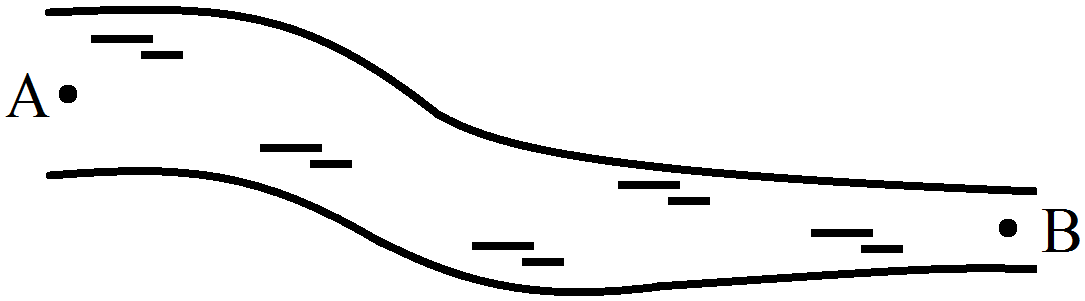
$=\text{h}=5\text{cm}=0.05\text{m}.\text{v}_\text{a}=10\text{cm}/\text{s}=0.10\text{cm}/\text{s}.$
Area of cross- section at $\text{A}=1\text{cm}^2=\frac{1}{10000}\text{m}^2.$
Hence the discharge $\text{Q}=0.10\times\frac{1}{10000}\text{m}^3=10^{-5}\text{m}^3$
Area of cross- section at $\text{B}=0.5\text{cm}^2=\frac{0.5}{10000}\text{m}^2$
The velocity at $\text{B}=\text{v}_\beta=\frac{10^{-5}}{\Big(\frac{0.5}{10000}\Big)}\text{m}/\text{s}=\frac{1}{5}\text{m}/\text{s}$
$=100\times\frac{1}{5}\text{cm}/\text{s}=20\text{cm}/\text{s}$
$\text{p}_\text{a}+\rho\text{gh}+\frac{1}{2}\rho\text{V}\text{a}^2=\text{p}_\beta+\frac{1}{2}\rho\beta^2+\frac{1}{2}\rho\text{v}\beta^2$
$\text{p}_\beta-\text{p}_\text{a}=\rho\text{gh}-\frac{1}{2}\rho\big(\text{V}\beta^2-\text{V}\text{a}^2\big)$
$=1000\times10\times0.05-\frac{1}{2}\times1000\times\big(0.2^2-0.1^2\big)\text{N}/\text{m}^2$
$=500-500\times(0.04-0.01)\text{N}/\text{m}^2$
$500-15\text{N}/\text{m}^2$
$=485\text{N}/\text{m}^2$
$=2\times\text{g}$
Weight of the Fluid Displaced = Upthrust = Volume of of solid immersed × density of water × g$=\pi\text{r}^2\times1\times\text{g}$
where, h is the height and r is the radius of the solid immersed in a water.$\therefore$ Weight of the fluid displaced $\pi(20)^2\text{h}\times1\times\text{g}$
$2000\times\text{g}=\pi(10)^2\text{h}\times1\times\text{g}$
$2000=\pi(10)^2\text{h}$
$2000=\pi\times100\times\text{h}$
$\therefore\text{h}=\frac{20}{\pi}\text{cm}\cdot$
Now, using the formula of the time period,$\text{T}=2\pi\sqrt{\Big(\frac{\text{h}}{\text{g}}\Big)}$
$\text{T}=2\times\frac{22}{7}\times\sqrt{\Big(\frac{20}{\pi}\times980\Big)}$
$\therefore\text{T}=0.51$ seconds.
Hence, the time period of S.H.M. is 0.51 Seconds. Hope it Helps.The spring balance measures the weight of an object. It will show the same weight
for the given iron and the wood block in the vacuum but in the air, a force of
buoyancy will act on both the blocks which will be equal to the weight of the air displaced.
The volume of iron block $=\frac{1}{7800}\text{m}^3$
The volume of wooden block $=\frac{1}{800}\text{m}^3$
The weight of air displaced by iron block$=\frac{1.293\times1}{7800}\text{Kg}$
$=\frac{1.293}{7800}\text{Kg}$
The weight of air displaced by wooden block $=\frac{1.293\times1}{800}\text{Kg}$
$=\frac{1.293}{800}\text{Kg}$
The apparent weight of the iron block shown in the spring balance $=\frac{1-1.293}{7800}\text{Kg}$
$=\frac{(7800-1.293)}{7800}\text{Kg}$
$=\frac{7798.707}{7800}\text{Kg}$
The apparent weight of the wooden block shown in the spring balance $=\frac{1-1.293}{800}\text{Kg}$
$=\frac{(800-1.293)}{800}\text{Kg}$
$=\frac{798.707}{800}\text{Kg}$
Hence the ratio of the apparent weights$=\frac{\Big(\frac{(7798.707)}{7800}\Big)}{\Big(\frac{798.707}{800}\Big)}$
$=\frac{\big(7898.707\times800\big)}{\big(7800\times798.707\big)}$
$=1.0015$