Question 14 Marks
Coulomb's law states that the electrostatic force of attraction or repulsion acting between two stationary point charges is given by
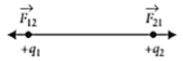
where F denotes the force between two charges $q _1$ and $q _2$ separated by a distance r in free space, $\varepsilon_0$ is a constant known as the permittivity of free space. Free space is a vacuum and may be taken to be air practically. If free space is replaced by a medium, then $\varepsilon_0$ is replaced by $\left(\varepsilon_0 k\right)$ or $\left(\varepsilon_0 \varepsilon_r\right)$ where k is known as dielectric constant or relative permittivity.
(i) In coulomb's law, $F =k \frac{q_1 q_2}{r^2}$, then on which of the following factors does the proportionality constant k depends?
(a) Nature of the medium between the two charges
(b) Distance between the two charges
(c) Electrostatic force acting between the two charges
(d) Magnitude of the two charges
(ii) Dimensional formula for the permittivity constant $\varepsilon_0$ of free space is
(a) $\left[ M ^{-1} L^3 T^2 A^2\right]$
(b) $\left[ ML ^{-3} T^4 A^2\right]$
(c) $\left[ M ^{-1} L^{-3} T^4 A^2\right]$
(d) $\left[ ML ^{-3} T^4 A^{-2}\right]$
(iii) The force of repulsion between two charges of 1 C each, kept 1m apart in vaccum is
(a) $\frac{1}{9 \times 10^9} N$
(b) $\frac{1}{9 \times 10^{12}} N$
(c) $9 \times 10^7 N$
(d) $9 \times 10^9 N$
(iv) Two identical charges repel each other with a force equal to 10 mgwt when they are 0.6 m apart in air. ( $g =$ $10 m s ^{-2}$ ). The value of each charge is
(a) 2 mC
(b) $2 \times 10^{-7} mC$
(c) $2 \mu C$
(d) 2 nC
OR
Coulomb's law for the force between electric charges most closely resembles with
(a) law of conservation of energy
(b) Newton's 2nd law of motion
(c) law of conservation of charge .
(d) Newton's law of gravitation
where F denotes the force between two charges $q _1$ and $q _2$ separated by a distance r in free space, $\varepsilon_0$ is a constant known as the permittivity of free space. Free space is a vacuum and may be taken to be air practically. If free space is replaced by a medium, then $\varepsilon_0$ is replaced by $\left(\varepsilon_0 k\right)$ or $\left(\varepsilon_0 \varepsilon_r\right)$ where k is known as dielectric constant or relative permittivity.
(i) In coulomb's law, $F =k \frac{q_1 q_2}{r^2}$, then on which of the following factors does the proportionality constant k depends?
(a) Nature of the medium between the two charges
(b) Distance between the two charges
(c) Electrostatic force acting between the two charges
(d) Magnitude of the two charges
(ii) Dimensional formula for the permittivity constant $\varepsilon_0$ of free space is
(a) $\left[ M ^{-1} L^3 T^2 A^2\right]$
(b) $\left[ ML ^{-3} T^4 A^2\right]$
(c) $\left[ M ^{-1} L^{-3} T^4 A^2\right]$
(d) $\left[ ML ^{-3} T^4 A^{-2}\right]$
(iii) The force of repulsion between two charges of 1 C each, kept 1m apart in vaccum is
(a) $\frac{1}{9 \times 10^9} N$
(b) $\frac{1}{9 \times 10^{12}} N$
(c) $9 \times 10^7 N$
(d) $9 \times 10^9 N$
(iv) Two identical charges repel each other with a force equal to 10 mgwt when they are 0.6 m apart in air. ( $g =$ $10 m s ^{-2}$ ). The value of each charge is
(a) 2 mC
(b) $2 \times 10^{-7} mC$
(c) $2 \mu C$
(d) 2 nC
OR
Coulomb's law for the force between electric charges most closely resembles with
(a) law of conservation of energy
(b) Newton's 2nd law of motion
(c) law of conservation of charge .
(d) Newton's law of gravitation
Answer
View full question & answer→Coulomb's law states that the electrostatic force of attraction or repulsion acting between two stationary point charges is given by
$F =\frac{1}{4 \pi \varepsilon_0} \frac{q_1 q_2}{r^2}$
where F denotes the force between two charges $q _1$ and $q _2$ separated by a distance r in free space, $\varepsilon_0$ is a constant known as the permittivity of free space. Free space is a vacuum and may be taken to be air practically. If free space is replaced by a medium, then $\varepsilon_0$ is replaced by $\left(\varepsilon_0 k\right)$ or $\left(\varepsilon_0 \varepsilon_r\right)$ where k is known as dielectric constant or relative permittivity.
(i) (a) Nature of the medium between the two charges
Explanation: The proportionality constant k depends on the nature of the medium between the two charges.
(ii) (b) $\left[ ML ^{-3} T^4 A^2\right]$
Explanation: $\left[ ML ^{-3} T^4 A^2\right]$
(iii) (d) $9 \times 10^9 N$
Explanation: $9 \times 10^9 N$
(iv) (c) $2 \mu C$
Explanation: $F =\frac{1}{4 \pi \varepsilon_0} \frac{q_1 q_2}{d^2}$
$\begin{array}{l}\therefore\left(10 \times 10^{-3}\right) \times 10=\frac{\left(9 \times 10^9\right) \times q^2}{(0.6)^2} \\ \text { or } q ^2=\frac{10^{-1} \times 0.36}{9 \times 10^9}=4 \times 10^{-12} \\ \text { or } q =2 \times 10^{-6} C =2 \mu C \end{array}$
OR
(d) Newton's law of gravitation
Explanation: Newton's law of gravitation
$F =\frac{1}{4 \pi \varepsilon_0} \frac{q_1 q_2}{r^2}$
where F denotes the force between two charges $q _1$ and $q _2$ separated by a distance r in free space, $\varepsilon_0$ is a constant known as the permittivity of free space. Free space is a vacuum and may be taken to be air practically. If free space is replaced by a medium, then $\varepsilon_0$ is replaced by $\left(\varepsilon_0 k\right)$ or $\left(\varepsilon_0 \varepsilon_r\right)$ where k is known as dielectric constant or relative permittivity.
(i) (a) Nature of the medium between the two charges
Explanation: The proportionality constant k depends on the nature of the medium between the two charges.
(ii) (b) $\left[ ML ^{-3} T^4 A^2\right]$
Explanation: $\left[ ML ^{-3} T^4 A^2\right]$
(iii) (d) $9 \times 10^9 N$
Explanation: $9 \times 10^9 N$
(iv) (c) $2 \mu C$
Explanation: $F =\frac{1}{4 \pi \varepsilon_0} \frac{q_1 q_2}{d^2}$
$\begin{array}{l}\therefore\left(10 \times 10^{-3}\right) \times 10=\frac{\left(9 \times 10^9\right) \times q^2}{(0.6)^2} \\ \text { or } q ^2=\frac{10^{-1} \times 0.36}{9 \times 10^9}=4 \times 10^{-12} \\ \text { or } q =2 \times 10^{-6} C =2 \mu C \end{array}$
OR
(d) Newton's law of gravitation
Explanation: Newton's law of gravitation