Question 13 Marks
Figure shows a rectangular conducting loop PQRS in which arm RS of length I is movable. The loop is kept in a uniform magnetic field B directed downward perpendicular to the plane of the loop. The arm RS is moved with a uniform speed v.
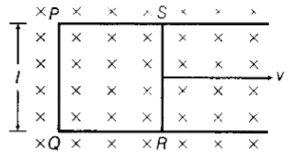
Deduce an expression for
i. the emf induced across the arm RS
ii. the external force required to move the arm and
iii. the power dissipated as heat.
Deduce an expression for
i. the emf induced across the arm RS
ii. the external force required to move the arm and
iii. the power dissipated as heat.
Answer
View full question & answer→i. Let RS moves with speed $v$ rightward and also $R S$ is at distances $x_1$ and $x_2$ from PQ at instants $t_1$ and $t_2$, respectively.
$\begin{array}{l}\text { Change in flux, } d \phi=\phi_2-\phi_1=B l\left(x_2-x_1\right)\left[\because \text { magnetic flux, } \phi=\vec{B} \cdot \vec{A}=B A \cos 0^0=B l x\right] \\
\Rightarrow d \phi=B l d x \Rightarrow \quad \frac{d \phi}{d t}=B l \frac{d x}{d t}=B l v \quad\left[\because v=\frac{d x}{d t}\right]\end{array}$
If resistance of loop is R, then $I=\frac{v B I}{R}$
$\begin{array}{l}\text { ii. Magnetic force }=B I l \sin 90^{\circ} \\ \quad
=\left(\frac{v B l}{R}\right) B l=\frac{v B^2 l^2}{R}\end{array}$
Now, External force must be equal to magnetic force
$\therefore$ External force $=\frac{v B^2 l^2}{R}$
$\begin{array}{l}\text { iii. As, } P=I^2 R=\left(\frac{ v B}{R}\right)^2 \times R=\frac{ v ^2 B^2 l^2}{R^2} \times R \\ \quad
\therefore P=\frac{ v ^2 B^2 l^2}{R}\end{array}$
$\begin{array}{l}\text { Change in flux, } d \phi=\phi_2-\phi_1=B l\left(x_2-x_1\right)\left[\because \text { magnetic flux, } \phi=\vec{B} \cdot \vec{A}=B A \cos 0^0=B l x\right] \\
\Rightarrow d \phi=B l d x \Rightarrow \quad \frac{d \phi}{d t}=B l \frac{d x}{d t}=B l v \quad\left[\because v=\frac{d x}{d t}\right]\end{array}$
If resistance of loop is R, then $I=\frac{v B I}{R}$
$\begin{array}{l}\text { ii. Magnetic force }=B I l \sin 90^{\circ} \\ \quad
=\left(\frac{v B l}{R}\right) B l=\frac{v B^2 l^2}{R}\end{array}$
Now, External force must be equal to magnetic force
$\therefore$ External force $=\frac{v B^2 l^2}{R}$
$\begin{array}{l}\text { iii. As, } P=I^2 R=\left(\frac{ v B}{R}\right)^2 \times R=\frac{ v ^2 B^2 l^2}{R^2} \times R \\ \quad
\therefore P=\frac{ v ^2 B^2 l^2}{R}\end{array}$