Questions

M.C.Q [1M]

🎯

Test yourself on this topic

12 questions · timed · auto-graded

MCQ 11 Mark
How will the image formed by a convex lens be affected if the central portion of the lens is wrapped in a black paper?
  • A
    No image is formed by the remaining portion of the lens
  • B
    Full image will be formed but will be less bright
  • C
    Two images will be formed
  • D
    Central portion of the image will be absent
Answer
(b) Full image will be formed but will be less bright
Explanation: Image will be formed at the same position and same height but intensity of image formed will be less hence its brightness will be less as less number of light rays will form the image. Light rays from the covered portion will not contribute to image formation.  
View full question & answer
MCQ 21 Mark
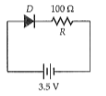
In the given figure, a diode D is connected to an external resistance $R =100 \Omega$ and an emf of 3.5 V . If the barrier potential developed across the diode is 0.5 V , the current in the circuit will be
Image
  • A
    40mA
  • B
    30mA
  • C
    35mA
  • D
    20mA
Answer
(b) 30 mA
Explanation: $I =\frac{V_{\text {pet }}}{R}=\frac{3.5-0.5}{100} A=\frac{3}{100} A=30 mA$
View full question & answer
MCQ 31 Mark
A convex lens is dipped in a liquid whose refractive index is equal to the refractive index of the lens. Then its focal length will:
  • A
    Become infinite
  • B
    Become zero
  • C
    Reduce
  • D
    Remain same as in air
Answer
(a) Become infinite
Explanation: $\frac{1}{f}=\left(\frac{\mu_2}{\mu_1}-1\right)\left(\frac{1}{R_1}-\frac{1}{R_2}\right)$
Since, $\mu_2=\mu_1$, 
$\frac{1}{f}=0$, hence $f=\infty$
View full question & answer
MCQ 41 Mark
If the percentage change in current through a resistor is 1%, then the change in power through it would be:
  • A
    0.5%
  • B
    1 %
  • C
    2%
  • D
    1.7%
Answer
(c) $2 \%$
Explanation: Power, $P = I ^2 R$
$\begin{array}{l}\therefore \frac{\Delta P}{P} \times 100
=2 \frac{\Delta I}{I} \times 100+\frac{\Delta R}{R} \times 100 \\ =2 \times 1 \%+0=2 \%\end{array}$
View full question & answer
MCQ 51 Mark
In Young's double-slit experiment, the intensity of light at a point on the screen where the path difference is $\lambda$ is k ( $\lambda$ being the wavelength of light used). The intensity at a point where the path difference is $\frac{\lambda}{4}$, will be
  • A
    k
  • B
    $\frac{k}{4}$
  • C
    $\frac{k}{2}$
  • D
    zero
Answer
(c) $\frac{k}{2}$
Explanation: Path difference $\lambda$ implies a maximum, so $I _{\max }= k$
$\begin{array}{l}I=I_{\max } \cos ^2 \frac{\phi}{2}=k \cos ^2\left(\frac{1}{2} \cdot \frac{2 \pi}{\lambda} \cdot \frac{\lambda}{4}\right) \\ 
=k \cos ^2 \frac{\pi}{4}=k\left(\frac{1}{\sqrt{2}}\right)^2=\frac{k}{2}\end{array}$
View full question & answer
MCQ 61 Mark
The susceptibility of a magnetic substance is found to depend on temperature and the strength of the magnetising field. The material is a:
  • A
    diamagnet
  • B
    superconductor
  • C
    ferromagnet
  • D
    paramagnet
Answer
(d) paramagnet
Explanation: The susceptibility of a paramagnetic substance depends both on the temperature and strength of the magnetising field.  
View full question & answer
MCQ 71 Mark
If the rotational velocity of dynamo armature is doubled, then induced emf will become:
  • A
    two times
  • B
    half
  • C
    unchanged
  • D
    four times
Answer
(a) two times
Explanation: $\varepsilon=N B A \omega \sin \omega t$ i.e., $\varepsilon \propto \omega$
$\frac{e_2}{\in_1}=\frac{2 \omega}{\omega}=2$
View full question & answer
MCQ 81 Mark
The resistance of a galvanometer is $50 \Omega$ and the current required to give full scale deflection is $100 \mu A$. In order to convert it into an ammeter for reading up to 10 A , it is necessary to put a resistance of
  • A
    $5 \times 10^{-2} \Omega$
  • B
    $5 \times 10^{-5} \Omega$
  • C
    $5 \times 10^{-4} \Omega$
  • D
    $5 \times 10^{-3} \Omega$
Answer
(c) $5 \times 10^{-4} \Omega$
Explanation: $I _{ g }=10^{-4} A$
$\begin{array}{l} I =10 A ; G =50 \Omega \\ 
S=\frac{I_g \times G}{\left(I-I_g\right)} \\ 
=5 \times 10^{-4} \Omega\end{array}$
View full question & answer
MCQ 91 Mark
Three condensers of capacity $2 \mu F, 4 \mu F$ and $8 \mu F$ respectively, are first connected in series and then connected in parallel. The ratio of the equivalent capacitance in the two cases will be
  • A
    7:3
  • B
    3:7
  • C
    4:49
  • D
    49:4
Answer
(c) $4: 49$
Explanation: $\frac{1}{C_s}=\frac{1}{C_1}+\frac{1}{C_2}+\frac{1}{C_3}=\frac{1}{2}+\frac{1}{4}+\frac{1}{8}=\frac{7}{8} ; C_s=\frac{8}{7} \mu F$;
$\begin{array}{l}C_p=C_1+C_2+C_3=2+4+8=14 \mu F \\ 
\frac{C_s}{C_p}=\frac{\frac{8}{7}}{14}=\frac{4}{49}\end{array}$
View full question & answer
MCQ 101 Mark
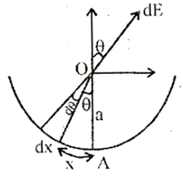
A semi-circular arc of radius 'a' is charged uniformly and the charge per unit lengths is $\lambda$. The electric field at the centre is:
  • A
    $\frac{\lambda}{2 \pi \varepsilon_0 a^2}$
  • B
    $\frac{\lambda}{4 \pi \varepsilon_0 a}$
  • C
    $\frac{\lambda}{2 \pi \varepsilon_0 a}$
  • D
    $\frac{\lambda^2}{2 \pi \varepsilon_0 a}$
Answer
(c) $\frac{\lambda}{2 \pi \varepsilon_0 \alpha}$
Explanation: $\lambda=$ linear charge density;
Charge on elementary portions is given by $dq =\lambda dx$
Image

Electric field at O is given by, $d E=\frac{\lambda d x}{4 \pi \varepsilon_0 a^2}$
Horizontal electric field, i.e., perpendicular to AO, will cancelled.
Hence, net electric field = addition of all electrical fields in direction of AO
$\begin{array}{l}=\sum dE \cos \theta \\ 
\Rightarrow E=\int \frac{\lambda d x}{4 \pi \varepsilon_0 a ^2} \cos \theta\end{array}$
Also, $d \theta=\frac{ d x}{ a }$ or $dx = ad \theta$
$\begin{array}{l}E=\int_{-\pi / 2}^{\pi / 2} \frac{\lambda \cos \theta d \theta}{4 \pi \varepsilon_0 a}=\frac{\lambda}{4 \pi \varepsilon_0 a}[\sin \theta]_{-\pi / 2}^{\frac{\pi}{2}} \\ 
=\frac{\lambda}{4 \pi \varepsilon_0 a}[1-(-1)]=\frac{\lambda}{2 \pi \varepsilon_0 a}\end{array}$ 
View full question & answer
MCQ 111 Mark
A frog can be levitated in a magnetic field produced by a current in a vertical solenoid placed below the frog. This is possible, because the body of the frog behaves as
  • A
    paramagnetic
  • B
    ferromagnetic
  • C
    anti-ferromagnetic
  • D
    diamagnetic
Answer
(d) diamagnetic
Explanation: To levitate a body, a force must be applied on it which at least balances the body's weight. Since weight will always pull the frog down, the magnetic force on the frog due to the vertical solenoid placed below it must act in the upward direction. Thus, the frog is repelled by the magnetic field. Diamagnetic substances are the only substances which are repelled by a magnetic field. This shows that the body of the frog behaves diamagnetically.  
View full question & answer
MCQ 121 Mark
The resistivity of a semiconductor at room temperature is in between:
  • A
    $10^{-3}$ to $10^6 \Omega cm$
  • B
    $10^{10}$ to $10^{12} \Omega cm$
  • C
    $10^{-2}$ to $10^{-5} \Omega cm$
  • D
    $10^6$ to $10^8 \Omega cm$
Answer
(a) $10^{-3}$ to $10^6 \Omega cm$
Explanation: Resistivity of a semiconductor at room temp, is in between $10^{-3}$ to $10^6 \Omega cm$.
View full question & answer
M.C.Q [1M] - Physics STD 12 Science Questions - Vidyadip