Question 13 Marks
Derive the formula for the force acting on current carrying rod placed in a magnetic field.
Answer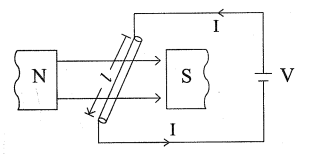
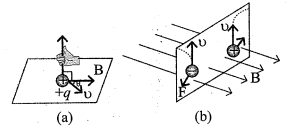
→As shown in figure, consider a uniform conducting rod of length $l$ and cross-sectional area A.
→Suppose the number density of mobile charge carriers (moving charges) in conductor is $n$. Hence, the total number of (free) electric charges will be $n A l$.
→In this conduction rod, a steady current is I and the drift velocity of electron is $\overrightarrow{v_d}$. In the presence of an external magnetic field $\vec{B}$ The force on these carriers is
$\overrightarrow{ F }=(n l A) q\left(\overrightarrow{v_d} \times \overrightarrow{ B }\right)$
Where, $q\left(\overrightarrow{v_d} \times \vec{B}\right)$ is magnetic force acting on one particle.
→But, electric current density
$\therefore \vec{j}=n q \overrightarrow{v_d}$
→From, equation (1) and (2)
$\overrightarrow{ F }=\vec{j} l A \times \overrightarrow{ B }$
→Hence, current density $\hat{j}$ and length $l$ both are in the same direction.
So, $\vec{j} l=\vec{l} j$
→So, the equation becomes
$\overrightarrow{ F }=j \vec{l} A \times \overrightarrow{ B }$
But $I =j A$
$\therefore \overrightarrow{ F }= I (\vec{l} \times \overrightarrow{ B })$
→Where, $\vec{l}$ is a vector magnitude of $l$ and it is in the direction of the current I .
→Here equation (3) is only applicable for a straight rod. In this equation $\vec{B}$ is the external magnetic field. It is not the magnetic field which is produced by the current carrying rod.
→If the wire has an arbitrary shape, we consider the wire is made up of rubber & linear strips of $d l$ and by summing up the force.
$\overrightarrow{ F }=\sum_j I d \vec{l}_j \times \overrightarrow{ B }$
If $d l \rightarrow 0$, then it is converted in to an integral.
$\overrightarrow{ F }=\int I d \vec{l} \times \overrightarrow{ B }$
• Special Cases :
(i) If $\theta=0$ or $\theta=\pi$ then
$F = Bl l \sin \theta=0$
because, $\sin 0=\sin \pi=0$
→Thus, if the current is parallel or antiparallel to the external magnetic field, the magnetic force on the conductor is zero.
(ii) If $\theta=\frac{\pi}{2}$ then, $F = BI l \sin \theta= BI l$ because, $\sin \frac{\pi}{2}=+1$
Thus, if the current and the external magnetic field are mutually perpendicular, the magnetic force on the conductor is maximum.
→Note :
→The magnetic force exerted on a current-carrying wire placed in a uniform magnetic field.
$\overrightarrow{ F }= I \vec{l} \times \overrightarrow{ B }$
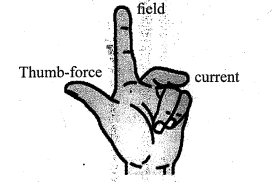
→The direction of this force can be obtained using Fleming's left hand rule.
→"As shown in the diagram, the first finger of the left hand is placedin the direction of the magnetic field and the middle finger in the direction of the current, the direction of the thumb represents the direction of magnetic force."
View full question & answer→→As shown in figure, consider a uniform conducting rod of length $l$ and cross-sectional area A.
→Suppose the number density of mobile charge carriers (moving charges) in conductor is $n$. Hence, the total number of (free) electric charges will be $n A l$.
→In this conduction rod, a steady current is I and the drift velocity of electron is $\overrightarrow{v_d}$. In the presence of an external magnetic field $\vec{B}$ The force on these carriers is
$\overrightarrow{ F }=(n l A) q\left(\overrightarrow{v_d} \times \overrightarrow{ B }\right)$
Where, $q\left(\overrightarrow{v_d} \times \vec{B}\right)$ is magnetic force acting on one particle.
→But, electric current density
$\therefore \vec{j}=n q \overrightarrow{v_d}$
→From, equation (1) and (2)
$\overrightarrow{ F }=\vec{j} l A \times \overrightarrow{ B }$
→Hence, current density $\hat{j}$ and length $l$ both are in the same direction.
So, $\vec{j} l=\vec{l} j$
→So, the equation becomes
$\overrightarrow{ F }=j \vec{l} A \times \overrightarrow{ B }$
But $I =j A$
$\therefore \overrightarrow{ F }= I (\vec{l} \times \overrightarrow{ B })$
→Where, $\vec{l}$ is a vector magnitude of $l$ and it is in the direction of the current I .
→Here equation (3) is only applicable for a straight rod. In this equation $\vec{B}$ is the external magnetic field. It is not the magnetic field which is produced by the current carrying rod.
→If the wire has an arbitrary shape, we consider the wire is made up of rubber & linear strips of $d l$ and by summing up the force.
$\overrightarrow{ F }=\sum_j I d \vec{l}_j \times \overrightarrow{ B }$
If $d l \rightarrow 0$, then it is converted in to an integral.
$\overrightarrow{ F }=\int I d \vec{l} \times \overrightarrow{ B }$
• Special Cases :
(i) If $\theta=0$ or $\theta=\pi$ then
$F = Bl l \sin \theta=0$
because, $\sin 0=\sin \pi=0$
→Thus, if the current is parallel or antiparallel to the external magnetic field, the magnetic force on the conductor is zero.
(ii) If $\theta=\frac{\pi}{2}$ then, $F = BI l \sin \theta= BI l$ because, $\sin \frac{\pi}{2}=+1$
Thus, if the current and the external magnetic field are mutually perpendicular, the magnetic force on the conductor is maximum.
→Note :
→The magnetic force exerted on a current-carrying wire placed in a uniform magnetic field.
$\overrightarrow{ F }= I \vec{l} \times \overrightarrow{ B }$
→The direction of this force can be obtained using Fleming's left hand rule.
→"As shown in the diagram, the first finger of the left hand is placedin the direction of the magnetic field and the middle finger in the direction of the current, the direction of the thumb represents the direction of magnetic force."