The acceleration of a particle is zero as measured from an inertial frame of reference. Can we conclude that no force acts on the particle?
Question types
Newton’s Laws of Motion question types
82 questions across 5 question groups — pick any mix to generate a Physics paper with step-by-step answer keys.
82
Questions
5
Question groups
5
Question types
01
1 Marks Question
5 Q→02Short Answer Type Questions [2M]
14 Q→033 Marks Question
12 Q→044 Marks Questions
6 Q→05Long Answer Type Questions [5M]
45 Q→Sample Questions
Newton’s Laws of Motion questions
One sample from each question group in this chapter. Select any group above to see the full set with answer keys.
View full solution →
Consider a book lying on a table. The weight of the book and the normal force by the table on the book are equal in magnitude and opposite in direction. Is this an example of Newton's third law?
Raindrops of radius 1mm and mass 4mg are falling with a speed of 30m/s on the head of a bald person. The drops splash on the head and come to rest. Assuming equivalently that the drops cover a distance equal to their radii on the head, estimate the force exerted by each drop on the head.
Two blocks A and B of mass mA and mB respectively are kept in contact on a frictionless table. The experimenter pushes the block A from behind so that the blocks accelerate. If the block A exerts a force F on the block B, what is the force exerted by the experimenter on A?
An object is placed far away from all the objects that can exert force on it. A frame of reference is constructed by taking the origin and axes fixed in this object. Will the frame be necessarily inertial?
A spy jumps from an airplane with his parachute. The spy accelerates downward for some time when the parachute opens. The acceleration is suddenly checked and the spy slowly falls on the ground. Explain the action of parachute in checking the acceleration.
Is it possible for a particle to describe a curved path if no force acts on it? Does your answer depend on the frame of reference chosen to view the particle?
When a train starts, the head of a standing passenger seems to be pushed backward. Analyse the situation from the ground frame. Does it really go backward? Coming back to the train frame, how do you explain the backward movement of the head on the basis of Newton's laws?
A block of mass 2kg placed on a long frictionless horizontal table is pulled horizontally by a constant force F. It is found to move 10m in the first two seconds. Find the magnitude of F.
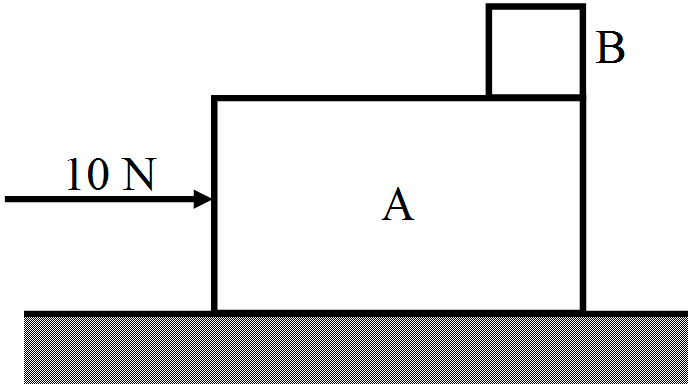
A small block B is placed on another block A of mass 5kg and length 20cm. Initially the block B is near the right end of block A. A constant horizontal force of 10N is applied to the block A. All the surfaces are assumed frictionless. Find the time elapsed before the block B separates from A.
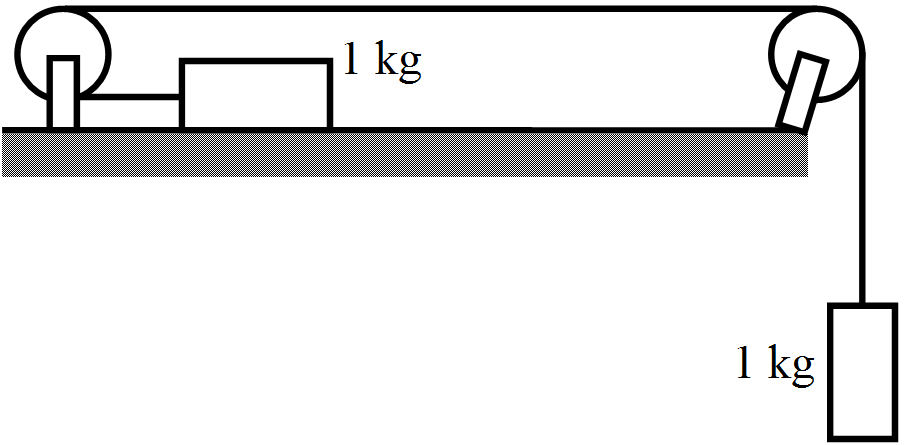
Calculate the tension in the string shown in figure. The pulley and the string are light and all surfaces are frictionless. Take g = 10m/s2.
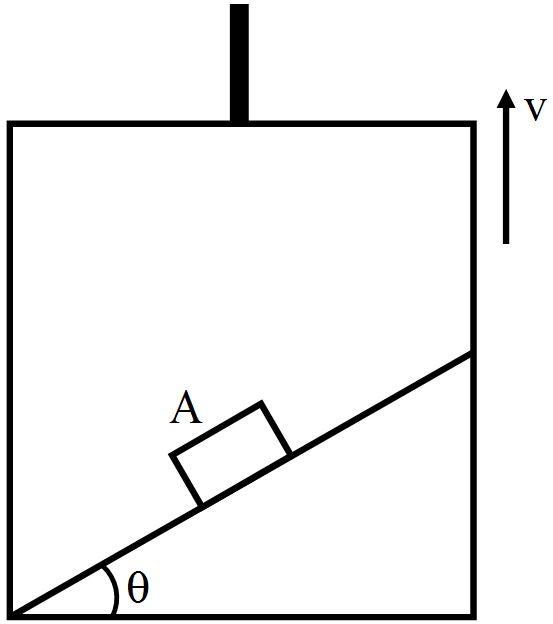
A block A can slide on a frictionless incline of angle $\theta$ and length l, kept inside an elevator going up with uniform velocity v. Find the time taken by the block to slide down the length of the incline if it is released from the top of the incline.
View full solution →A monkey of mass 15kg is climbing on a rope with one end fixed to the ceiling. If it wishes to go up with an acceleration of 1m/s2, how much force should it apply to the rope? If the rope is 5m long and the monkey starts from rest, how much time will it take to reach the ceiling?
A force $\overrightarrow{\text{F}}=\overrightarrow{\text{v}}\times\overrightarrow{\text{A}}$ is exerted on a particle in addition to the force of gravity, where v is the velocity of the particle and $\overrightarrow{\text{A}}$ is a constant vector in the horizontal direction. With what minimum speed a particle of mass m be projected so that it continues to move undeflected with a constant velocity?
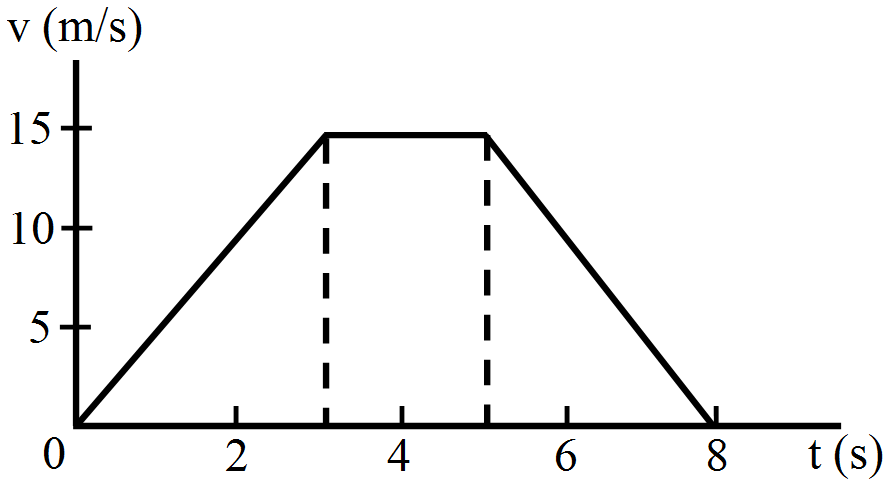
View full solution →A particle of mass 50g moves on a straight line. The variation of speed with time is shown in figure. Find the force acting on the particle at t = 2, 4 and 6 seconds.
Suppose you are running fast in a field when you suddendly find a snake in front of you. You stop quickly. Which force is responsible for your deceleration?
A plumb bob is hung from the ceiling of a train compartment. If the train moves with an acceleration 'a' along a straight horizontal track, the string supporting the bob makes an angle $\tan^{-1}\Big(\frac{\text{a}}{\text{g}}\Big)$ with the normal to the ceiling. Suppose the train moves on an inclined straight track with uniform velocity. If the angle of incline is $\tan^{-1}\Big(\frac{\text{a}}{\text{g}}\Big),$ the string again makes the same angle with the normal to the ceiling. Can a person sitting inside the compartment tell by looking at the plumb line whether the train is accelerated on a horizontal straight track or it is going on an incline? If yes, how? If no, suggest a method to do so.
View full solution →A person is standing on a weighing machine placed on the floor of an elevator. The elevator starts going up with some acceleration, moves with uniform velocity for a while and finally decelerates to stop. The maximum and the minimum weights recorded are 72kg and 60kg. Assuming that the magnitudes of the acceleration and the deceleration are the same, find:
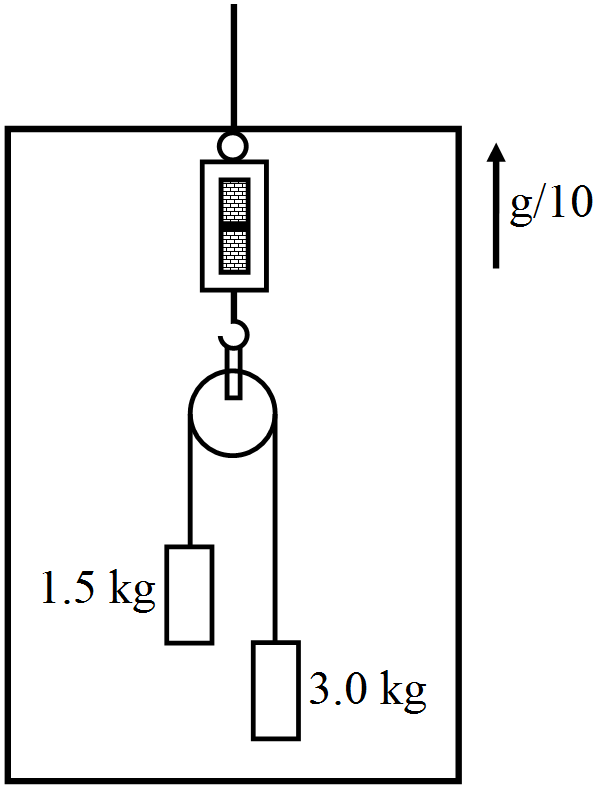
- The true weight of the person.
- The magnitude of the acceleration. Take g = 9.9m/s2.
Two blocks of unequal masses are tied by a spring. The blocks are pulled stretching the spring slightly and the system is released on a frictionless horizontal platform. Are the forces due to the spring on the two blocks equal and opposite? If yes, is it an example of Newton's third law?
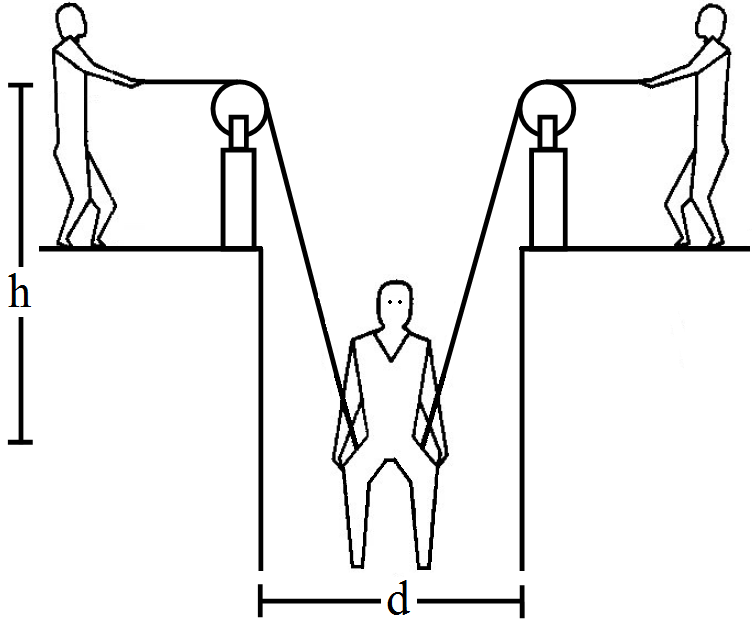
A man has fallen into a ditch of width d and two of his friends are slowly pulling him out using a light rope and two fixed pulleys as shown in figure. Show that the force (assumed equal for both the friends) exerted by each friend on the road increases as the man moves up. Find the force when the man is at a depth h.
Consider the situation shown in figure. Both the pulleys and the string are light and all the surfaces are frictionless.
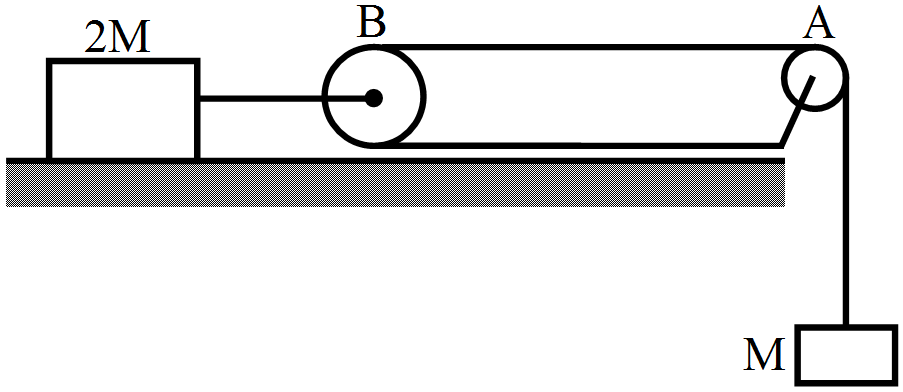
- Find the acceleration of the mass M.
- Find the tension in the string.
- Calculate the force exerted by the clamp on the pulley A in the figure.
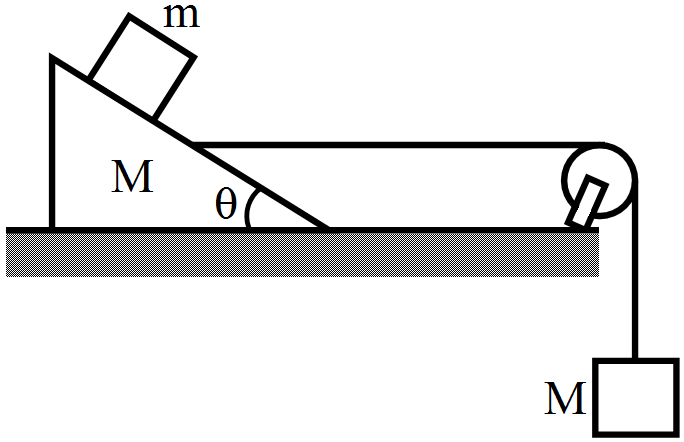
Find the mass M of the hanging block in figure which will prevent the smaller block from slipping over the triangular block. All the surfaces are frictionless and the strings and the pulleys are light.
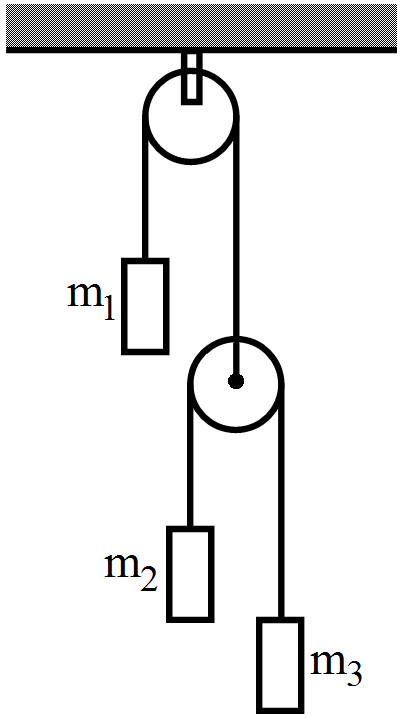
Let m1 = 1kg, m2 = 2kg and m3 = 3kg in figure. Find the accelerations of m1, m2 and m3. The string from the upper pulley to m1 is 20cm when the system is released from rest. How long will it take before m, strikes the pulley?
The force exerted by the floor of an elevator on the foot of a person standing there is more than the weight of the person if the elevator is:
- Going up and slowing down.
- Going up and speeding up.
- Going down and slowing down.
- Going down and speeding up.
A force F1 acts on a particle so as to accelerate it from rest to a velocity v. The force F1 is then replaced by F2 which decelerates it to rest:
- F1 must be equal to F2.
- F1 may be equal to F2.
- F1 must be unequal to F2.
- None of these.
Generate a Newton’s Laws of Motion paper free
Pick question groups from the list above, set marks and difficulty, and export a branded PDF with step-by-step answer keys. First 3 chapters free — no signup.