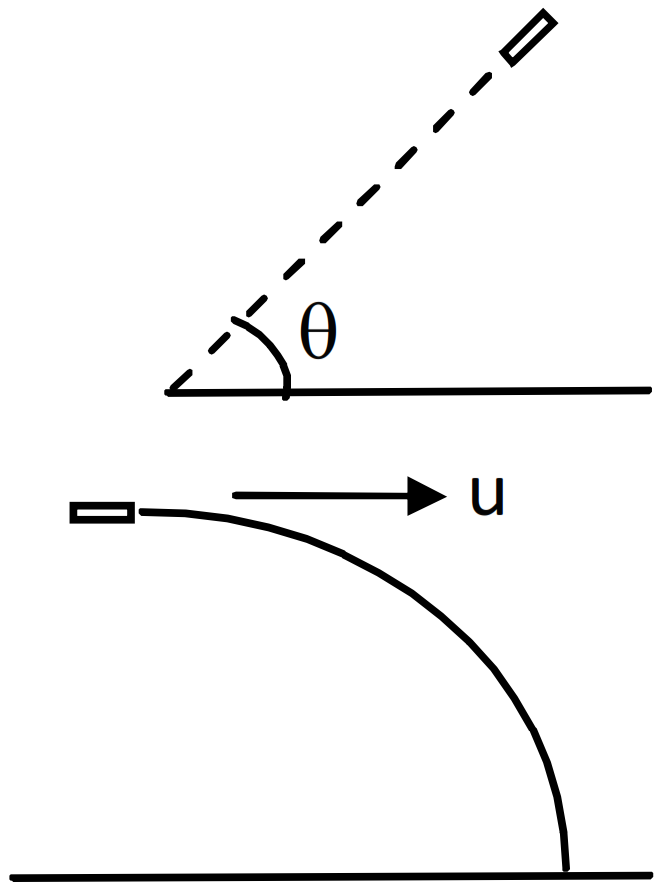
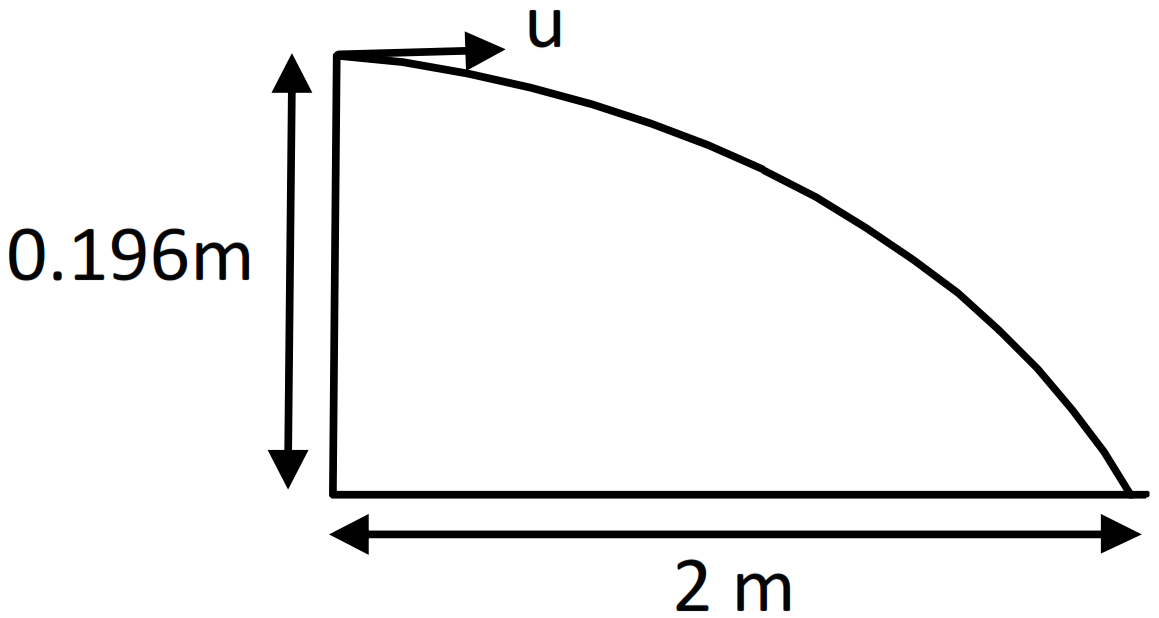
$\text{t}=\sqrt{\frac{2\text{h}}{\text{g}}}=\sqrt{\frac{2\times0.196}{9.8}}=0.2\sec$
Horizontal velocity with which it is projected be u.$\therefore\text{x = ut}$
$\Rightarrow\text{u}=\frac{\text{x}}{\text{t}}=\frac{2}{0.2}=10\text{m/s}.$
22 questions · timed · auto-graded
$\text{t}=\sqrt{\frac{2\text{h}}{\text{g}}}=\sqrt{\frac{2\times0.196}{9.8}}=0.2\sec$
Horizontal velocity with which it is projected be u.$\therefore\text{x = ut}$
$\Rightarrow\text{u}=\frac{\text{x}}{\text{t}}=\frac{2}{0.2}=10\text{m/s}.$
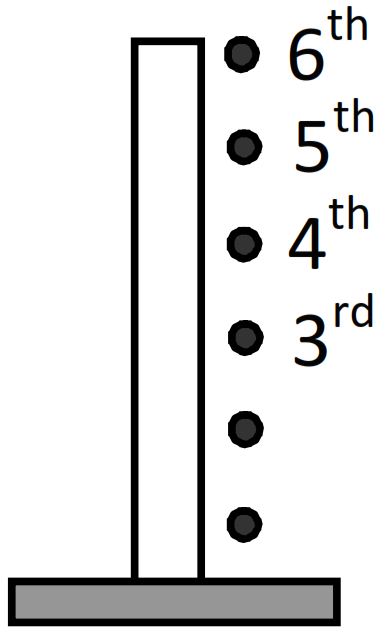
$\therefore$ 4th ball move for 2 sec, 5th ball 1 sec and 3rd ball 3 sec when 6th ball is being dropped.
For 3rd ball t = 3 sec$\text{S}_3=\text{ut}+\frac{1}{2}\text{at}^2=0+\frac{1}{2}(9.8)3^2=4.9\text{m}$ below the top.
For 4th ball, t = 2 sec$\text{S}_2=0+\frac{1}{2}\text{ gt}^2=\frac{1}{2}(9.8)2^2=19.6\text{m}$ below the top (u = 0)
For 5th ball, t = 1 sec$\text{S}_3=\text{ut}+\frac{1}{2}\text{at}^2=0+\frac{1}{2}(9.8)\text{t}^2=4.98\text{m}$ below the top.

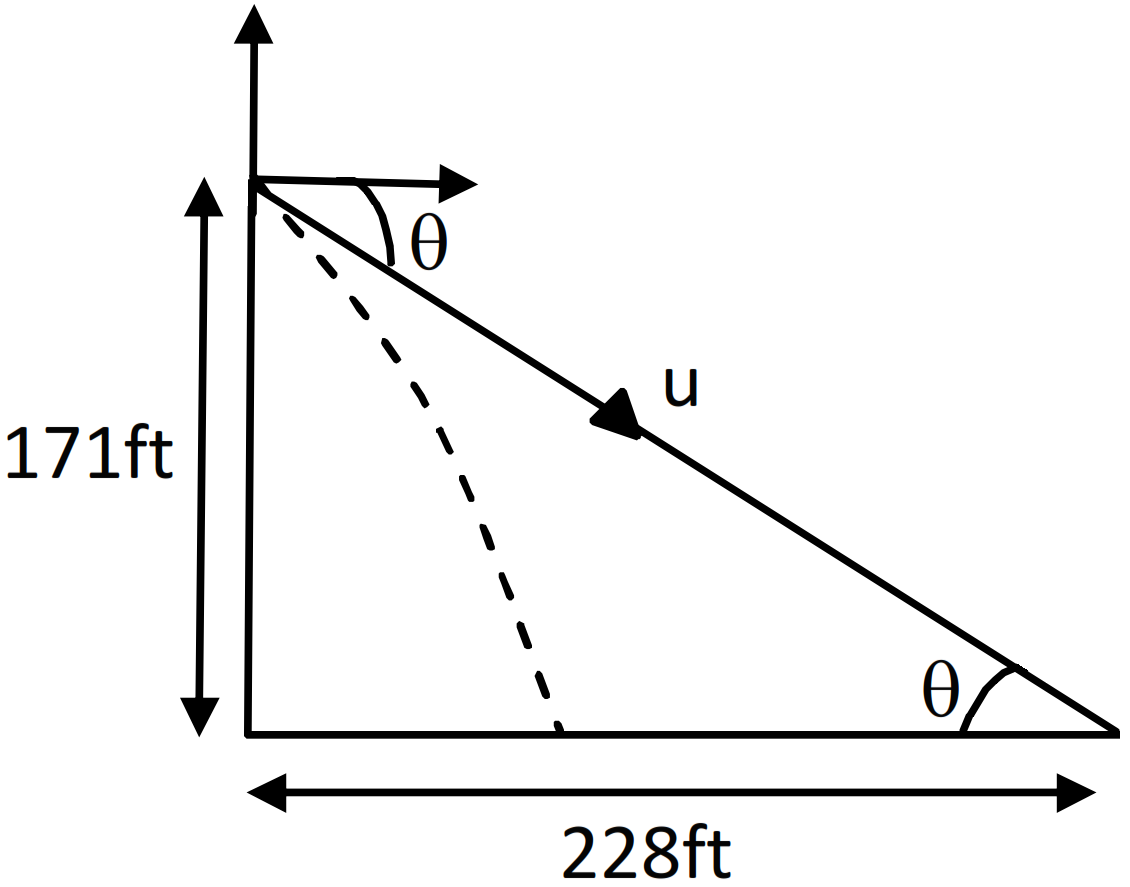
$\Rightarrow\theta=\tan^{-1}\Big(\frac{171}{228}\Big)$
The motion of projectile (i.e. the packed) is from A. Taken reference axis at A.
$\therefore\theta=-37^{\circ}$ as u is below x-axis.
u = 15ft/s, g = 32.2ft/s2, y = -171ft
$\text{y = x}\tan\theta-\frac{\text{x}^2\text{g}\sec^2\theta}{2\text{u}^2}$
$\therefore-171=-\text{x}(0.7536)-\frac{\text{x}^2\text{g}(1.568)}{2(225)}$
$\Rightarrow0.1125\text{x}^2+0.7536\text{x}-171=0$
$\text{}=35.78\text{ft}$
Horizontal range covered by the packet is 35.78ft.
So, the packet will fall 228 - 35.78 = 192ft short of his friend.

Displacement → Distance between final and initial position.

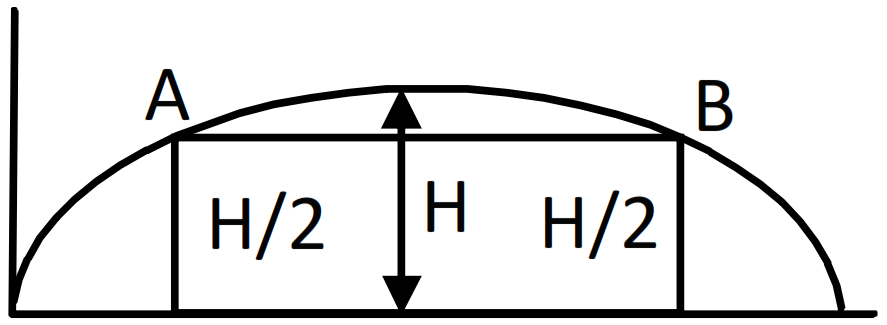
maximum height reached = 125m
$\text{v}^2-\text{u}^2=2\text{as}$
$\Rightarrow\text{v}=\sqrt{(\text{u}^2+2\text{as})}=\sqrt{50^2+(-10)(62.5)}=35\text{m/s}.$

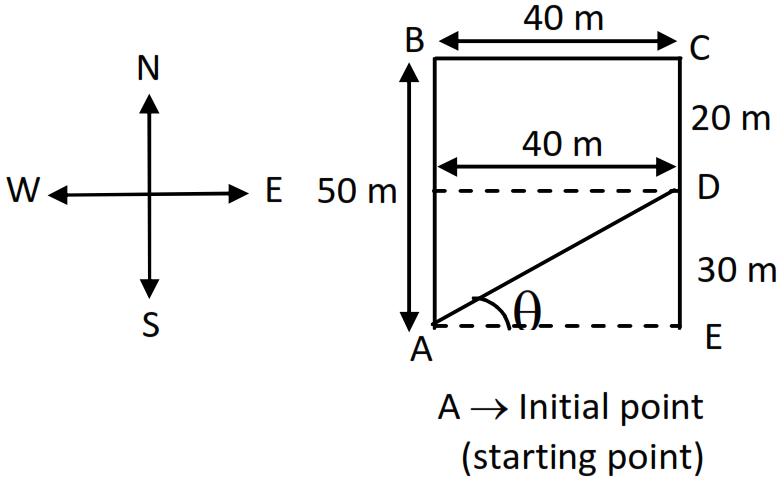
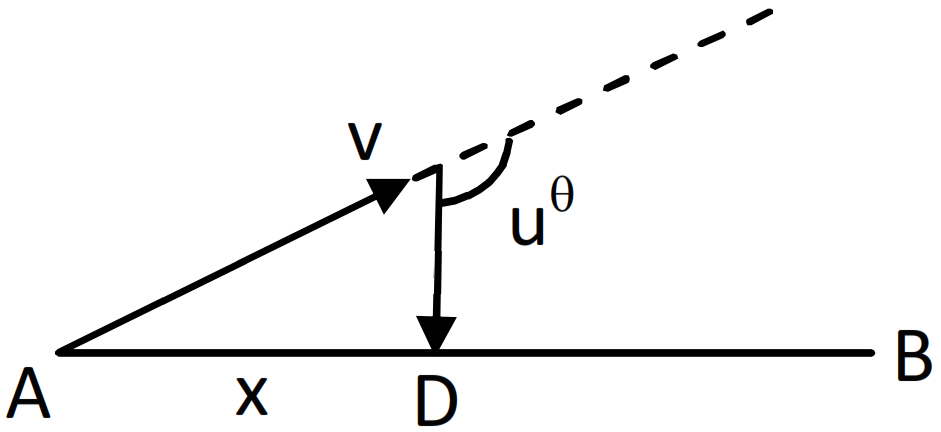
His displacement is AD
$\text{AD}=\sqrt{\text{AF}^2-\text{DF}^2}=\sqrt{30^2+40^2}=50\text{m}$
In $\triangle\text{AED}$
$\Rightarrow\tan\theta=\frac{\text{DE}}{\text{AE}}=\frac{30}{40}=\frac{3}{4}$
$\Rightarrow\theta=\tan^{-1}\Big(\frac{3}{4}\Big)$
His displacement from his house to the field is 50m, $\tan^{-1}\Big(\frac{3}{4}\Big)$ north to east.

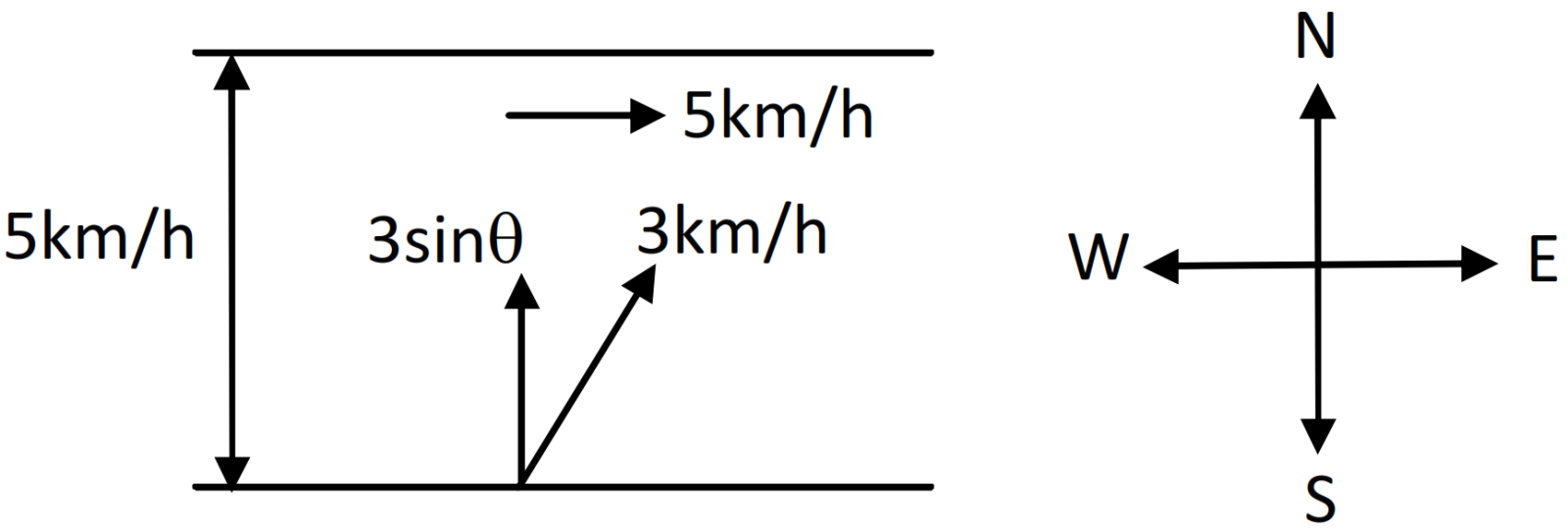
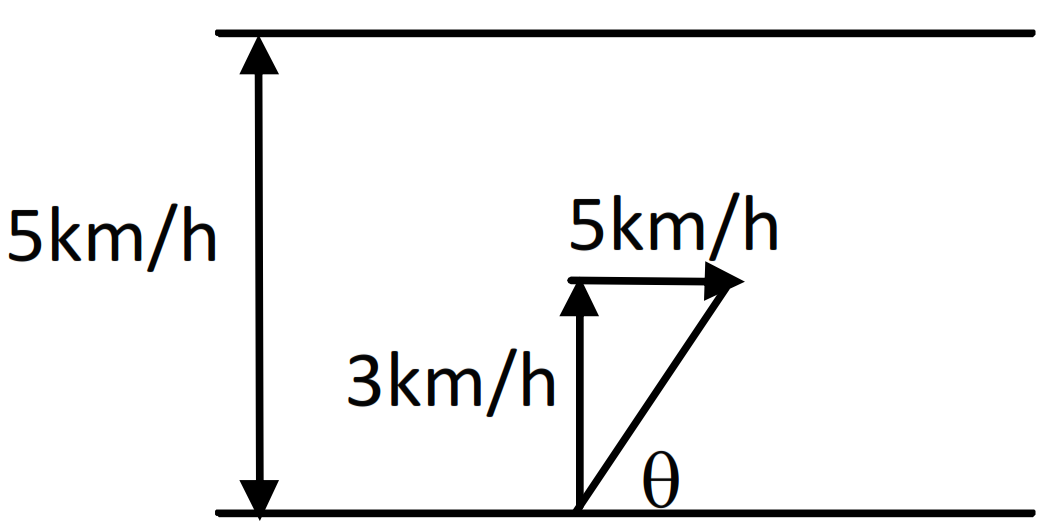
$\text{Distance = 0.5km, velocity = 3}\sin\theta\text{km/h}$
$\text{Time}=\frac{\text{Distance}}{\text{Velocity}}$
$=\frac{0.5}{3\sin\theta}\text{hr}$
$=\frac{10}{\sin\theta}\text{min}.$

$\text{Time}=\frac{\text{Distance}}{\text{Velocity}}$
$=\frac{0.5}{3}=0.16\text{hr}$
$\therefore0.16\text{hr}=60\times0.16=9.6=10\text{ minute.}$

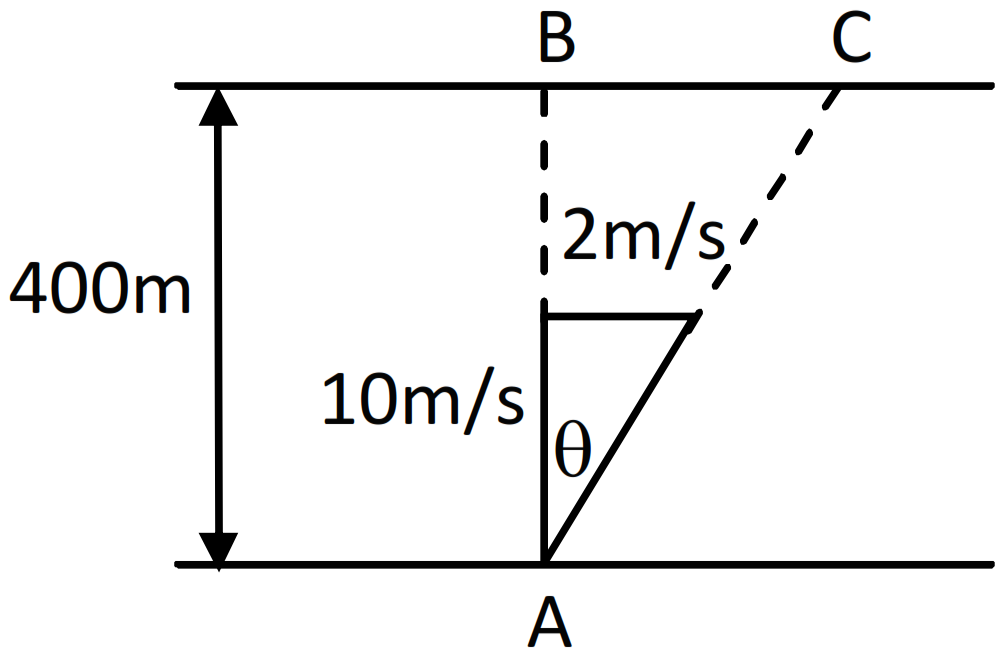
$\tan\theta=\frac{2}{10}=\frac{1}{5}$
Velocity = 10m/s
distance = 400m
$\text{Time}=\frac{400}{10}=40\sec.$
In $\triangle\text{ABC},\tan\theta=\frac{\text{BC}}{\text{AB}}=\frac{\text{BC}}{400}=\frac{1}{5}$
$\Rightarrow\text{BC}=\frac{400}{5}=80\text{m}$


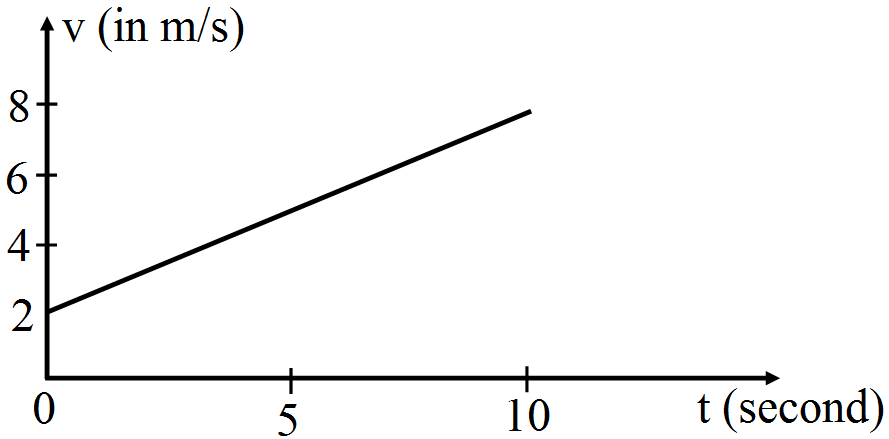
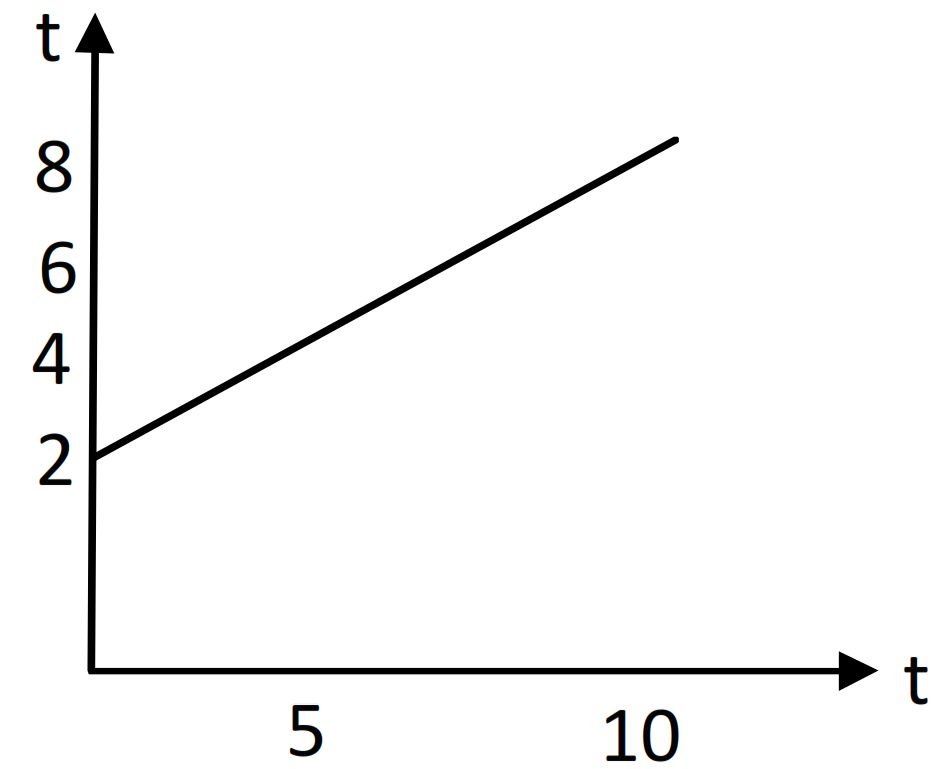
final velocity v = 8m/s
time = 10 sec,
acceleration $=\frac{\text{v}-\text{u}}{\text{ta}}=\frac{8-2}{10}=0.6\text{m/s}^2$
$\Rightarrow\text{Distance S}=\frac{\text{v}^2-\text{u}^2}{2\text{a}}=\frac{8^2-2^2}{2\times0.6}=50\text{m}.$
Displacement = 50m.


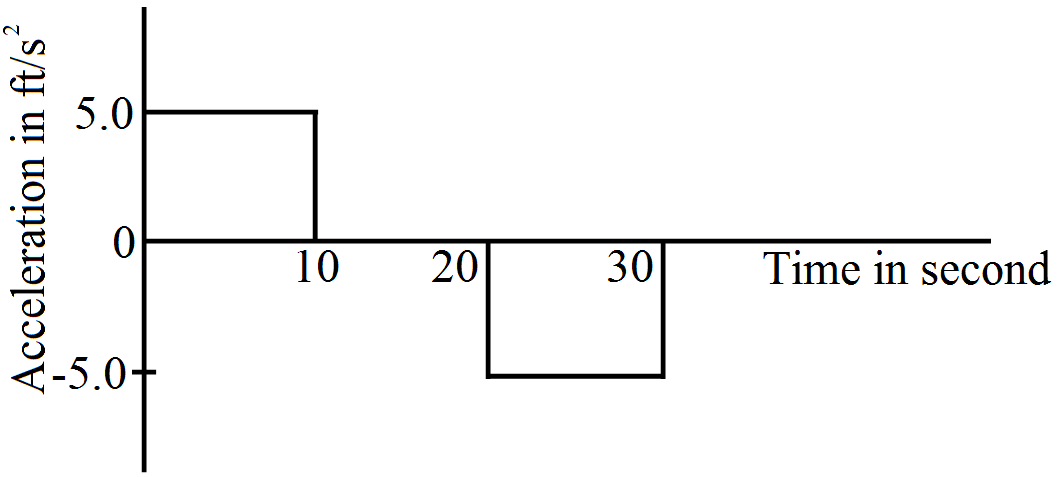
$\text{S}_1=\text{ut}+\frac{1}{2}\text{at}^2=0+\frac{1}{2}\times5\times10^2=250\text{ft}.$
At t = 10s, v = u + at = 0 + 5 × 10 = 50ft/s$\therefore$ From 10 to 20 seconds $(\triangle\text{t} = 20-10 = 10 \text{ sec})$ moves with uniform velocity 50ft/sec,
Distance S2 = 50 × 10 = 500ft Between 20 sec to 30 sec acceleration is constant i.e. -5ft/s2. At 20 sec velocity is 50ft/sec. t = 30 - 20 = 10s$\text{S}_3=\text{ut}+\frac{1}{2}\text{at}^2=50\times10+\frac{1}{2}(-5)10^2$
$\text{S}_3=500-250=250\text{ft}$
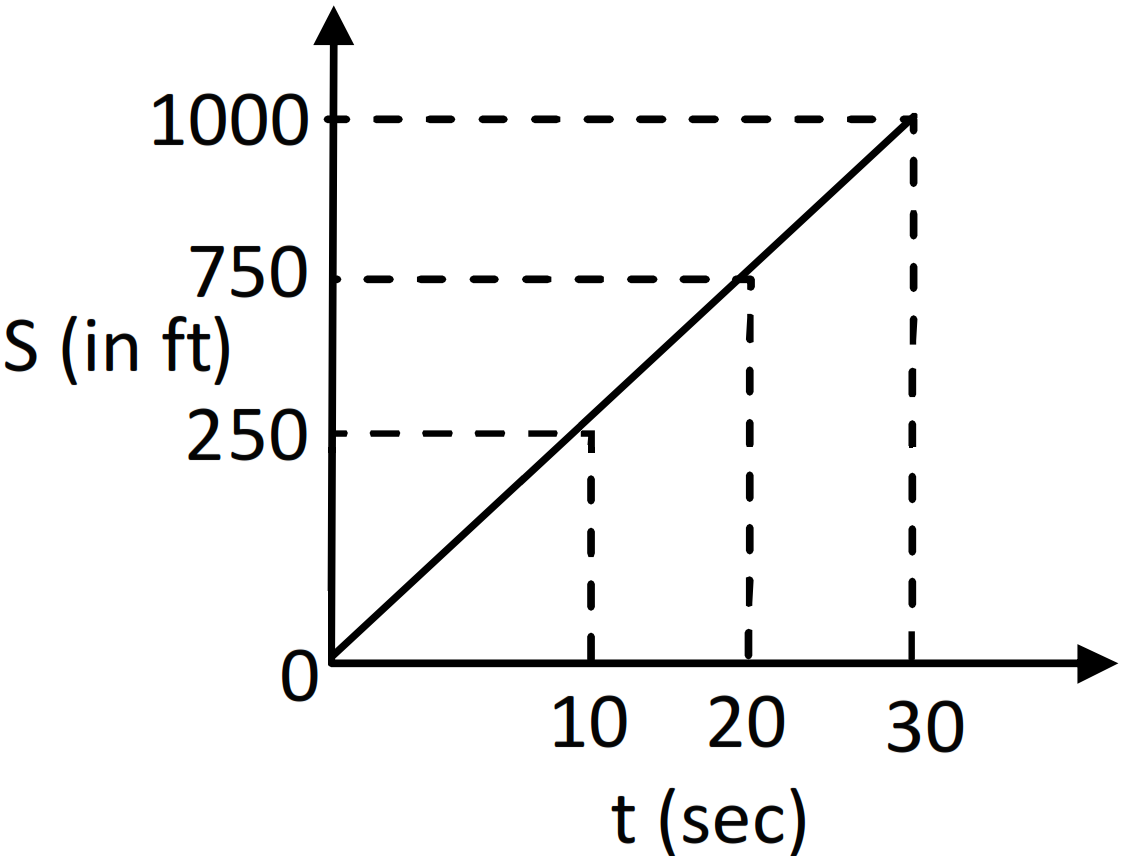
Total distance travelled is 30s: S1 + S2 + S3 = 250 + 500 + 250 = 1000ft The position-time graph:
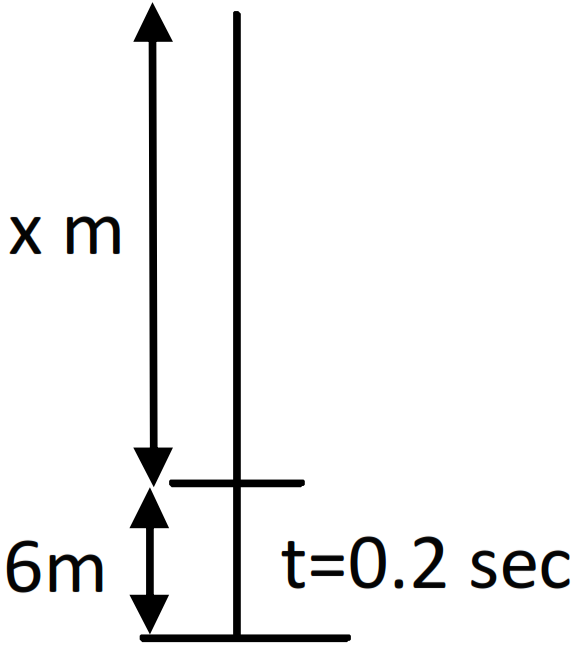
$\text{S = ut}+\frac{1}{2}\text{at}^2$
$\Rightarrow6=\text{u}(0.2)+4.9\times0.04$
$\Rightarrow\text{u}=\frac{5.8}{0.2}=29\text{m/s}.$
For distance x, u = 0, v = 29m/s, a = g = 9.8m/s2$\text{S}=\frac{\text{v}^2-\text{u}^2}{2\text{a}}=\frac{29^2-0^2}{2\times9.8}=42.05\text{m}$
Total distance = 42.05 + 6 = 48.05 = 48m.
$\text{s = ut}+\frac{1}{2}\text{at}^2$
$\Rightarrow60=-7\text{t}+\frac{1}{2}10\text{t}^2$
$\Rightarrow5\text{t}^2-7\text{t}-60=0$
$\text{t}=\frac{7\pm\sqrt{49-4.5(-60)}}{2\times5}=\frac{7\pm35.34}{10}$
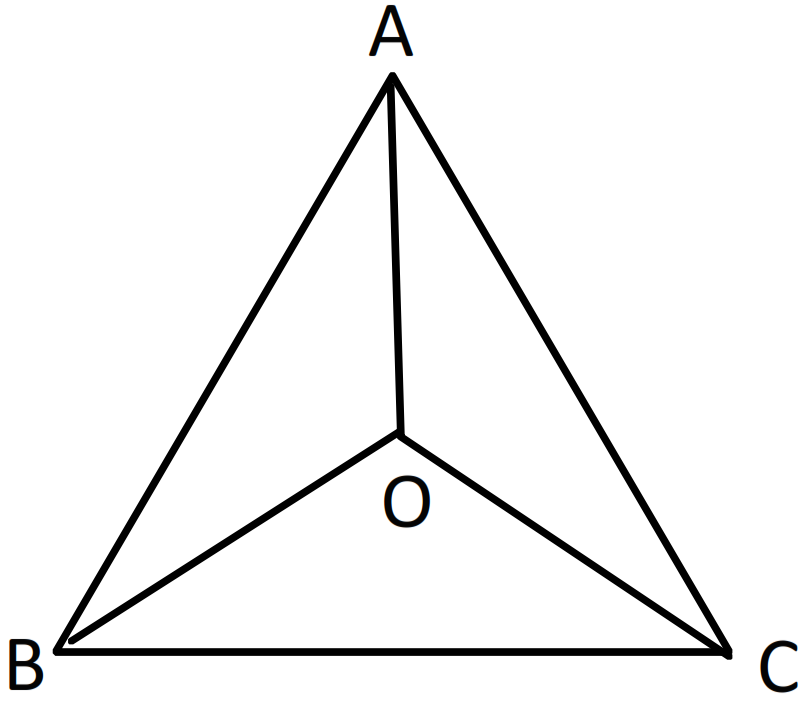
taking positive sign $\text{t}=\frac{7+35.34}{10}=4.2\sec$ $(\therefore\text{t}\neq-\text{ve})$ Therefore, the ball will take 4.2 sec to reach the ground.$=\frac{\frac{\text{a}}{\sqrt{3}}}{\text{v}\cos30^{\circ}}=\frac{2\text{a}}{\sqrt{3}\text{v}\times\sqrt{3}}=\frac{2\text{a}}{3\text{v}}$

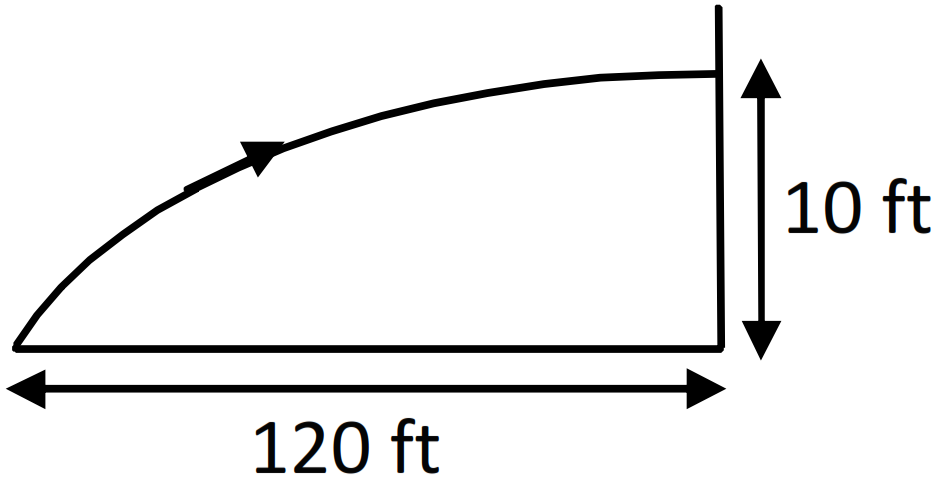
$\Rightarrow\text{t}=\frac{\text{x}}{\text{u}\cos\theta}=\frac{120}{64\cos45^{\circ}}=2.65\sec.$
$\text{y = u}\sin\theta(\text{t})-\frac{1}{2}\text{gt}^2=64\frac{1}{\sqrt{2}(2.65)}-\frac{1}{2}(32.2)(2.65)^2$
= 7.08ft which is less than the height of goal post. In time 2.65, the ball travels horizontal distance 120ft (40yd) and vertical height 7.08ft which is less than 10ft. The ball will reach the goal post.
$=\frac{(40^2\sin2(60^{\circ}))}{10}=80\sqrt{3}\text{m}.$

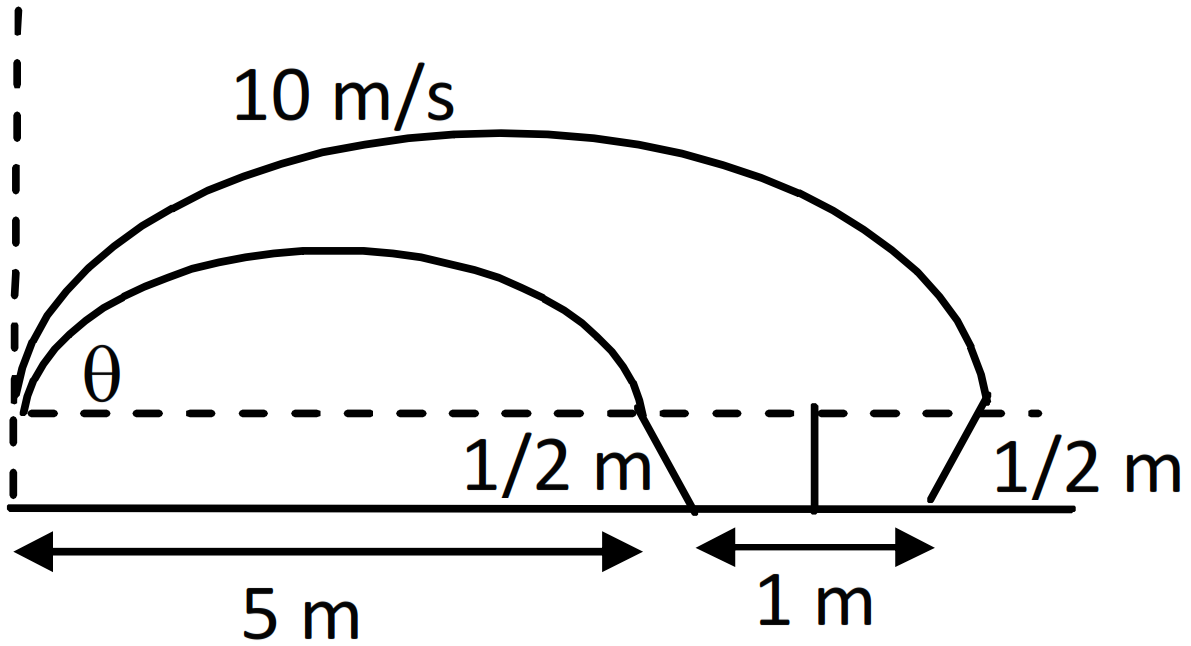
$\text{x}=\frac{\text{u}^2\sin2\theta}{\text{g}}$
$\Rightarrow5=\frac{10^2\sin2\theta}{10}$
$\Rightarrow5=10\sin2\theta$
$\Rightarrow\sin2\theta=\frac{1}{2}$
$\Rightarrow\sin30^{\circ} $ or $\sin150^{\circ}$
$\Rightarrow\theta=15^{\circ}$ or $75^\circ$
Similarly for end C, x = 6m Then $2\theta_1=\sin^{-1}\Big(\frac{\text{gx}}{\text{u}^2}\Big)=\sin^{-1}(0.6)=182^{\circ}$ or $71^{\circ}.$ So, for a successful shot, $\theta$ may very from 15° to 18° or 71° to 75°.

$\tan\theta-\frac{\text{gx}^2\sec^2\theta}{2\text{u}^2}$
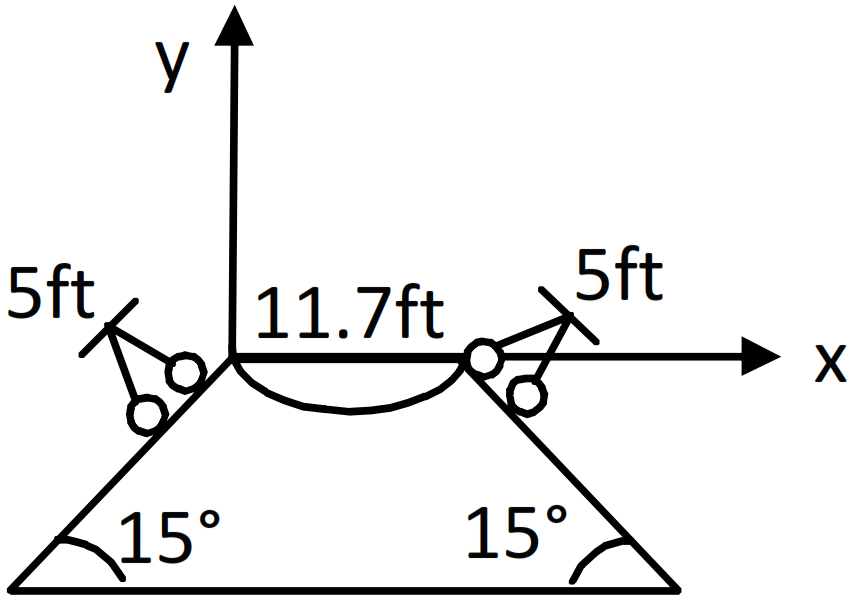
To find, minimum speed for just crossing, the ditch y = 0 ($\therefore$ A is on the x axis)$\Rightarrow\text{x}\tan\theta=\frac{\text{gx}^2\sec^2\theta}{2\text{u}^2}$
$\Rightarrow\text{u}^2=\frac{\text{gx}^2\sec^2\theta}{2\text{x}\tan\theta}=\frac{\text{gx}}{2\sin\theta\cos\theta}=\frac{\text{gx}}{\sin2\theta}$
$\Rightarrow\text{u}=\sqrt{\frac{(32.2)(16.7)}{\frac{1}{2}}}$ $\Big(\because\sin30^{\circ}=\frac{1}{2}\Big)$
⇒ u = 32.79ft/s = 32ft/s.
$\text{t}=\frac{\text{Displacement}}{\text{velocity}}$
$=\frac{\text{x}}{\sqrt{\text{v}^2-\text{u}^2}}$
$=\frac{\text{x}}{\sqrt{(\text{v + u})(\text{v}-\text{u})}}=\frac{\text{x}}{\sqrt{\big(\frac{\text{x}}{\text{t}_1}\big)\big(\frac{\text{x}}{\text{t}_2}\big)}}$
$=\sqrt{\text{t}_1\text{t}_2}.$

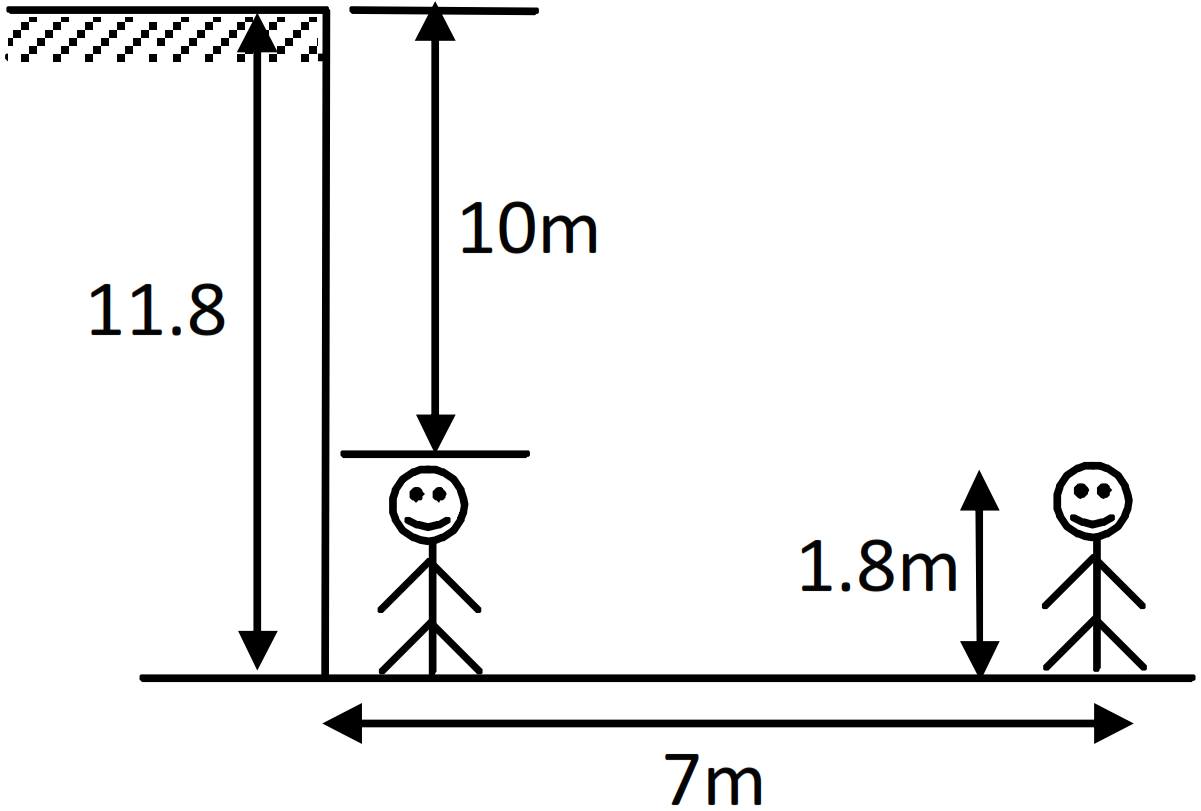
$\text{S = ut}+\frac{1}{2}\text{at}^2$
$\Rightarrow10=0+\frac{1}{2}(9.8)\text{t}^2$
$\Rightarrow\text{t}^2=2.04$
$\Rightarrow\text{t}=1.42$
In this time the man has to reach at the bottom of the building. Velocity $\frac{\text{s}}{\text{t}}=\frac{7}{1.42}=4.9\text{m/s}.$

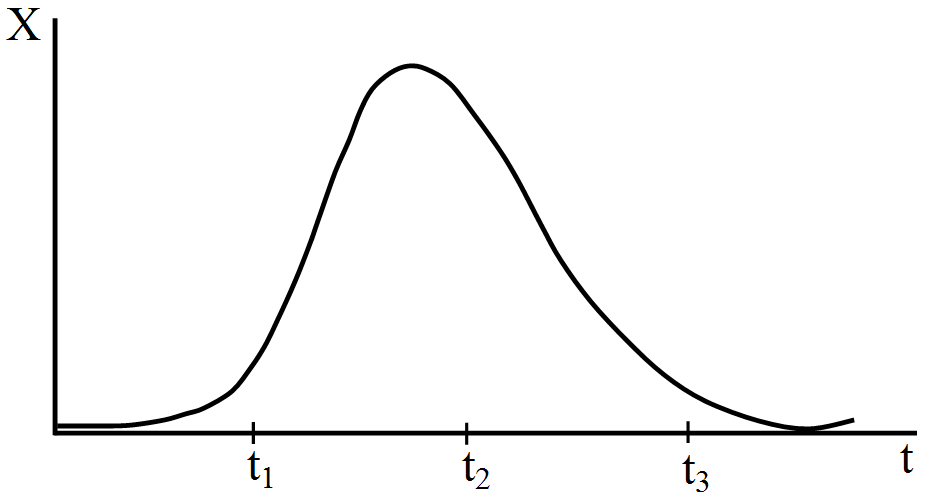
As slope is increasing acceleration is positive.
As slope is decreasing acceleration is negative.
As slope is increasing acceleration is positive.