But we can hear our foot sep as sound of foot wil travel through our body and we will be able to hear it.
8 questions · timed · auto-graded
$\text{v}=320\text{m/s}$
So the maximum time interval will be$\text{t}=\frac{\text{s}}{\text{v}}$
$=\frac{160}{320}=0.5\ \text{seconds}.$
$\Rightarrow\text{K}=\text{v}^2\rho=(1330)^2\times800\text{N/m}^2$
We know $\text{K}=\Bigg(\frac{\frac{\text{F}}{\text{A}}}{\frac{\triangle\text{V}}{\text{V}}}\Bigg)$$\Rightarrow\triangle\text{V}=\frac{\text{pressuress}}{\text{K}}$
$=\frac{2\times10^5}{1330\times1330\times800}$
So, $\triangle\text{V}=0.15\text{cm}^3$
$\text{n}_0=\frac{1}{2\text{l}}\sqrt{\frac{\text{T}}{\text{m}}}.$
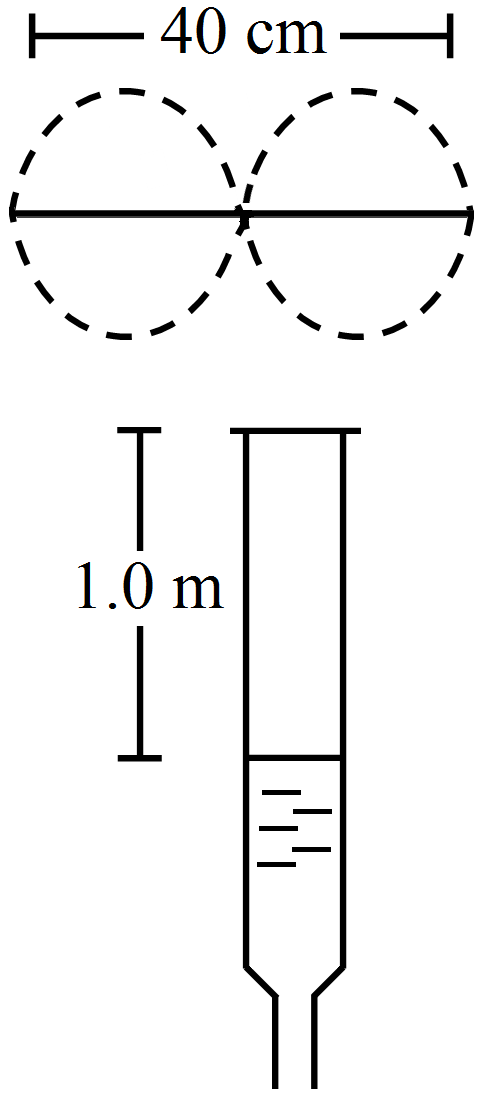
So, 2nd harmonic 2n0 $=\Big(\frac{2}{2\text{l}}\Big)\sqrt{\frac{\text{T}}{\text{m}}}$ As it is unison with fundamental frequency of vibration in the air column$\Rightarrow2\text{n}_0=\frac{340}{4\times1}=85\text{Hz}$
$\Rightarrow85=\frac{2}{2\times0.4}\sqrt{\frac{\text{T}}{14}}$
$\Rightarrow\text{T}=85^2\times(0.4)^2\times10^{-2}=11.6\ \text{Newton}.$
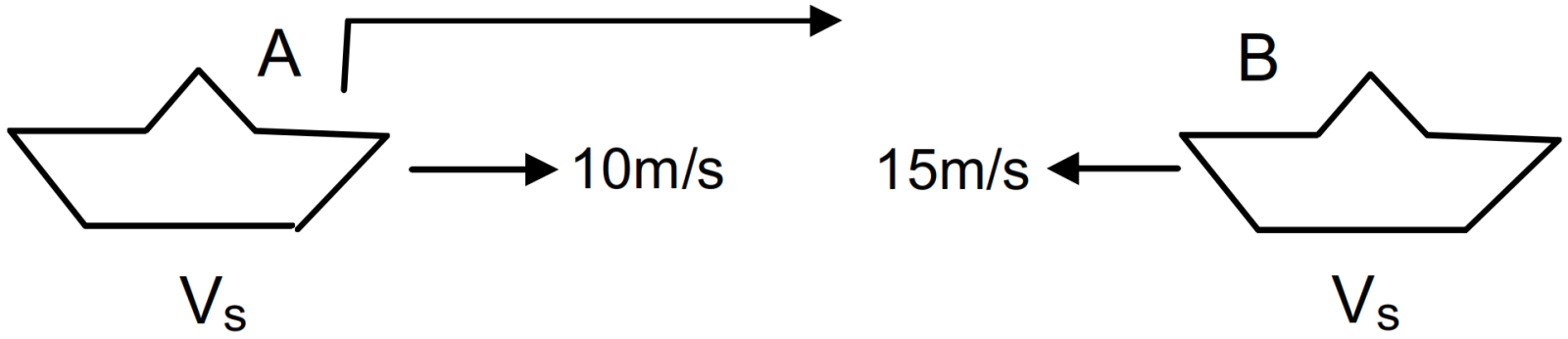
So, the apparent frequency heard by the submarine B,
$=\Big(\frac{1500+15}{1500-10}\Big)\times2000=2034\text{Hz}.$
$=\Big(\frac{1500+10}{1500-15}\Big)\times2034=2068\text{Hz}.$

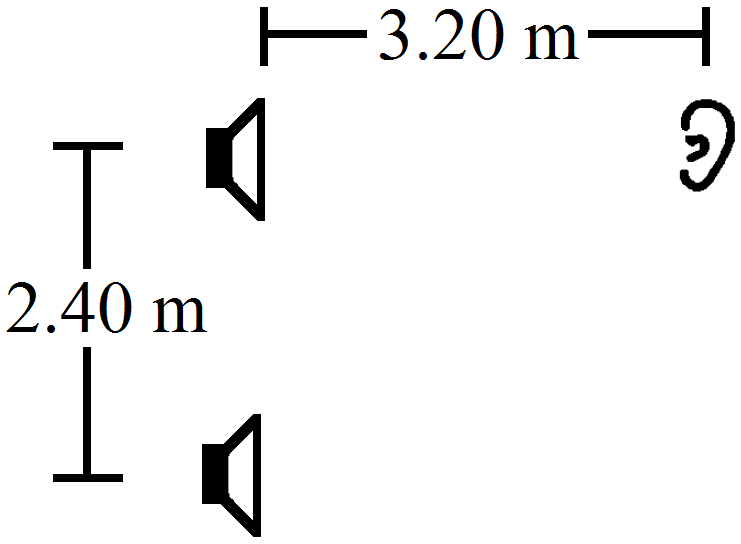
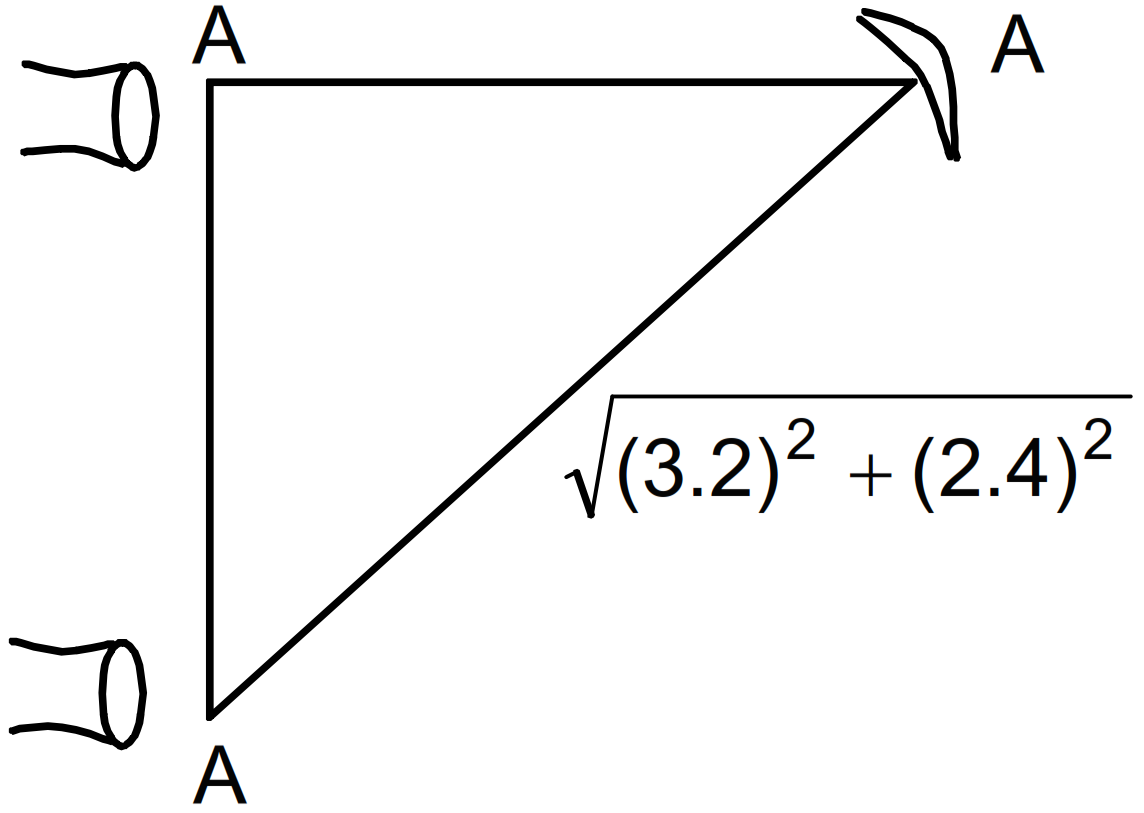
As shown in the figure the path differences $2.4=\triangle\text{x}=\sqrt{(3.2)^2+(2.4)^2}-3.2$
Again, the wavelength of the either sound waves $=\frac{320}{\rho}$
We know, destructive interference will be occur
If $\triangle\text{x}=\frac{(2\text{n}+1)\lambda}{2}$
$\Rightarrow \sqrt{(3.2)^2+(2.4)^2-(3.2)}=\frac{(2\text{n}+1)}{2}\frac{320}{\rho}$
Solving we get
$\Rightarrow\text{V}=\frac{(2\text{n}+1)400}{2}=200(2\text{n}+1)$
Where $\text{n}=1,2,3,\ \dots49.$ (audible region)
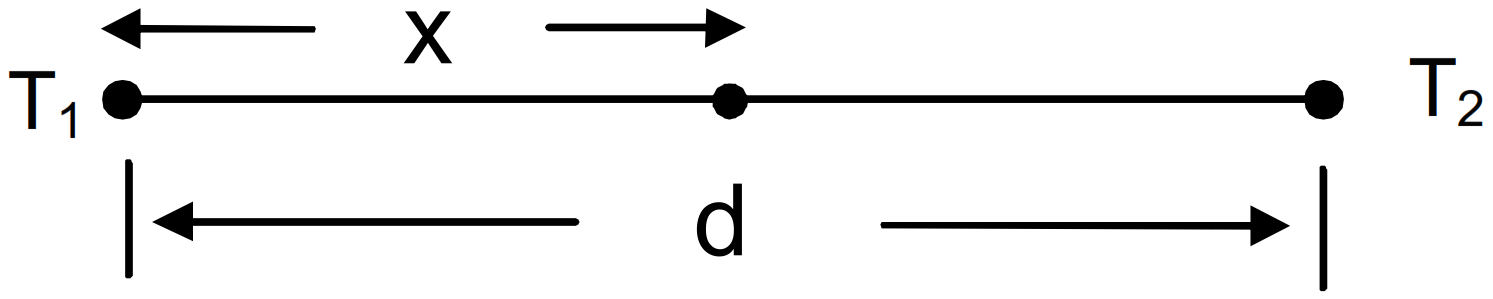
The variation of temperature is given by
$\text{T}=\text{T}_1+\frac{(\text{T}_2-\text{T}_2)}{\text{d}}\text{x}\ \dots(1)$
We know that $\text{V}\propto\sqrt{\text{T}}$
$\Rightarrow\frac{\text{V}_\text{T}}{\text{V}}=\sqrt{\frac{\text{T}}{273}}$
$\Rightarrow\text{V}_\text{T}=\text{v}\sqrt{\frac{\text{T}}{273}}$
$\Rightarrow\text{dt}=\frac{\text{dx}}{\text{V}_\text{T}}=\frac{\text{du}}{\text{v}}\times\sqrt{\frac{273}{\text{T}}}$
$\Rightarrow\text{t}=\frac{273}{\text{V}}\int\limits_0^\text{d}\frac{\text{dx}}{\Big[\frac{\text{T}_1+(\text{T}_2-\text{T}_1)}{\text{dx}}\Big]^{\frac{1}{2}}}$
$=\frac{\sqrt{273}}{\text{V}}\times\frac{2\text{d}}{\text{T}_2-\text{T}_1}\bigg[\text{T}_1+\frac{\text{T}_2-\text{T}_1}{\text{d}}\text{x}\bigg]_0^\text{d}$
$=\Big(\frac{2\text{d}}{\text{V}}\Big)\Big(\frac{\sqrt{273}}{\text{T}_2-\text{T}_1}\Big)\times\sqrt{\text{T}}_2-\sqrt{\text{T}_1}$
$=\text{T}=\frac{2\text{d}}{\text{V}}\frac{\sqrt{273}}{\sqrt{\text{T}}_2+\sqrt{\text{T}_1}}$
Putting the given value we get
$=\frac{2\times33}{330}$
$=\frac{\sqrt{273}}{\sqrt{280}+\sqrt{310}}=96\text{ms}.$
Give, $\text{F}=600\text{Hz},$ and $\text{v}=300\text{m/s}$ $\Rightarrow\lambda=\frac{\text{v}}{\text{f}}=\frac{330}{600}=0.55\text{mm}$
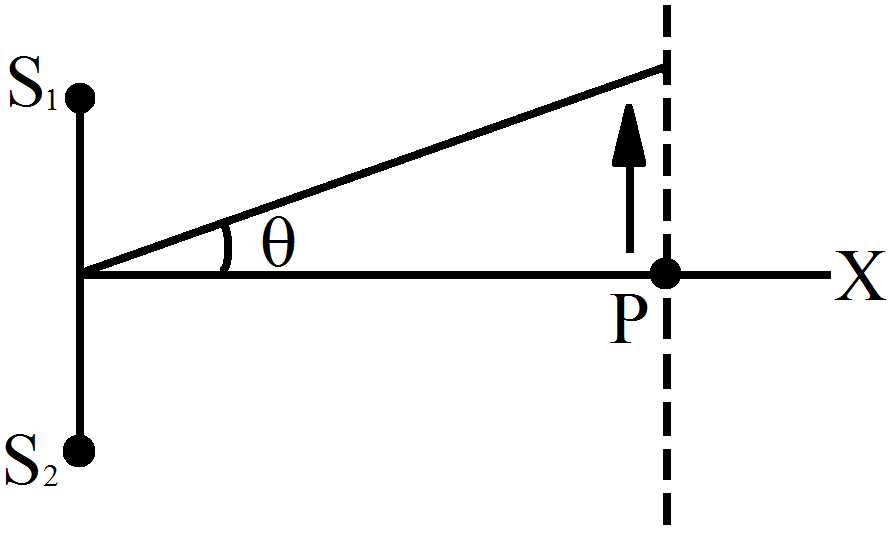
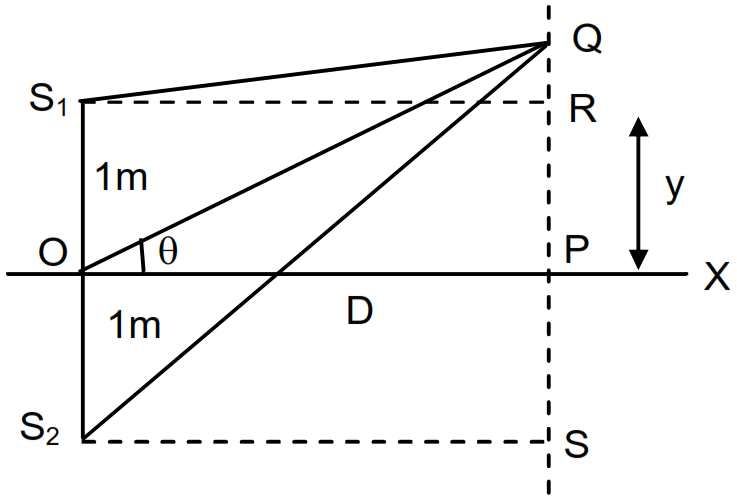
Let $\text{OP}=\text{D},\ \text{PQ}=\text{y}\Rightarrow\theta=\frac{\text{y}}{\text{R}}\ \dots(1)$ Now path difference is given by, $\text{x}=\text{S}_2\text{Q}-\text{S}_1\text{Q}=\frac{\text{yd}}{\text{D}}$ Where d = 2m$\Big[$The proof of $\text{x}=\frac{\text{yd}}{\text{D}}$ is discussed in interference of light waves$\Big]$
$\therefore\frac{\text{yd}}{\text{D}}=\frac{\lambda}{2}$ $\Big[$for minimum $\text{y},\text{x}=\frac{\lambda}{2}\Big]$
$\therefore\frac{\text{y}}{\text{D}}=\theta=\frac{\lambda}{2}=\frac{0.55}{4}=0.1375\times(57.1)^\circ=7.9^\circ$
$\frac{\text{yd}}{\text{D}}=\lambda\Rightarrow\frac{\text{y}}{\text{D}}=\theta=\frac{\lambda}{\text{D}}=\frac{0.55}{2}=0.275\ \text{rad}$
$\therefore\theta=16^\circ$
$\frac{\text{yd}}{\text{D}}=2\lambda,3\lambda,4\lambda,\ \dots$
$\Rightarrow\frac{\text{y}}{\text{D}}=\theta=32^\circ,64^\circ,128^\circ$
But since, the maximum value of $\theta$ can be 90°, he will hear two more maximum i.e. at 32° and 64°.