- $\frac{4\pi\text{d}}{\lambda}\Big(1-\frac{1}{\text{n}^2}\sin^2\theta\Big)^{\frac{1}{2}}+\pi$
Solution:
None of the option is correct
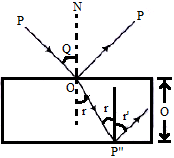
Consider the diagram, the ray (P) is incident at an angle $\theta$ and gets reflected in the direction P' and refracted in the direction P. Due to reflection from the glass medium, there is a phase change of $\pi$.
According to snell's law, we have $\text{n}=\frac{\sin\theta}{\sin\text{r}}$
$\Rightarrow\sin\text{r}=\frac{\sin\theta}{\text{n}}$
$\Rightarrow\ \cos\text{r}=\sqrt{1-\sin2\text{r}}$
$\Rightarrow\ \cos\text{r}=\sqrt{1-\frac{\sin^2\theta}{\text{n}^2}}$
The time taken to travel along OP" is given by
$\Delta\text{t}=\frac{\text{OP}''}{\text{v}}$
$=\frac{\frac{\text{d}}{\cos\text{r}}}{\frac{\text{c}}{\text{n}}}\ \Big[\because\ \text{PO}''=\frac{\text{d}}{\cos\text{r}}\text{ and }\text{v}=\frac{\text{c}}{\text{n}}\Big]$
$=\frac{\text{nd}}{\text{c}\cos\text{r}}$
$=\frac{\text{nd}}{\text{c}\Big(1-\frac{\sin^2\theta}{\text{n}^2}\Big)^{\frac{1}{2}}}\ \ \bigg[\because\ \cos\text{r}=\sqrt{1-\frac{\sin^2\theta}{\text{n}^2}}\bigg]$
$=\frac{\text{nTd}}{\lambda}\Big(1-\frac{\sin^2\theta}{\text{n}^2}\Big)^\frac{-1}{2}$
Now, the phase difference $(\Delta\phi)$ is given by
$\frac{2\pi}{\text{T}}\times\Delta\text{t}\times\frac{2\pi}{\text{T}}\times=\frac{\text{nTd}}{\lambda}\Big(1-\frac{\sin^2\theta}{\text{n}^2}\Big)^\frac{-1}{2}$
$=\frac{2\pi\text{nd}}{\lambda}\Big(1-\frac{\sin^2\theta}{\text{n}^2}\Big)^\frac{-1}{2}$
Therefore, the net phase difference $=\Delta\phi+\pi$
$=\frac{2\pi\text{nd}}{\lambda}\Big(1-\frac{\sin^2\theta}{\text{n}^2}\Big)^\frac{-1}{2}+\pi$