MCQ 511 Mark
The steps of construction of an $\angle AOB = 45^\circ$ is given in jumbled order below:
$1.$ Place compass on intersection point.
$2.$ Place ruler on start point and where arc intersects perpendicular line.
$3.$ Adjust compass width to reach start point.
$4.$ Construct a perpendicular line.
$5.$ Draw $45$ degree line.
$6.$ Draw an arc that intersects perpendicular line.
Which step comes last ?
AnswerCorrect sequence is:
$1.$ Construct a perpendicular line.
$2.$ Draw an arc that intersect the perpendicular line.
$3.$ Adjust the compass width to reach the start point.
$4.$ Place compass on intersection point.
$5.$ Place ruler on start point and where the arc intersects the perpendicular line.
$6.$ Draw $45$ degree line. So the last step is $5$ Option $D$ is correct.
View full question & answer→MCQ 521 Mark
A quadrilateral is a rhombus but not a square if:
- A
its diagonals do not bisect each other
- B
its diagonals are not perpendicular
- C
opposite angles are not equal
- ✓
the length of diagonals are not equal
AnswerCorrect option: D. the length of diagonals are not equal
The length of diagnols are not equal
View full question & answer→MCQ 531 Mark
In $\triangle\text{XYZ},$ $a, b, c$ denote the three sides, which of the following is incorrect?
- ✓
$a − b > c$
- B
$a + c > b$
- C
$a − b < c$
- D
$a + b > c$
AnswerCorrect option: A. $a − b > c$
Actually, $a − b < c\ ∀ a, b, c$ $($the symbol$, ∀ a, b, c$ means for all $a, b, c)$ This implies that $b − c < a; c − a < b$
View full question & answer→MCQ 541 Mark
With the help of ruler and compass, it is not possible to construct an angle of:
- A
$37.5^\circ $
- ✓
$40^\circ $
- C
$22.5^\circ $
- D
AnswerCorrect option: B. $40^\circ $
With the help of a ruler and a compass, we can construct the angels, $90^\circ , 60^\circ , 45^\circ , 22.5^\circ , 30^\circ ,$
etc.i.e., the multiples of $15^\circ $ and its bisector of an angle.
So, it is not possible to construct an angle of $40^\circ $
View full question & answer→MCQ 551 Mark
The number of angles in Fig. is:
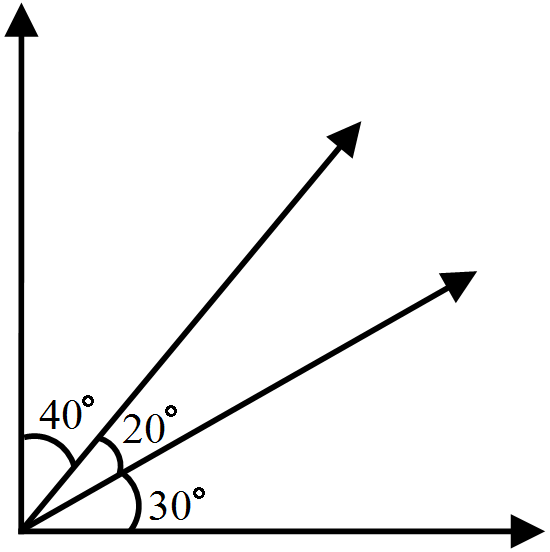
AnswerAngles shown in the figure are $40^\circ , 20^\circ , 30^\circ , 60^\circ , 50^\circ $ and $90^\circ $. Therefore, there are $6$ angles,
View full question & answer→MCQ 561 Mark
A perpendicular is drawn using:
AnswerA perpendicular is drawn using scale, protractor as well as set squares.
View full question & answer→MCQ 571 Mark
A triangle $\triangle\text{PQR}$ with $ \angle\text{Q}=90^∘,$ $QR = 4\ cm$ and $PR = 5\ cm$ is constructed. What would be the measure of $PQ$?
- ✓
$2\ cm$
- B
$6\ cm$
- C
$7\ cm$
- D
$3\ cm$
AnswerCorrect option: A. $2\ cm$
$2\ cm$
View full question & answer→MCQ 581 Mark
In $\triangle\text{ABC},$ $\overline{\text{AB}}>\overline{\text{BC}}>\overline{\text{CA}}$ which of the following is the smallest angle?
AnswerCorrect option: B. $\angle{\text{B}}$
$\angle{\text{B}}$
View full question & answer→MCQ 591 Mark
With the help of a ruler and a compass, it is possible to construct an angle of:
- A
$35^\circ$
- B
$40^\circ$
- ✓
$37.5^\circ$
- D
AnswerCorrect option: C. $37.5^\circ$
Using ruler and compass it is possible to construct $37.5^\circ$
Step $1$: Construct angle of $150^\circ$
Step $2$: Bisect the angle to get $75^\circ$
Step $3$: Again bisect the angle to get $37.5^\circ$
View full question & answer→MCQ 601 Mark
$X$ and $Y$ are two distinct points in a plane. How many lines can be drawn passing through both $X$ and $Y$?
View full question & answer→MCQ 611 Mark
Mark $(\checkmark)$ against the correct answer in the following:
Where does the vertex of an angle lie?
AnswerThe vertex of an angle is the point where two rays begin or meet, where two line segments join or meet, where two lines intersect (cross), or any appropriate combination of rays, segments and lines that result in two straight "sides" meeting at one place.
View full question & answer→MCQ 621 Mark
Into what type of parts is a figure divided by bisecting it?
MCQ 631 Mark
Number of lines passing through five points such that no three of them are collinear is:
MCQ 641 Mark
The number of diagonals in a septagon is:
AnswerWe know that, if a polygon has n sides, then Number of diagonals $=\frac{\text{n}(3-2)}{2}$
A septagon is a polygon having seven sides, i.e. $n = 7$
Number of diagonals in septagon $=\frac{7(7-3)}{2}=14$
Note: A diagonal is a line segment joining two non-consecutive vertices of a polygon.
View full question & answer→MCQ 651 Mark
In which of the following figures the adjacent sides are not necessarily be equal?
Answer$(a)$ & $(c)$ Both parallelogram and rectangle.
View full question & answer→MCQ 661 Mark
The steps for constructing a perpendicular from point $A$ to line $P$ $Q$ is given in jumbled order as follows: $(A$ does not lie on $PQ)$
$1.$ Join $R$ − $S$ passing through $A$.
$2.$ $P$lace the pointed end of the compass on $A$ and with an arbitrary radius, mark two points $D$ and $E$ on line $P$$Q$ with the same radius.
$3.$ From points $D$ and $E$, mark two intersecting arcs on either side of $P$ $Q$ and name them $R$ and $S$.
$4.$ $D$raw a line $P$ $Q$ and take a point $A$ anywhere outside the line.The second step in the process is:
Answer
Correct sequence is:
$1.$ Draw a line $P$ $Q$ and take a point $A$ anywhere outside the line.
$2.$ $P$lace the pointed end of the compass on $A$ and with an arbitrary radius, mark two points $D$ and $E$ on line $P$ $Q$ with the same radius.
$3.$ From points $D$ and $E$, mark two intersecting arcs on either side of $P$ $Q$ and name them $R$ and $S$.
$4.$ Join $R$ − $S$ passing through $A.$
$5.\ S$o the second step is $2$.
View full question & answer→MCQ 671 Mark
The last step in the process is:
AnswerCorrect sequence is
Step $1$. Draw a ray $QR$
Step $2$. Place the pointed end of the compass on $Q$ and draw a semi circular arc with arbitrary radius.
Step $3$. Mark a point $B$ on the same arc with the same radius from point $A$. Similarly, mark a point $C$ from $B$.
Step $4$. Draw two intersecting arcs from $B$ and $C$ and mark the intersection as point $D$.
Step $5$. Join $Q-D$ and extend it to obtain $QP$.
View full question & answer→MCQ 681 Mark
Read the statements carefully.
Statement 1: Two lines are said to be perpendicular if they intersect each other at an angle of $90^\circ $.
Statement 2: A unique circle can be drawn passing through the given centre.
Which of the following options holds?
- A
Both Statement - $1$ and Statement - $2$ are true.
- ✓
Statement - $1$ is true and Statement - $2$ is false.
- C
Statement -$1$ is false and Statement - $2$ is true.
- D
Both Statement -$1$ and Statement - $2$ are false.
AnswerCorrect option: B. Statement - $1$ is true and Statement - $2$ is false.
Statement - $1$ is true and Statement - $2$ is false.
View full question & answer→MCQ 691 Mark
At $7\ a.m$. the angle between the Sun's ray and the ground at a point is $43^\circ $ What would be the angle at $10\ a.m.$?
AnswerCorrect option: C. Between $43^\circ $ and $90^\circ $
Let QP be the sun's ray and RP be the ground.
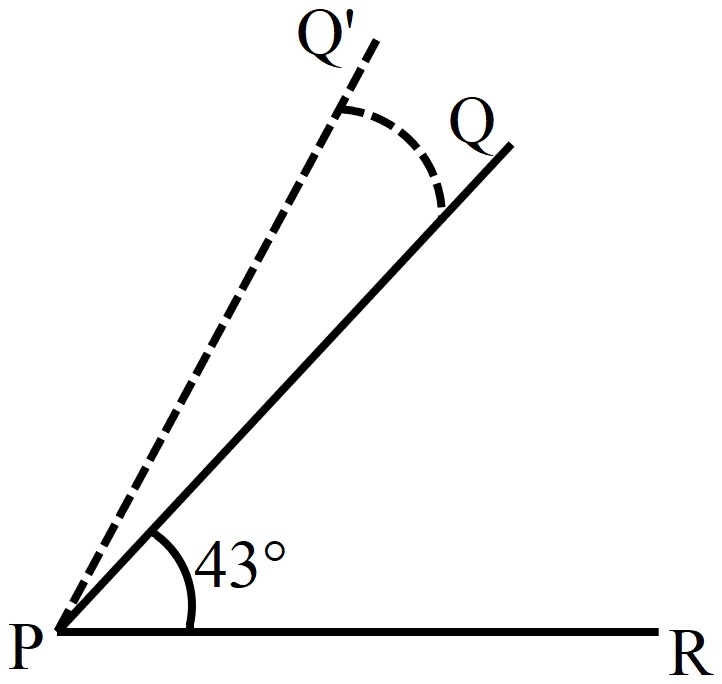
The angle between $QP$ and $PR$ at $P$ is $43^\circ $ at $7\ a.m.$ At $10\ a.m$., the sun's ray is $Q'P$.
We know that at $12$ noon the sun is exactly above our head.
So, the sun's ray will be perpendicular to the ground.
So, clearly at $10\ am$, the required angle will be between $43^\circ $ and $90^\circ $. View full question & answer→MCQ 701 Mark
A vertex of square is $(3,4)$ and diagonals equation is given by $x + 2y = 1,$
then the second diagonal which passes through given vertex will be
- A
$2x - y + 2 = 0$
- B
$x + 2y = 11$
- ✓
$2x - y = 2$
- D
AnswerCorrect option: C. $2x - y = 2$
$2x - y = 2$
View full question & answer→MCQ 711 Mark
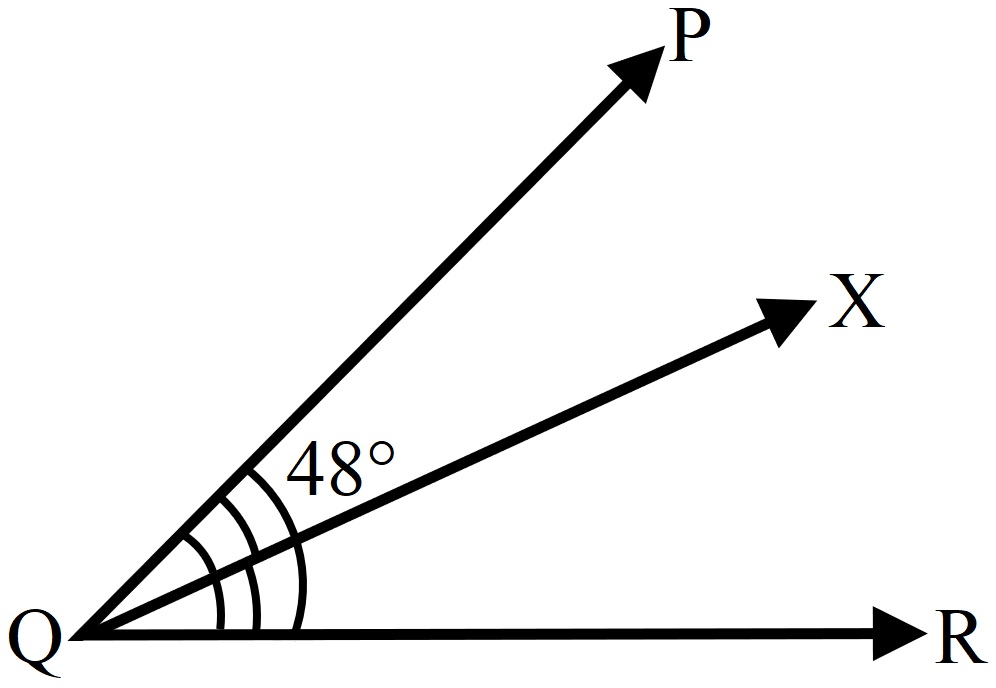
The figure shows $\angle{\text{PQR}}$ which measures 48° $\overrightarrow{\text{QX}}$ is drawn such that $\angle{\text{PQX}}=\angle{\text{XQR}}.$ What is $\overrightarrow{\text{QX}}$ called?
- A
- B
- ✓
- D
Either $[a]$ or $[b]$
View full question & answer→MCQ 721 Mark
A line segment has ______ end points.
MCQ 731 Mark
A maths teacher asked his students to draw a pair of parallel lines. Which instrument $(s)$ are the students most likely to use?
AnswerCorrect option: D. Both $[b]$ and $[c]$
The lines drawn using the two edges of a ruler are parallel.
Also a ruler and a setsquare can be used to draw a pair of parallel lines.
View full question & answer→MCQ 741 Mark
The fourth step in the process is:
Answer$0^\circ <$ acute angle $< 90^\circ <$ obtuse angle $< 180^\circ $.
View full question & answer→MCQ 751 Mark
An angle of $15$ is drawn using a pair of compasses and a ruler. How is it done?
- A
Bisecting $60^\circ $ angle.
- B
Bisecting $60^\circ$ and $120^\circ $ angles.
- ✓
Bisecting $60^\circ $ and then bisecting it again.
- D
Bisecting a $60^\circ $ and $180^\circ $ angles.
AnswerCorrect option: C. Bisecting $60^\circ $ and then bisecting it again.
Bisecting $60^\circ $ and then bisecting it again.
View full question & answer→MCQ 761 Mark
An angle which can be constructed using a pair of compass and ruler is
- A
$20^\circ $
- B
$80^\circ $
- ✓
$60^\circ $
- D
AnswerCorrect option: C. $60^\circ $
An angle which can be constructed using a pair of compass and ruler is $60^\circ $ as multiples of
$15^\circ $ can be drawn using a compass.
View full question & answer→MCQ 771 Mark
A polygon has prime number of sides. Its number of sides is equal to the sum of the two least consecutive primes. The number of diagonals of the polygon is:
AnswerThe two least consecutive primes are $2$ and $3$.
$2 + 3 = 5$
So, sides of polygon $(n) = 5$
Number of diagonals $=\frac{\text{n}(\text{n}-3)}{2}=\frac{5(5-3)}{2}=5$
View full question & answer→MCQ 781 Mark
Identify the condition to be checked before constructing a triangle.
MCQ 791 Mark
The measurements of $\triangle\text{DEF}$ are $\text{EF}=8.4\text{cm},$ $\angle\text{E}=100^∘$ and $\angle=82^∘$. Which of the following is correct?
- A
$ADEF$ can be constructed.
- B
$ADEF$ is an obtuse angled triangle.
- ✓
- D
$ADEF$ is an acute angled triangle.
Answer$\triangle\text{le} $ cannot be constructed as sum of only two $\triangle\text{les}$ $\angle\text{E}$ & $\angle\text{F}>180^∘(\angle\text{E}+\angle\text{F}=182^∘),$ which is not possible in a Ale.
View full question & answer→MCQ 801 Mark
Which of the following statement is true about the given figure?
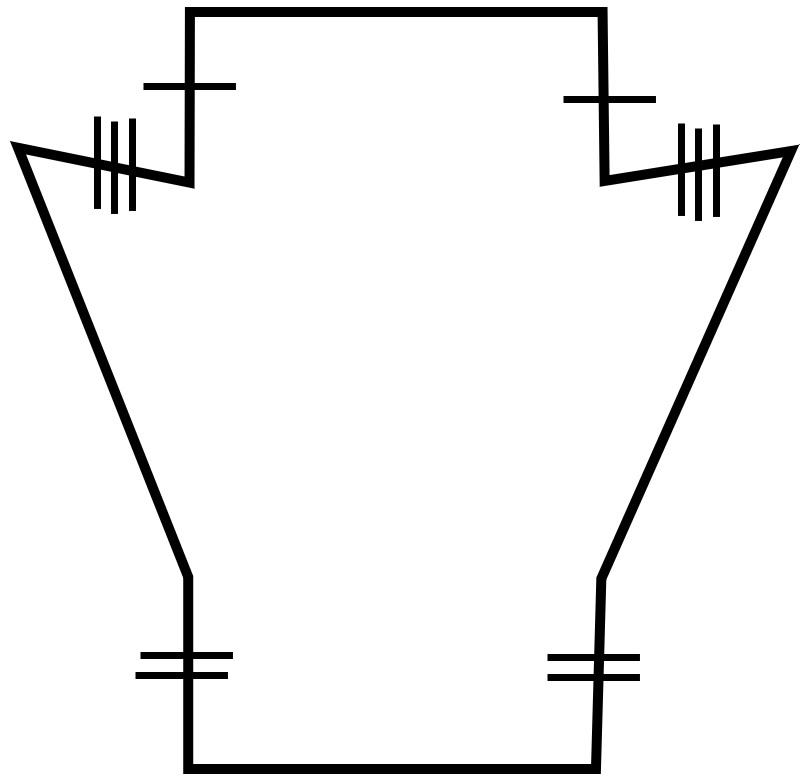
AnswerGiven figure is a polygon.
View full question & answer→MCQ 811 Mark
What do you call two lines intersecting at a point?
MCQ 821 Mark
Mark $(\checkmark)$ against the correct answer in the following:
Which of the following has no end points?
AnswerA line has no end points. We can produce it infinitely in both directions.
View full question & answer→MCQ 831 Mark
How many complete turns is equivalent to $90^\circ ?$
- A
$2$
- B
$1$
- C
$\frac{1}{2}$
- ✓
$\frac{1}{4}$
AnswerCorrect option: D. $\frac{1}{4}$
$\frac{1}{4}$
View full question & answer→MCQ 841 Mark
The steps to construct a line perpendicular to $XY$ and passing through $P$ is given in random order :
$1.$ Move the set square along $XY$ so the other short side touches Point $P$.
$2.$ Use the edge of the set square to draw a line through Point $P$.
$3.$ Draw a line $XY$ and mark point $P$.
$4.$ Place one short side of the set square on the line $XY$.
Which of the following will be the first step:
Answer$1.$ Draw a line $XY$ and mark a point $P$ on it.
$2.$ Place one short side of the set square on the line $XY$.
$3.$ Move the set square along $XY$ so the other short side touches point $P$.
$4.$ Use the edge of the set square to draw a line through point $P$.
$5.$ So is the second step.Option $D$ is correct.
View full question & answer→MCQ 851 Mark
The first step in the process will be:
AnswerCorrect sequence of steps is :
Step $1$: Draw segment $AB$ and take a point $P$ on it.
Step $2$: From point $P$, mark two equidistant points from $P$ on line $AB$, and name them $C$ and $D$
Step $3$ : From points $C$ and $D$ mark two intersecting arcs on either side of the line $AB$. Name the intersection point as $E$
Step $4$: Join $E$ and $P$. $EP$ is the required perpendicular. So the first step is $4$
So option $D$ is correct.
View full question & answer→MCQ 861 Mark
When two line segments meet at a point forming right angle they are said to be __________ to each other.
AnswerWhen two line segments meet at a point forming right angle
they are said to be perpendicular to each other.
View full question & answer→MCQ 871 Mark
When a perpendicular is drawn to a given line, in what ratio is the line divided into?
- A
$1 : 1$
- B
$1 : 2$
- C
$2 : 1$
- ✓
AnswerA line does not have a definite length.Hence, when a perpendicular is drawn to the given line,
nothing can be said about the ratio it gets divided into.
View full question & answer→MCQ 881 Mark
A line segment $\overrightarrow{\text{TP}}$is bisected at I. What is the measure of $\overrightarrow{\text{Tl}}$?
- A
$\frac{1}{2}\overrightarrow{\text{ IP}}$
- ✓
$\overrightarrow{\text{IP}}$
- C
$\overrightarrow{\text{TP}}$
- D
$\frac{1}{3}\overrightarrow{\text{ TP}}$
AnswerCorrect option: B. $\overrightarrow{\text{IP}}$
$\overrightarrow{\text{TI}}=\frac{1}{2}\overrightarrow{\text{ TP}}=\text{IP}$
View full question & answer→MCQ 891 Mark
When two lines are perpendicular to each other, the angle is said to be _______ angle.
AnswerTwo given lines are perpendicular means the angle between them is $90^\circ$, i.e. a right angle.
View full question & answer→MCQ 901 Mark
Which of the following angles is possible to construct using a compass?
- ✓
$60^\circ$
- B
$32^\circ$
- C
$51.25^\circ$
- D
AnswerCorrect option: A. $60^\circ$
An angle of $60^\circ$ can be constructed using a compass.
Step $1$ : Make a compelete arc on a straight line.
Step $2$ : Make an arc on the previous arc with the same opening of compass from the start point of previous arc.
Step $3$: Draw a line through the centre of arc and point of intersection.
View full question & answer→MCQ 911 Mark
The line segment connecting $(x, 6)$ and $(9, y)$ is bisected by the point $(7, 3)$ Find the values of $x$ and $y$
- A
$15, 6$
- B
$33, 12$
- ✓
$5, 0$
- D
$14, 6$
AnswerCorrect option: C. $5, 0$
Since line segment connecting $(x,6)$ and $(9,y)$ is bisected by the point $(7,3)$
Therefore, $\frac{\text{x}+9}{2}=7\Rightarrow\text{x}=5$ and $\frac{6+\text{y}}{2}=3\Rightarrow\text{y}=0$
$\therefore\text{x}=5,\text{y}=0$
View full question & answer→MCQ 921 Mark
Each angle of equilateral triangle is $60^\circ$. The angles are bisected then each angle will be of:
- A
$60^\circ$
- ✓
$30^\circ$
- C
$90^\circ$
- D
$120^\circ$
AnswerCorrect option: B. $30^\circ$
Angle bisector divide the angle in two equal parts.
$\therefore$ bisected angle $=\frac{60{^\circ}}{2}=30{^\circ}$ So option $B$ is correct.
View full question & answer→MCQ 931 Mark
Which of the following can be drawn on a piece of paper?
AnswerA line segment can be drawn on a paper.
View full question & answer→MCQ 941 Mark
In Fig. $AB = BC$ and $AD = BD = DC.$
The number of isoscles triangles in the figure is:
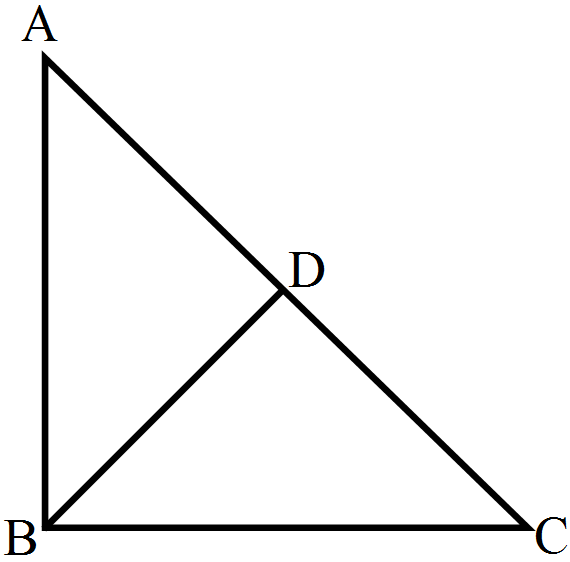
AnswerA triangle, in which two sides are equal, is known as an isosceles triangle.
Hence, there are $3$ isosceles triangles in the given figure,
i.e. $A ABC, AABD$ and $ABDC. [AB = BC, AD = DB$ and $BD = DC]$
View full question & answer→MCQ 951 Mark
Which of the following is used to draw a line parallel to a given line?
MCQ 961 Mark
Which of the following can be used to construct a $30o$ angle?
AnswerCorrect option: A. Construct $60o$ angle using compasses and bisect it.
Construct $60o$ angle using compasses and bisect it.
View full question & answer→MCQ 971 Mark
Number of line segments in Fig is:

AnswerA line segment is a part of a line that has finite length and is bounded by two distinct end points.
In the given figure, the line segments are $AS, SC, CD, DE, AC, AD, BD, BE, CE$ and $AE$.
Hence, there are $10$ line segments in the given figure.
View full question & answer→MCQ 981 Mark
Mark $(\checkmark)$ against the correct answer in the following:
An angle measuring $270^\circ $ is:
AnswerThis is because it is more than $180^\circ $ and less than $360^\circ $.
View full question & answer→MCQ 991 Mark
Mark $(\checkmark)$ against the correct answer in the following:
Which of the following has two end point?
AnswerA line segment has two end points and both of them are fixed. Thus, a line segment has a fixed length.
View full question & answer→MCQ 1001 Mark
Two lines are said to be perpendicular to each other when they meet at ____angle.
- A
$180^\circ $
- ✓
$90^\circ $
- C
$60^\circ $
- D
$360^\circ $
AnswerCorrect option: B. $90^\circ $
$90^\circ $
View full question & answer→